Showing results for nocion leaf

A closer look at grades 6–8

Amplify Science is based on the latest research on teaching and learning and helps teachers deliver rigorous and riveting lessons through hands-on investigations, literacy-rich activities, and interactive digital tools that empower students to think, read, write, and argue like real scientists.

In the 6–8 classroom, this looks like students:

  • Collecting evidence from a variety of sources.
  • Making sense of evidence in a variety of ways.
  • Formulating convincing scientific arguments.

Is your school implementing the domain model? Click here.
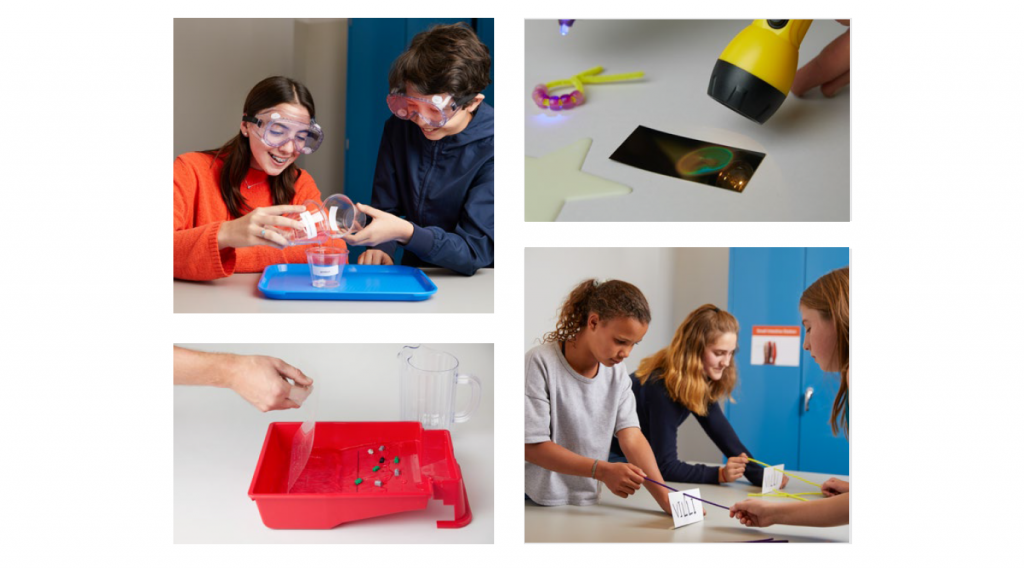
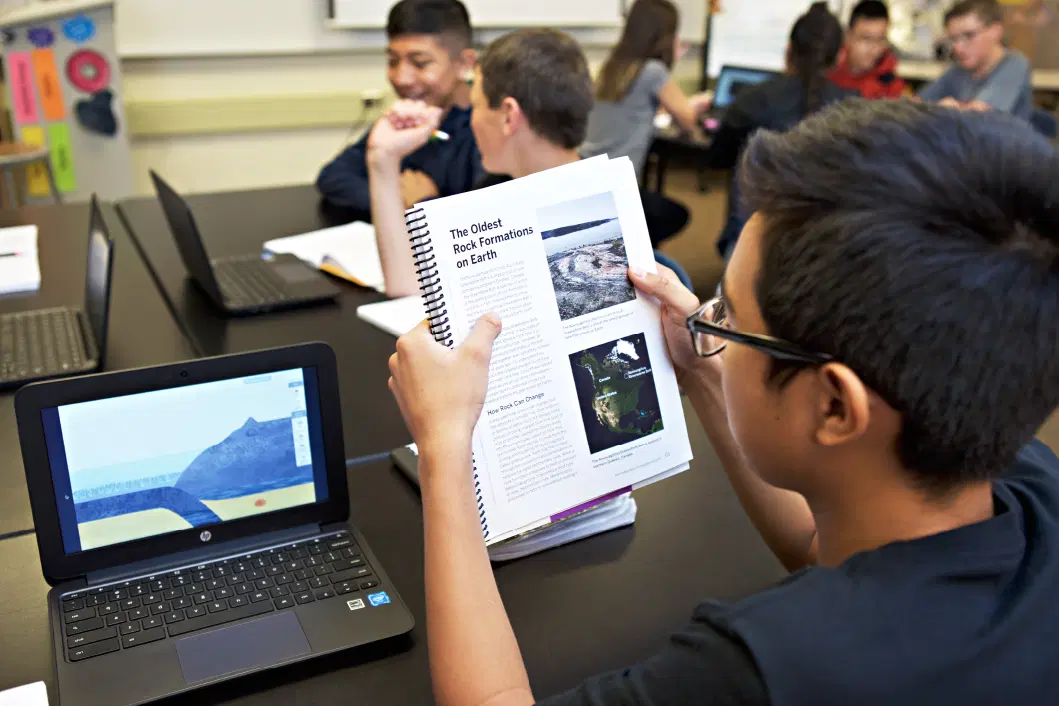
Collage of four images showing children engaged in educational activities such as conducting experiments and crafting in a classroom setting.
A four-step process diagram: Spark intrigue, Explore evidence, Explain and elaborate, and Evaluate claims, connected by arrows, with an engagement statement below.

Program structure

Our cyclical lesson design ensures students receive multiple exposures to concepts through a variety of modalities. As they progress through the lessons within a unit, students build and deepen their understanding, increasing their ability to develop and refine complex explanations of the unit’s phenomenon.

It’s this proven program structure and lesson design that enables Amplify Science to teach less, but achieve more. Rather than asking teachers to wade through unnecessary content, we designed our 6–8 program to address 100% of the NGSS in fewer lessons than other programs.

Scope and sequence

Every year our grades 6–8 sequence consists of 9 units, with each unit containing 10–19 lessons. Lessons are written to last a minimum of 45-minutes, though teachers can expand or contract the timing to meet their needs.

A grid of educational icons, each representing a different science topic, such as earth and space science, life science, and physical science, with titles and lesson counts.

Unit types

Each unit delivers three-dimensional learning experiences and engages students in gathering evidence from a rich collection of sources, while also serving a unique purpose.

In grades 6–8, there are three types of units:

  • One unit is a launch unit.
  • Three units are core units.
  • Two units are engineering internships.
Launch units

Launch units are the first units taught in each year of Amplify Science. The goal of the Launch unit is to introduce students to norms, routines, and practices that will be built on throughout the year, including argumentation, active reading, and using the program’s technology. For example, rather than taking the time to explain the process of active reading in every unit in a given year, it is explained thoroughly in the Launch unit, thereby preparing students to read actively in all subsequent units.

Core units

Core units establish the context of the unit by introducing students to a real-world problem. As students move through lessons in a Core unit, they figure out the unit’s anchoring phenomenon, gain an understanding of the unit’s disciplinary core ideas and science and engineering practices, and make linkages across topics through the crosscutting concepts. Each Core unit culminates with a Science Seminar and final writing activity.

Engineering Internship units

Engineering Internship units invite students to design solutions for real-world problems as interns for a fictional company called Futura. Students figure out how to help those in need, from tsunami victims in Sri Lanka to premature babies, through the application of engineering practices. In the process, they apply and deepen their learning from Core units.

Units at a glance

Abstract digital artwork featuring a yellow human figure, red shapes, and a blue-toned screen, with vibrant, multicolored patterns and textures in the background.
Microbiome

Domain: Life Science

Unit type: Launch

Student role: Microbiological researchers

Phenomenon: The presence of 100 trillion microorganisms living on and in the human body may keep the body healthy.  

An abstract illustration of a person receiving an oral examination, with colorful geometric shapes and an eye chart in the background.
Metabolism

Domain: Life Science

Unit type: Core

Student role: Medical researchers

Phenomenon: Elisa, a young patient, feels tired all the time.  

Abstract orange background with geometric shapes, featuring icons of a vest, bar chart, leaf, beaker, fruit, medical stethoscope, and an envelope within a hexagonal frame.
Metabolism Engineering Internship

Domains: Life Science, Engineering Design

Unit type: Engineering internship

Student role: Food engineers

Phenomenon: Designing health bars with different molecular compositions can effectively meet the metabolic needs of patients or rescue workers.  

Six spiders with varying body colors (brown, yellow, blue, and red) and patterns are arranged on a dark, textured background, seemingly in a diagram or chart formation.
Traits and Reproduction

Domain: Life Science

Unit type: Core

Student role: Biomedical students

Phenomenon: Darwin’s bark spider offspring have different silk flexibility traits, even though they have the same parents.  

Illustration of a person with closed eyes in a red winter coat and hat, surrounded by falling snow and orange circles on a dark background.
Thermal Energy

Domain: Physical Science

Unit type: Core

Student role: Thermal scientists

Phenomenon: One of two proposed heating systems for Riverdale School will best heat the school. 

Abstract illustration of a sun with blue and orange rays over a colorful landscape featuring green hills and a vibrant sky.
Ocean, Atmosphere, and Climate

Domains: Earth and Space Science, Physical Science

Unit type: Core

Student role: Climatologists

Phenomenon: During El Niño years, the air temperature in Christchurch, New Zealand is cooler than usual.  

Illustration of clouds above a small town and farmland, with wind currents depicted swirling through the landscape under a blue sky.
Weather Patterns

Domains: Earth and Space Science, Physical Science

Unit type: Core

Student role: Forensic meteorologists

Phenomenon: In recent years, rainstorms in Galetown have been unusually severe.  

A polar bear stands on a small floating ice sheet in the ocean, surrounded by melting ice, with a red sun in the sky.
Earth’s Changing Climate

Domains: Earth and Space Science, Life Science

Unit type: Core

Student role: Climatologists

Phenomenon: The ice on Earth’s surface is melting.  

A purple hexagonal graphic with icons including a building, wrench, screwdriver, sun, molecules, paint bucket, and tiles on a geometric patterned background.
Earth’s Changing Climate Engineering Internship

Domains: Earth and Space Science, Engineering Design

Unit type: Engineering internship

Student role: Civil engineers

Phenomenon: Designing rooftops with different modifications can reduce a city’s impact on climate change.  

A robotic rover sits on a hill in a rocky, reddish landscape, with visible tracks in the dust leading to its current position under a hazy sky.
Geology on Mars

Domain: Earth and Space Science

Unit type: Launch

Student role: Planetary geologists

Phenomenon: Analyzing data about landforms on Mars can provide evidence that Mars may have once been habitable. 

Two green prehistoric reptiles with long snouts are near the shore; one is on land while the other swims in blue water, with plants, rocks, and an island in the background.
Plate Motion

Domain: Earth and Space Science

Unit type: Core

Student role: Geologists

Phenomenon: Mesosaurus fossils have been found on continents separated by thousands of kilometers of ocean, even though the Mesosaurus species once lived all together.  

A purple geometric background featuring a hexagonal badge with a telescope, mountain, audio wave, and star symbols inside.
Plate Motion Engineering Internship

Domains: Earth and Space Science, Engineering Design

Unit type: Engineering internship

Student role: Mechanical engineering interns

Phenomenon: Patterns in earthquake data can be used to design an effective tsunami warning system.  

Illustration showing an ocean, forest, and mountains with a smoking volcano, plus a cross-section of underground tectonic plates.
Rock Transformations

Domain: Earth and Space Science

Unit type: Core

Student role: Geologists

Phenomenon: Rock samples from the Great Plains and from the Rocky Mountains — regions hundreds of miles apart — look very different, but have surprisingly similar mineral compositions.  

Four stages of an orange popsicle melting on a stick, from fully frozen on the left to completely melted on the right, against a plain background.
Phase Change

Domains: Physical Science, Earth and Space Science

Unit type: Core

Student role: Chemists

Phenomenon: A methane lake on Titan no longer appears in images taken by a space probe two years apart

Green geometric background with an outlined hexagon containing icons: a parachute, ruler, letter "A," bandage, stacked blocks, and a folded corner paper.
Force and Motion Engineering Internship

Domains: Engineering Design, Physical Science

Unit type: Engineering internship

Student role: Chemical engineering interns

Phenomenon: Designing portable baby incubators with different combinations of phase change materials can keep babies at a healthy temperature. Domains: Engineering Design, Physical Science

Abstract illustration showing red and blue circles on a split blue and light background, representing molecular movement across a membrane or barrier.
Chemical Reactions

Domains: Physical Science, Life Science, Earth and Space Science

Unit type: Core

Student role: Forensic chemists

Phenomenon: A mysterious brown substance has been detected in the tap water of Westfield.  

An underwater scene with a large whale surrounded by turtles, jellyfish, and various fish swimming in different directions.
Populations and Resources

Domains: Life Science, Earth and Space Science

Unit type: Core

Student role: Biologists

Phenomenon: The size of the moon jelly population in Glacier Sea has increased. 

Low-poly digital illustration of a fox hunting a rabbit in a forest with pine trees, mushrooms, mountains, and the sun in the background. Another rabbit sits near the trees.
Matter and Energy in Ecosystems

Domains: Life Science, Earth and Space Science, Physical Science

Unit type: Core

Student role: Ecologists

Phenomenon: The biodome ecosystem has collapsed.  

Two people climb over rocks filled with electronic devices; inset illustrations show a boot, a belt of batteries, and a radio.
Harnessing Human Energy

Domains: Physical Science, Earth and Space Science, Engineering Design

Unit type: Launch

Student role: Energy scientists

Phenomenon: Rescue workers can use their own human kinetic energy to power the electrical devices they use during rescue missions.  

A spacecraft approaches and docks with a modular space station featuring large blue solar panels, set against a black space background.
Force and Motion

Domain: Physical Science

Unit type: Core

Student role: Physicists

Phenomenon: The asteroid sample-collecting pod failed to dock at the space station as planned.

Green graphic with hexagonal emblem showing an infant, a thermometer, layered materials, a medical symbol, and a flame icon.
Force and Motion Engineering Internship

Domains: Engineering Design, Physical Science

Unit type: Engineering internship

Student role: Chemical engineering interns

Phenomenon: Designing emergency supply delivery pods with different structures can maintain the integrity of the supply pods and their contents.

Illustration of a roller coaster car with passengers raising their arms as they descend a steep track against a blue sky with clouds.
Magnetic Fields

Domain: Physical Science

Unit type: Core

Student role: Physicists

Phenomenon: During a test launch, a spacecraft traveled much faster than expected.  

Illustration of the Earth with arrows representing radiation or energy entering the atmosphere from space, focused on the Asia-Pacific region.
Light Waves

Domains: Physical Science, Life Science, Earth and Space Science

Unit type: Core

Student role: Spectroscopists

Phenomenon: The rate of skin cancer is higher in Australia than in other parts of the world.

A city skyline at night with illuminated windows, a large full moon, stars in the sky, and a bridge visible on the left side.
Earth, Moon, and Sun

Domains: Earth and Space Science, Physical Science

Unit type: Core

Student role: Astronomers

Phenomenon: An astrophotographer can only take pictures of specific features on the Moon at certain times.  

Four polygonal dinosaurs walking in a row, three green and one yellow, each with a rock and purple spikes on their backs, set against a grassy background with a blue sky.
Natural Selection

Domains: Life Science, Earth and Space Science

Unit type: Core

Student role: Biologists

Phenomenon: The newt population in Oregon State Park has become more poisonous over time.  

Red geometric background featuring a hexagonal emblem with icons of a world map, mosquito, DNA strand, bar chart, and interconnected blocks.
Natural Selection Engineering Internship

Domains: Engineering Design, Life Science

Unit type: Engineering internship

Student role: Clinical engineers

Phenomenon: Designing malaria treatment plans that use different combinations of drugs can reduce drug resistance development while helping malaria patients.  

Two tortoises with long necks are by a river; one is browsing leaves from a bush while the other is walking near the water's edge.
Evolutionary History

Domains: Life Science, Earth and Space Science

Unit type: Core

Student role: Paleontologists

Phenomenon: A mystery fossil at the Natural History Museum has similarities with both wolves and whales.    

Welcome to the Amplify Science classroom showcase!

The Amplify Science K–8 curriculum blends hands-on investigations, literacy-rich activities, and interactive digital tools to empower students to think, read, write, and argue like real scientists.

Discover inspiring classroom examples and teacher resources from educators nationwide who are bringing Amplify Science to life.

Want to showcase your classroom?

We love seeing how you bring learning to life! Share photos to inspire fellow educators.

A collage of four images: a Classroom Wall with a science board, a night sky with constellations, birds flying in the sky, and a classroom display about a gecko inspired by Amplify Science.
A collage of three classroom science boards on animal adaptations, rainforests, and force & motion—each featuring small cartoon animals—brightens the Classroom Wall and highlights hands-on activities inspired by Amplify Science.

Classroom Wall

Every Amplify Science unit includes a Classroom Wall that grows and evolves as students build understanding. Here are a few examples from real Amplify Science classrooms!

Grades K–5

Credit: Shannon Cox, Sabine Parish School District, LA

Credit: Rebecca Steindler O’Brien, P.S. 051 The Elias Howe School, NY

Credit: Veeh Nguyen, Belle Chasse Academy, LA

Credit: Brittney Gooden, LaSalle Parish, LA

Credit: Buffy Scott Marcantel, Maplewood Elementary, LA

Credit: Chrissy Campenni, Wyoming Area School District, PA

Credit: Christy Flynn, Grant Parish School Board, LA

Credit: William Howard Taft Elementary School, OH

Credit: Cristina Cullen, Glendora Unified School District, CA

Grades 6–8

Credit: Erica Fernandez, Elsinore Middle School, CA

Credit: Sheyenne Cahalan, Knox County R-1 School District, MO

Credit: Joshua Ryan Abellera, Fertitta Middle School, NV

Credit: Karen Wynne, Portola Middle School, CA

Credit: Crystal Cuaron Baker, Las Cruces Public Schools, NM

Credit: Natalia Seoane, Heritage Intermediate School, CA

Credit: Lisa Anglim, Elizabeth Ustach Middle School, CA

Credit: Maria Katsanos, New York City Public Schools, NY

Credit: Lindsey Hampf, Upper Township School District, NJ

Credit: Anna Radef, Cadwallader Middle School, NV

Credit: Jessica Kruger, Gardner International, MI

Credit: Albert Hutchful, Clark County School District, NV

Credit: Kim Eich, Anoka-Hennepin Public School District 1, MN

Credit: Shannon Cox, Sabine Parish School District, LA

Credit: Anna Radef, Clark County School District, NV

Hands-on science activities

Students engage in hands-on science activities throughout Amplify Science. These photos capture curiosity in action and showcase real students exploring, building, testing, and investigating in Amplify Science classrooms.

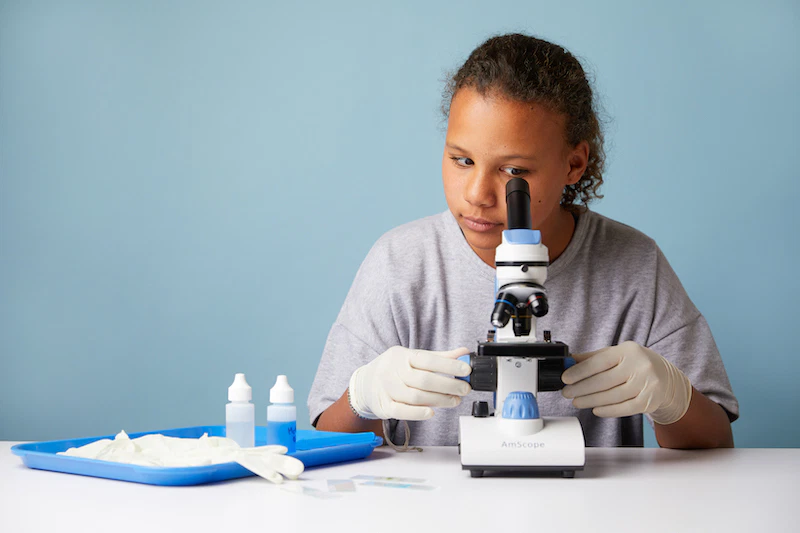
Students engage in hands-on activities and experiments with liquids and solids, reading, and preparing materials, enhanced by illustrations and abstract art around the photos, supporting the Amplify Science curriculum.

Grades K–5

Grade 1: Animal and Plant Defenses
Designing animal defenses during the Animal and Plant Defenses unit
Credit: Veeh Nguyen, Belle Chasse Academy, LA

Grade 1: Light and Sound
Exploring shadows for the Light and Sound unit
Credit: Brittney Gooden, LaSalle Parish, LA

Grade 1: Light and Sound
Investigating vibrations during the Light and Sound unit
Credit: Jennifer Baker, Rapides Parish School Board, LA

Grade 1: Light and Sound
Puppet show for the Light and Sound unit
Credit: Anna Dardar, Rapides Parish School Board, LA

Grade 2: Changing Landforms
Exploring sand samples for the Changing Landforms unit
Credit: Rebecca Steindler O’Brien, P.S. 051 The Elias Howe School, NY

Grade 3: Balancing Forces
Exploring forces with magnet tricks for the Balancing Forces unit
Credit: Maureen Patt, Broad Street Elementary School, NH

Grade 3: Inheritance and Traits
Imaginary clay creatures to investigate traits in real organisms for the Inheritance and Traits unit
Credit: Maribel Ramos, Esperanza Academy Charter School, PA

Grade 3: Inheritance and Traits
Students showing off their knowledge for the Inheritance and Traits unit by creating their own drawings.
Credit: Sandi O’Brien, Parkmead Elementary School, CA

Grade 3: Inheritance and Traits
Determining which offspring belong to which set of parent pigeons based on similar traits for the Inheritance and Traits unit
Credit: Sandi O’Brien, Parkmead Elementary School, CA

Grade 3: Inheritance and Traits
Using celery as a real-life example of how the environment can impact traits, during the Inheritance and Traits unit
Credit: Sandi O’Brien, Parkmead Elementary School, CA

Grade 3: Environments and Survival
Modeling how ruby-throated hummingbirds with different traits meet their need for food during the Environments and Survival unit
Credit: Sandi O’Brien, Parkmead Elementary School, CA

Grade 3: Weather and Climate
Learning the best ways to collect, measure, and compare rainfall data for the Weather and Climate unit
Credit: Sandi O’Brien, Parkmead Elementary School, CA

Grade 4: Energy Conversions
Students created their own simple systems using a solar panel, alligator clips, wires, an LED light, and a buzzer during the Energy Conversions unit
Credit: Sandi O’Brien, Parkmead Elementary School, CA

Grade 4: Energy Conversions
Designing wind turbines during the Energy Conversions unit
Credit: Sandi O’Brien, Parkmead Elementary School, CA

Grade 4: Vision and Light
Planning vision models for the Vision and Light unit
Credit: Maribel Ramos, Esperanza Academy Charter School, PA

Grade 4: Vision and Light
Writing a scientific explanation for the Vision and Light unit
Credit: Chrissy Campenni, Wyoming Area School District, PA

Grade 5: Patterns of Earth and Sky
Investigating daytime and nighttime during the Patterns of Earth and Sky unit
Credit: Sandi O’Brien, Parkmead Elementary School, CA

Grade 5: Patterns of Earth and Sky
Hands-On Flextension: Making artifacts for the Patterns of Earth and Sky unit
Credit: Adriana Barrera, J.W. Bishop Elementary School, TX

Grade 5: Modeling Matter
Flavor ingredients test for the Modeling Matter unit
Credit: Kevin Butters, Grand Island Public Schools, NE

Grade 5: Modeling Matter
Testing ingredients to make salad dressing during the Modeling Matter unit
Credit: Sandi O’Brien, Parkmead Elementary School, CA

Grade 5: Modeling Matter
Discussing solubility and attraction during the Modeling Matter unit
Credit: Cristina Cullen, Glendora Unified School District, CA

Grade 5: The Earth System
Designing freshwater systems for The Earth System unit
Credit: Sandi O’Brien, Parkmead Elementary School, CA

Grade 5: Ecosystem Restoration
Building terrariums for the Ecosystem Restoration unit
Credit: Elizabeth DeBoo, St. Frances Cabrini Academy, MO

Grade 5: Ecosystem Restoration
Leaves and Roots game board from the Ecosystem Restoration unit
Credit: Cyndi Thompson Crouch, Smithville School District, MO

Grade 5: Ecosystem Restoration
Food web models with students’ favorite stuffed animals for the Ecosystem Restoration unit
Credit: Halli Trinker, Boonton Township School District, NJ

Grades 6–8

Grade 6: Microbiome
Drawing scale models of microorganisms for the Microbiome unit
Credit: Elizabeth DeBoo, St. Frances Cabrini Academy, MO

Grade 6: Microbiome
Hands-On Flextension: Investigating microscopic evidence of life for the Microbiome unit
Credit: Elizabeth DeBoo, St. Frances Cabrini Academy, MO

Grade 6: Metabolism
Investigating chemical reactions with water, phenol red, baking soda, and calcium chloride for the Metabolism unit
Credit: Jessica Kruger, Gardner International Magnet School, MI

Grade 6: Metabolism
Introducing the classroom body systems model for the Metabolism unit
Credit: Elizabeth DeBoo, St. Frances Cabrini Academy, MO

Grade 6: Metabolism Engineering Internship
Healthy bars for the Metabolism Engineering Internship
Credit: Elizabeth DeBoo, St. Frances Cabrini Academy, MO

Grade 6: Thermal Energy
Simulating hot and cold water during the Thermal Energy unit
Credit: Whitney Stewart, Rapides Parish School Board, LA

Grade 6: Ocean, Atmosphere, and Climate
Playing the Ocean Currents game for the Ocean, Atmosphere, and Climate unit
Credit: Elizabeth DeBoo, St. Frances Cabrini Academy, MO

Grade 6: Weather Patterns
Modeling a warm air parcel for the Weather Patterns unit
Credit: Elizabeth DeBoo, St. Frances Cabrini Academy, MO

Grade 7: Geology on Mars
The Flowing Water Model for the Geology on Mars unit
Credit: Kim Eich, Anoka-Hennepin Public School District 1, MN

Grade 7: Plate Motion Engineering Internship
Modeling a tsunami wave for Plate Motion Engineering Internship
Credit: Elizabeth DeBoo, St. Frances Cabrini Academy, MO

Grade 7: Chemical Reactions
Investigating substance changes for the Chemical Reactions unit
Credit: Ashlie Beals Arkwright, SCAPA at Bluegrass, KY

Grade 7: Populations and Resources
Conducting a yeast experiment during the Populations and Resources unit
Credit: Elizabeth DeBoo, St. Frances Cabrini Academy, MO

Grade 8: Harnessing Human Energy
Investigating energy systems for the Harnessing Human Energy unit
Credit: Lisa Anglim, Elizabeth Ustach Middle School, CA

Grade 8: Force and Motion
Investigating forces on different objects for the Force and Motion unit
Credit: Elizabeth DeBoo, St. Frances Cabrini Academy, MO

Grade 8: Force and Motion Engineering Internship
Designing an Egg Drop Model during the Force and Motion Engineering Internship
Credit: Elizabeth DeBoo, St. Frances Cabrini Academy, MO

Grade 8: Magnetic Fields
Hands-On Flextension: Exploring electrostatic force for the Magnetic Fields unit
Credit: Melanie Wenger, Lincoln Park Middle School, NJ

Grade 8: Light Waves
Students observing that light can cause materials to heat up, change color, and move for the Light Waves unit
Credit: Gloria Davis, Panama-Buena Vista Unified School District, CA

Grade 8: Light Waves
Students discover what happens to light as it travels for the Light Waves unit
Credit: Gloria Davis, Panama-Buena Vista Unified School District, CA

Grade 8: Light Waves
Students participating in a fishbowl discussion to share observations and evidence for the Light Waves unit
Credit: Gloria Davis, Panama-Buena Vista Unified School District, CA

Grade 8: Earth, Moon, and Sun
Paper model of the Moon’s phases for Earth, Moon, and Sun unit
Credit: Elizabeth DeBoo, St. Frances Cabrini Academy, MO

Grade 8: Evolutionary History
Hands-On Flextension: Reconstructing owl pellet skeletons for the Evolutionary History unit
Credit: Elizabeth DeBoo, St. Frances Cabrini Academy, MO

Welcome, Central Kitsap, to Amplify Desmos Math!

Amplify Desmos Math K-5 thoughtfully combines conceptual understanding, procedural fluency, and application. Each lesson is designed to tell a story by posing problems that invite a variety of approaches before guiding students to synthesize their understanding of the learning goals.

Scroll to learn more about the program and explore sample materials.

About the program

We believe in math that motivates. Our structured approach to problem-based learning builds on students’ curiosity to develop lasting grade-level understandings for all students. 

The program motivates students with interesting problems they are eager to solve. Teachers can spend more time where it’s most impactful: creating a collaborative classroom of learners.

A powerful suite of math resources

Amplify Desmos Math combines the best of problem-based lessons, intervention, personalized practice, and assessments into a coherent and engaging experience for both students and teachers.  Feel free to explore our grade-level ancillary samplers to learn more about assessment and reporting, intervention, and differentiation:

Grade K Ancillary Sampler

Grade 1 Ancillary Sampler

Grade 2 Ancillary Sampler

Grade 3 Ancillary Sampler

Grade 4 Ancillary Sampler

Grade 5 Ancillary Sampler

A digital interface displays a math screener report on the left and a math problem involving division, alongside a visual representation of students lined up on the right, integrating rich math resources from Amplify Desmos Math.

Assessment

mCLASS® Assessments, along with daily formative checks, measure not only what students know, but how they think. The asset-based assessment system provides teachers with targeted, actionable insights, linked to core and intervention resources. Visit our mClass Math site to learn more.

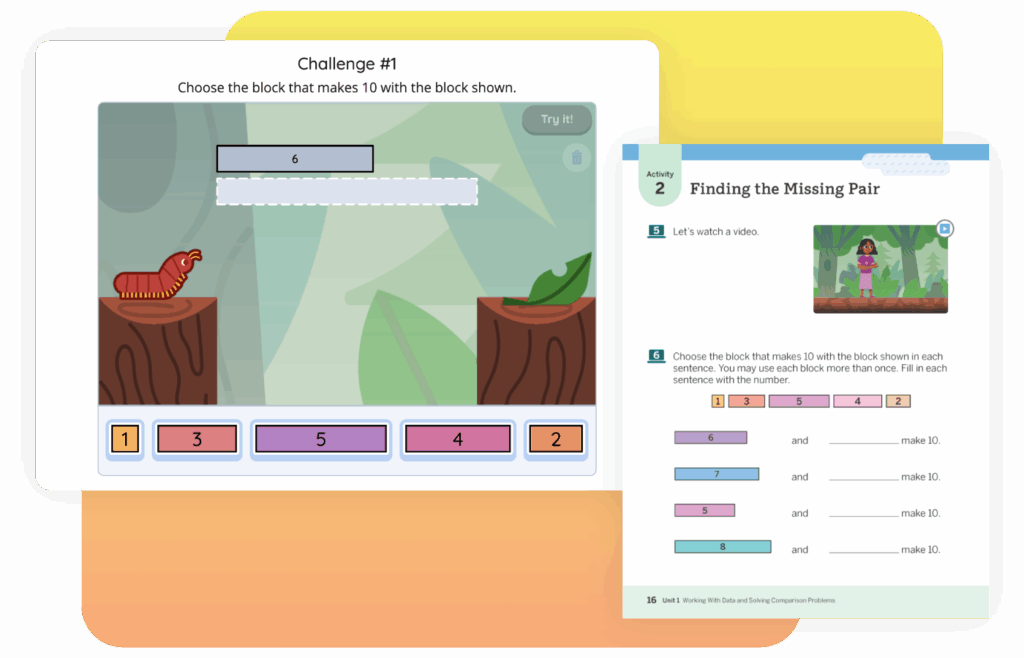
Two side-by-side math activities for children: on the left, a caterpillar-themed block challenge, and on the right, a worksheet for finding pairs that sum to 10. These exercises are fantastic ways to amplify children's engagement with math concepts.

Core instruction

Amplify Desmos Math lessons pair problems students are eager to solve with clear instructional moves for teachers. With low-floor, high-ceiling tasks every student can actively participate and be a part of the math community. Unit- and lesson-level core assessments give teachers data at their fingertips to guide and differentiate instruction.

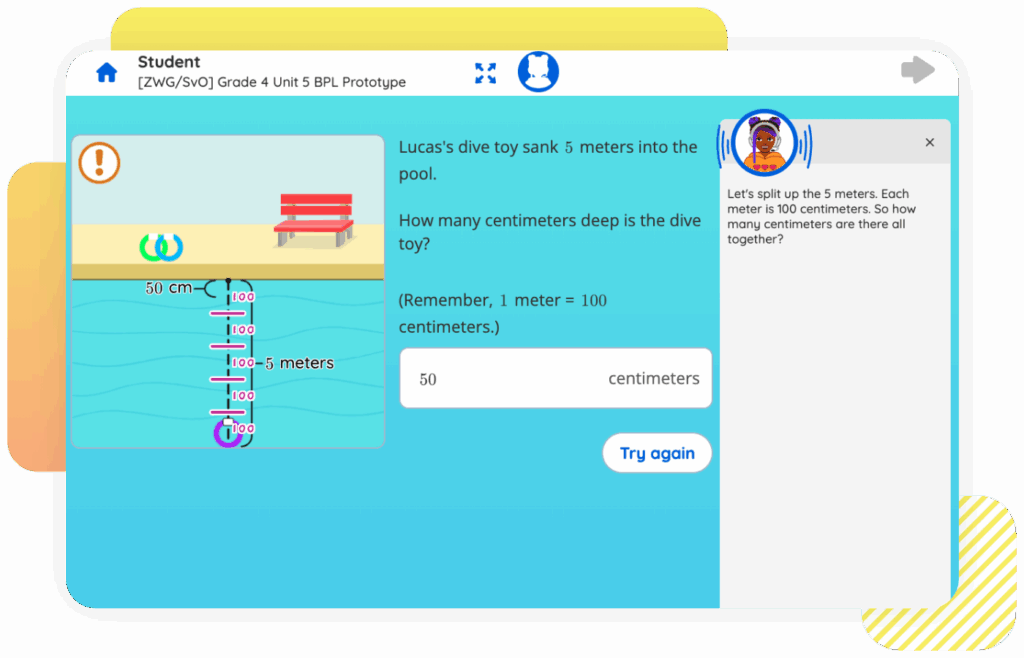
A math lesson screen shows a toy sinking 5 meters into a pool. A textbox asks how many centimeters that is, with space for an answer and a "Try again" button. An avatar explains the question, using Desmos math tools to amplify understanding.

Differentiation

Boost Personalized Learning activities help students access grade-level math through engaging, independent digital practice. Responsive Feedback adjusts to students’ work, providing item-level adaptivity to further support their learning and offer personalized differentiation. Visit our Boost Math site to learn more. 

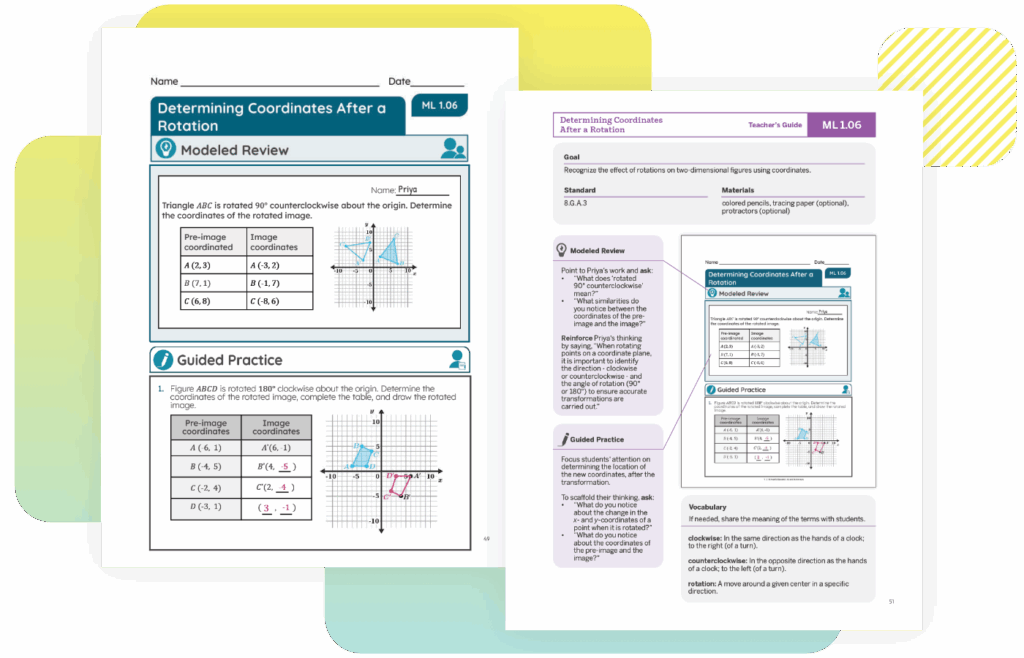
Two pages from a New York math textbook on determining coordinates after a rotation. Includes sections on modeled review, guided practice, and teacher's notes, with diagrams and examples that amplify the learning experience.

Embedded intervention

Integrated resources like Mini-Lessons, Fluency Practice, and Math Adventures provide targeted intervention on a specific concept or skill connected to the daily lesson. Extensions are also available to stretch students’ understanding.

Multilingual Learners

To support multilingual/English learners, Amplify Desmos Math incorporates research-based Math Language Routines (MLRs) by providing language modality strategies like sentence frames where appropriate, both in the teacher language provided for each task and in the differentiation support section found throughout the program. For further information on math language development, please see pg. 82 of the Amplify Desmos Math Program Guide.

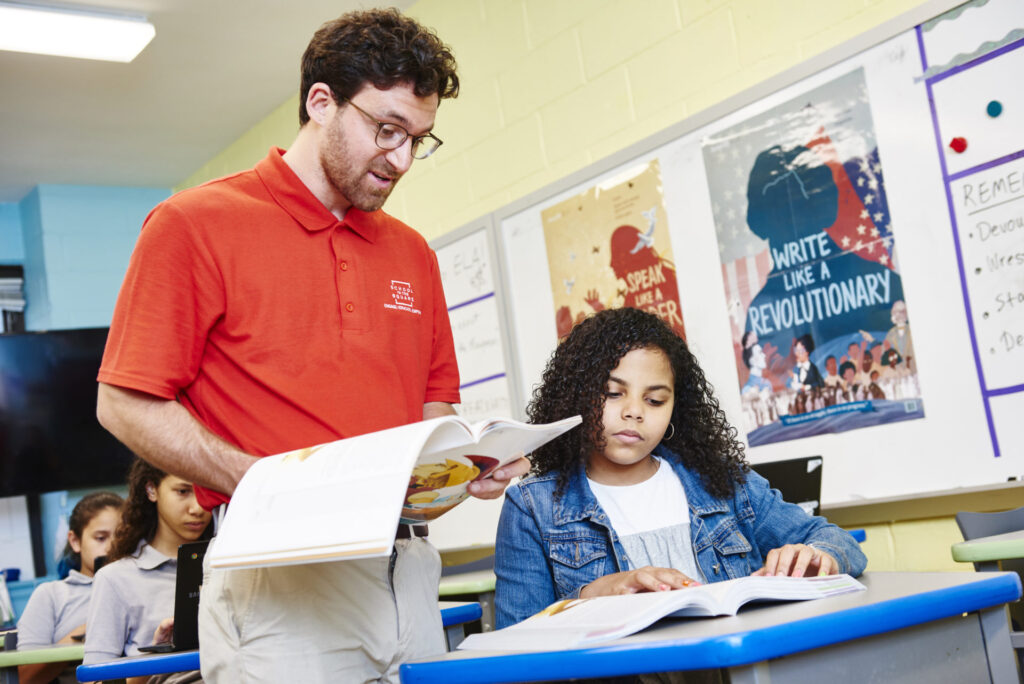
A male teacher in a red shirt explaining a lesson to a focused young female student in a classroom. other students are in the background.

Review Resources

To support your review of Amplify Desmos Math here are links to important K-5 review resources:

Two women in an office setting are smiling while looking at a tablet. Various educational icons surround the image.

K-5 sample materials

Click the links in the drop-down sections below to explore sample materials from each grade.  To see sample student responses, please click on the Teacher Edition pages and scroll to “Sample Student Work” (first one is about 30 pages in) or click on Intervention and Extension resources.   

For helpful navigation tips and more program information, download the Amplify Desmos Math Program Guide.

You can also watch a product expert walk through a lesson and the available program components.

Digital educational material showing an activity named "Hamster Homes" involving tube length and platform heights for a hamster cage. Includes a diagram with platforms measuring 9 inches.
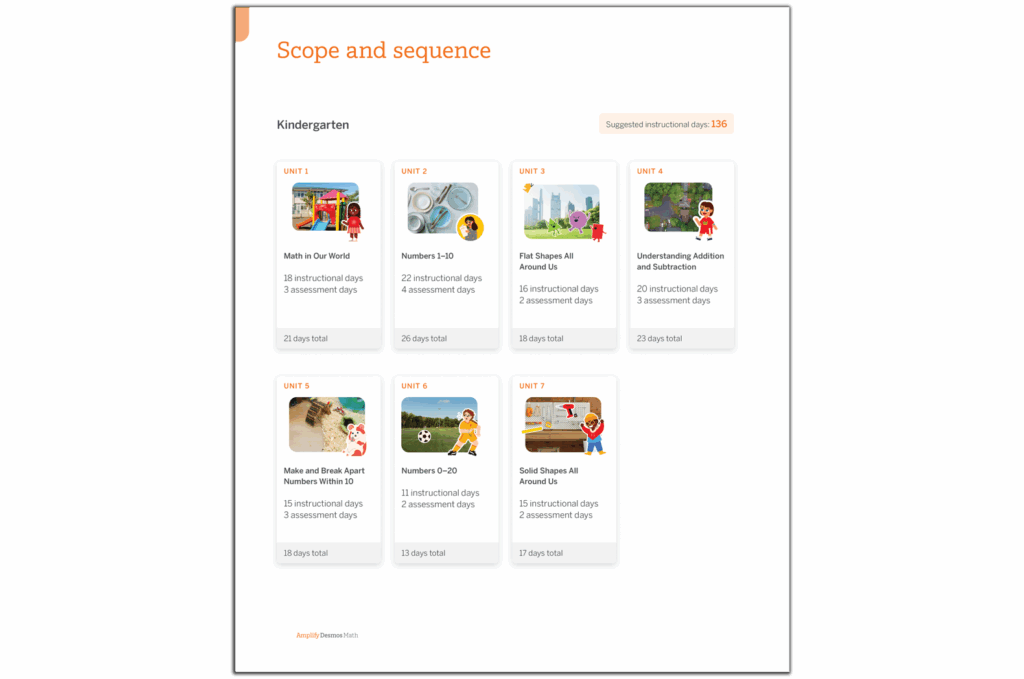
Screenshot of a kindergarten curriculum outline featuring units like Math in Our World, Numbers 1-10, Positions and Shapes, Understanding Addition, Making 10, and Shapes All Around Us. This comprehensive program utilizes New York Math standards to build foundational skills.
Program structure

Get to know the content and structure of Kindergarten Amplify Desmos Math.

Cover of Amplify Desmos Math Grade K Teacher Edition featuring three children playing with math-related objects and a group of rabbits sitting nearby, aligning with the engaging curriculum seen in New York math classrooms.
Teacher Edition pages

Planning and instructional guidance is visual, organized, and easy-to-follow. To help you review the program, we have included samples from a complete sub-unit on this site: Unit 2, Sub-Unit 1: Counting and Comparing Objects.

Educational activity screen displaying a blue backpack with icons, dot groups on the left, and a grid background. Prompt reads, "Look inside the backpack. Then choose the group with the same number of dots." A great tool to amplify Desmos math learning in line with New York math standards.
Digital experience

Explore our digital experience! Every lesson in Amplify Desmos Math has student print materials and digital recommendations.

Cover of "Amplify Desmos Math: Student Edition Kindergarten," featuring an illustration of three children playing with math-related toys. A group of small white animals, possibly hamsters, play nearby. The scene brilliantly captures the joy of New York math exploration for young learners.
Student Edition pages

Motivate students with mathematics that is both rigorous and delightful.

Cover of "Amplify Desmos Math Grade K Centers Resources" featuring a large, stylized red and pink "C" on a light pink background with simple geometric designs. This distinctive cover complements New York math curriculums with its engaging visual elements.
Centers Resources

Engaging, hands-on games for students to play collaboratively to strengthen their understanding of key skills and concepts.

Cover of "Amplify Desmos Math: Grade K." The title is displayed with a geometric "I" illustration in the center. Subtitle reads "Intervention and Extension Resources" on a pink and white background, ideal for New York math standards.
Intervention and Extension Resources

Additional resources to reinforce and extend key concepts, including Mini-Lessons and Extensions.

A digital activity screen, crafted in the style of Amplify Desmos Math, shows two paths with different quantities of mushrooms. The user is prompted to choose the path with more mushrooms. A bear is on the left side of the screen.

In this lesson, students apply their understanding of how to compare groups of images as they determine which group has more or fewer and then compare their strategies by guiding a bear through a path that has more mushrooms than the other.

Grade 1 math curriculum overview displaying six units with instructional and assessment days: counting, addition, subtraction, numbers to 10, comparing numbers, measuring length, and geometry—aligned with the New York Math standards.
Program structure

Get to know the content and structure of Grade 1 Amplify Desmos Math.

Children interact with math activities on a large tablet while observing fish illustrations. The text reads "Amplify Desmos Math Grade 1 Teacher Edition, aligned with New York Math standards.
Teacher Edition pages

Planning and instructional guidance is visual, organized, and easy-to-follow. To help you review the program, we have included samples from a complete sub-unit on this site: Unit 2, Sub-Unit 1: Story Problems in Maui.

A digital math exercise, amplified by Desmos Math, showcases a story problem about adding kalo plants with three illustrations and a filled-out number sentence 3 + 4 = 7. A "Check" button is present. This tool aligns perfectly with New York math standards.
Digital experience

Explore our digital experience! Every lesson in Amplify Desmos Math has student print materials and digital recommendations.

Illustration of three children engaged in math activities from the "Amplify Desmos Math: Student Edition 1" textbook. One child holds a number card, while the others manipulate counters and images, experiencing an exciting approach inspired by New York math techniques.
Student Edition pages

Motivate students with mathematics that is both rigorous and delightful.

Cover of "Amplify Desmos Math Centers Resources" for Grade 1, featuring a yellow and white 3D letter "C" on a light background.
Centers Resources

Engaging, hands-on games for students to play collaboratively to strengthen their understanding of key skills and concepts.

Cover of "Amplify Desmos Math, Grade 1: Intervention and Extension Resources" depicting a large, blocky number one and a yellow-themed design. Ideal for enhancing New York math curriculum.
Intervention and Extension Resources

Additional resources to reinforce and extend key concepts, including Mini-Lessons and Extensions.

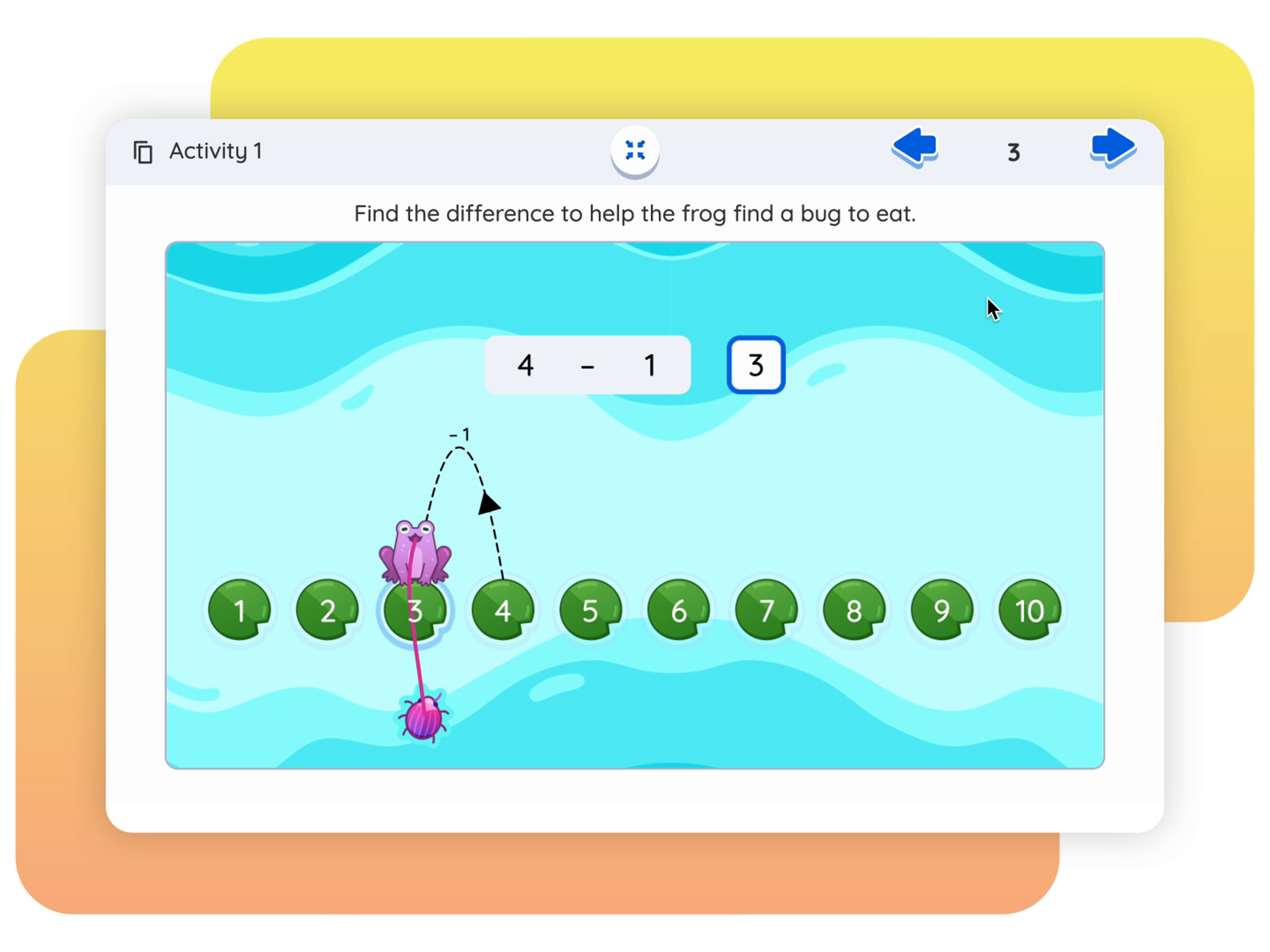
An educational game screen, inspired by New York math standards, shows a subtraction problem, "4 - 1," with a frog moving along numbered lily pads to reveal the answer "3.

In this lesson, students find differences when subtracting 1 and 2 from the same number by helping a frog reach a lily pad where it can eat a bug.

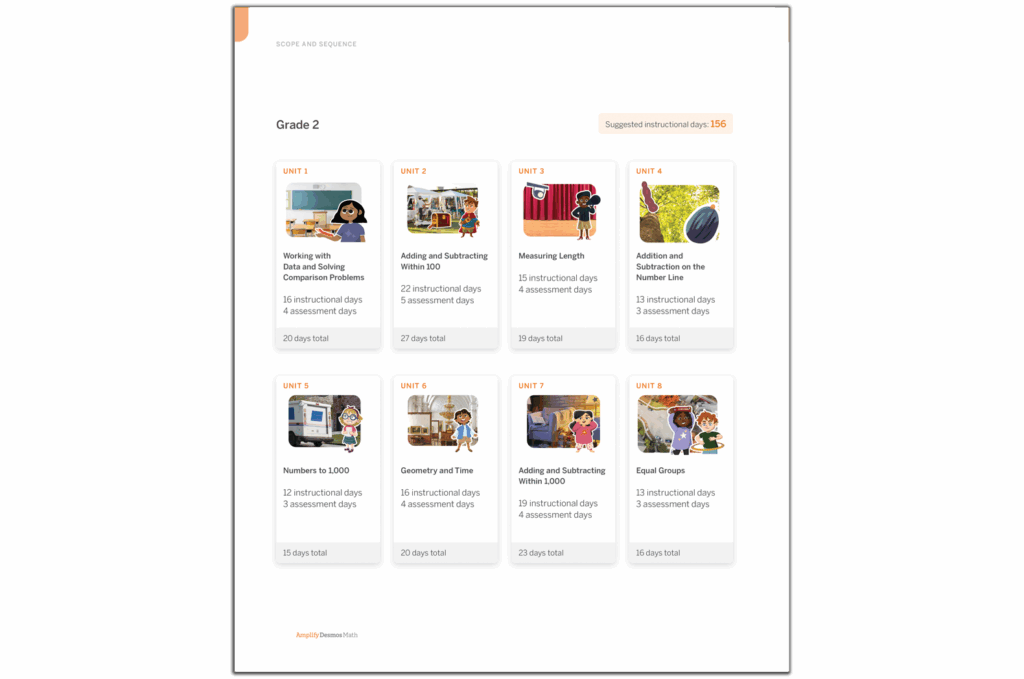
A curriculum overview for Grade 2 in New York Math displaying 8 units, including topics like comparisons, addition, subtraction, and geometric shapes, with details on the number of instructional and assessment days. This plan integrates resources from Amplify Desmos Math to enrich learning experiences.
Program structure

Get to know the content and structure of Grade 2 Amplify Desmos Math.

Cover of the "Amplify Desmos Math" Grade 2 Teacher Edition, showcasing children measuring with rulers and a poster displaying a mathematical equation, set against whimsical scenery with a colorful dragon. Perfect for New York math classrooms.
Teacher Edition pages

Planning and instructional guidance is visual, organized, and easy-to-follow. To help you review the program, we have included samples from a complete sub-unit on this site: Unit 2, Sub-Unit 1: Adding and Subtracting.

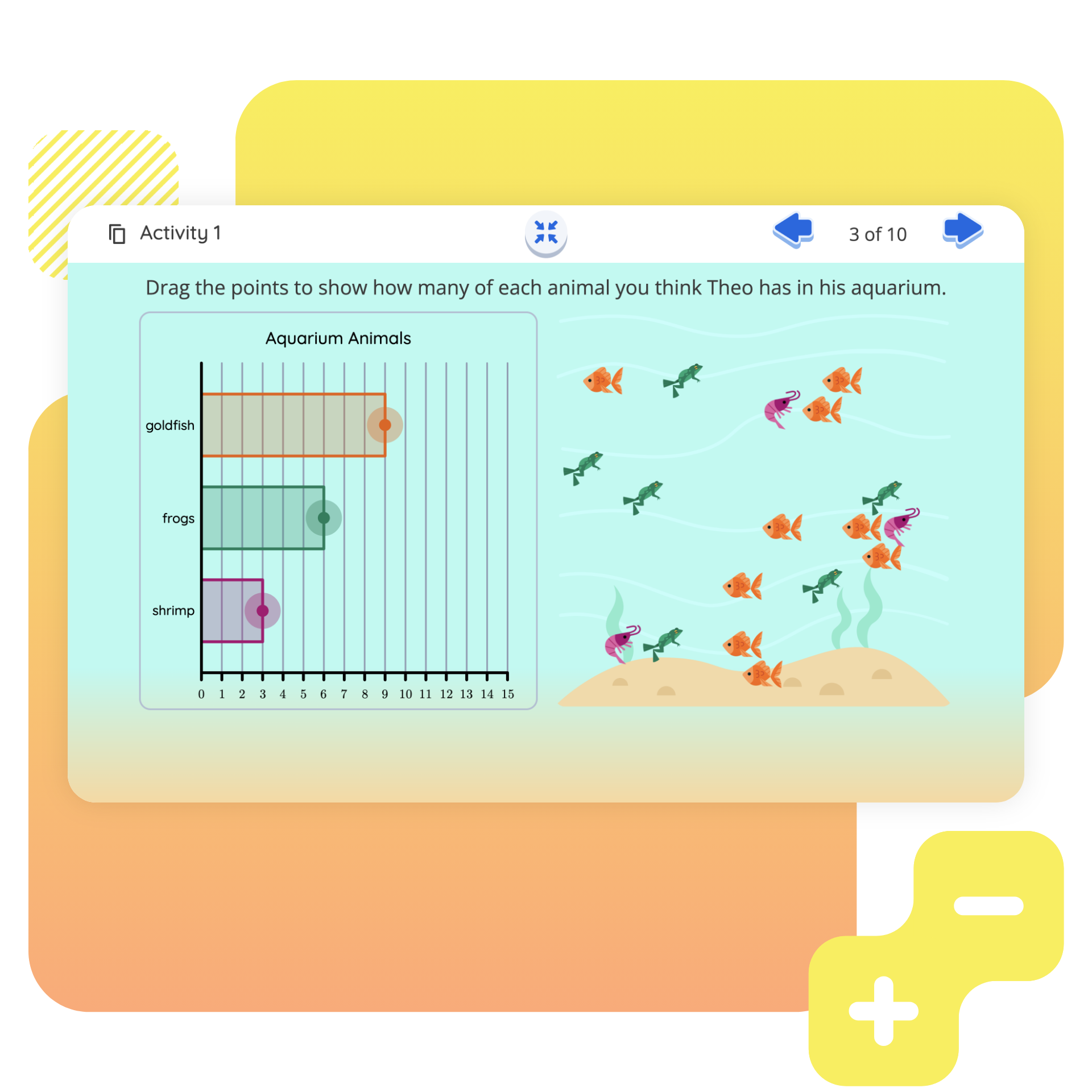
Activity screen displaying a task to estimate the number of animals in an aquarium, featuring a bar chart for goldfish, frogs, and shrimp. Utilizing Desmos math tools, an illustration of an aquarium with various animals is also included to amplify learning.
Digital experience

Explore our digital experience! Every lesson in Amplify Desmos Math has student print materials and digital recommendations.

Cover of "Amplify Desmos Math Student Edition 2" showing three children performing a New York math activity with blocks and measurements.
Student Edition pages

Motivate students with mathematics that is both rigorous and delightful.

Cover of an educational book titled "Amplify Desmos Math Grade 2 Centers Resources" featuring a green "C" on a light green background, perfect for enhancing New York math education.
Centers Resources

Engaging, hands-on games for students to play collaboratively to strengthen their understanding of key skills and concepts.

Cover of "Amplify Desmos Math Grade 2: Intervention and Extension Resources" featuring a green numeral 1 on a light green background, aligning with the New York math standards.
Intervention and Extension Resources

Additional resources to reinforce and extend key concepts, including Mini-Lessons and Extensions.

An educational activity where users must select the block with the correct number to make a total of 10 using the given block numbers. The UI, inspired by New York math standards, features a caterpillar and two tree stumps to amplify engagement with Desmos Math tools.

Students continue to develop fluency by finding the number that makes 10 by helping a millipede reach its favorite food – a clump of leaves!

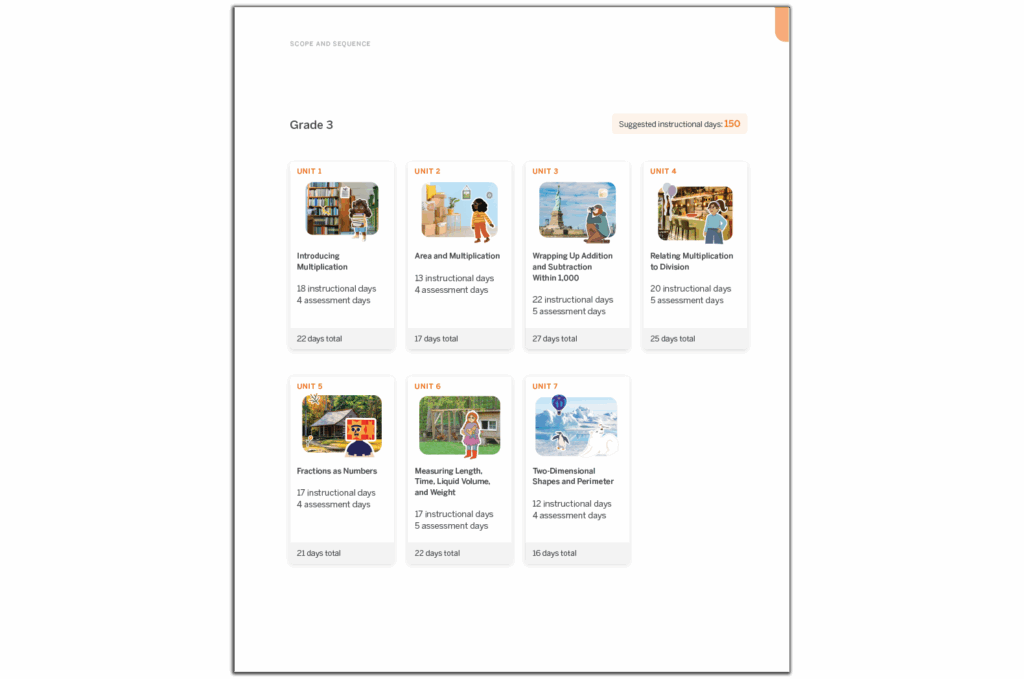
An educational curriculum outline for Grade 3 with seven units covering various mathematics topics, including multiplication, shapes, fractions, and measurement. Suggested instructional days are provided. The New York Math approach ensures a thorough understanding of each concept.
Program structure

Get to know the content and structure of Grade 3 Amplify Desmos Math.

Cover of a "Grade 3 Amplify Desmos Math Teacher Edition" book, featuring a cutaway building with diverse students and a teacher working on New York math problems and organizing materials.
Teacher Edition pages

Planning and instructional guidance is visual, organized, and easy-to-follow. To help you review the program, we have included samples from a complete sub-unit on this site: Unit 2, Sub-Unit 1: Concepts of Area Measurement.

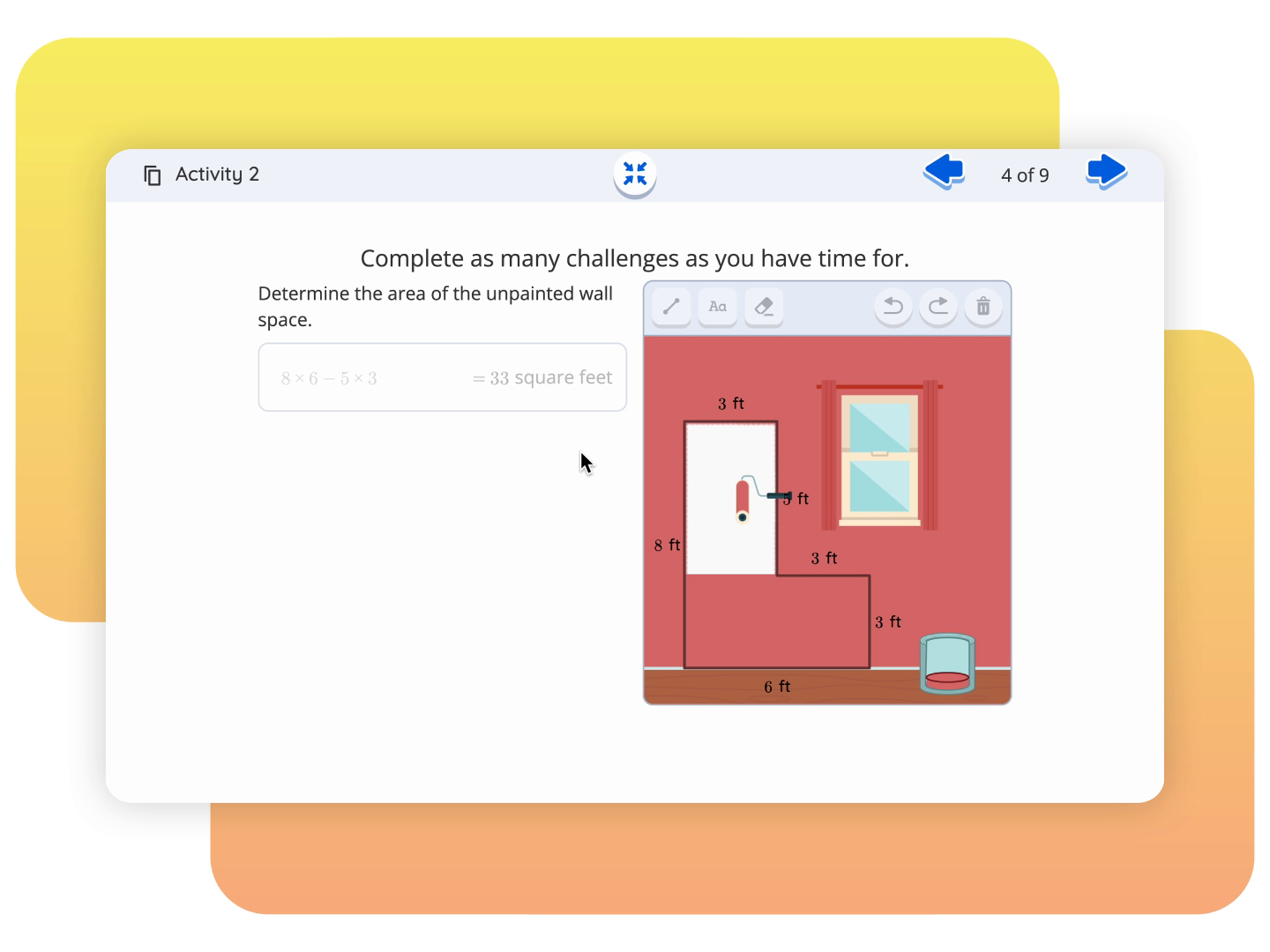
Educational software displays a challenge to determine the area of an unpainted wall. The wall features a door and window with given dimensions, and a mouse pointer hovers near the question, amplifying the student's engagement.
Digital experience

Explore our digital experience! Every lesson in Amplify Desmos Math has student print materials and digital recommendations.

Cover of "Amplify Desmos Math Student Edition 3" showcasing illustrated children engaged in various mathematical activities inside a glass house structure, reflecting the dynamic energy of New York math.
Student Edition pages

Motivate students with mathematics that is both rigorous and delightful.

Cover of the Amplify Desmos Math Grade 3 Centers Resources book, featuring a 3D letter "C" in blue and white on a minimalistic background, perfect for aligning with New York math standards.
Centers Resources

Engaging, hands-on games for students to play collaboratively to strengthen their understanding of key skills and concepts.

Cover of an "Amplify Cover of the "Amplify Desmos Math" Grade 3 book featuring intervention and extension resources, with a blue geometric "I" on a light blue background, aligning with New York Math standards.
Intervention and Extension Resources

Additional resources to reinforce and extend key concepts, including Mini-Lessons and Extensions.

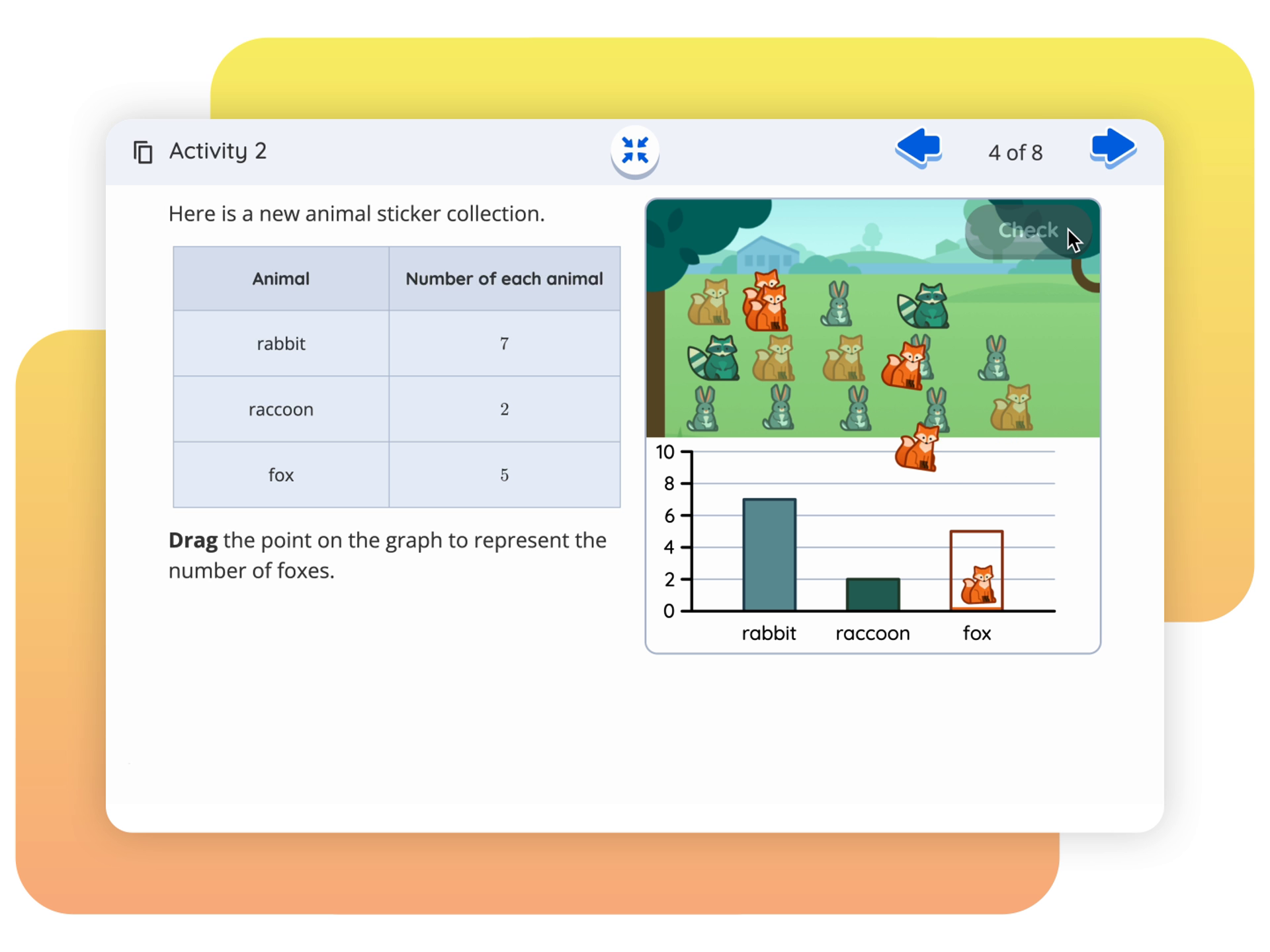
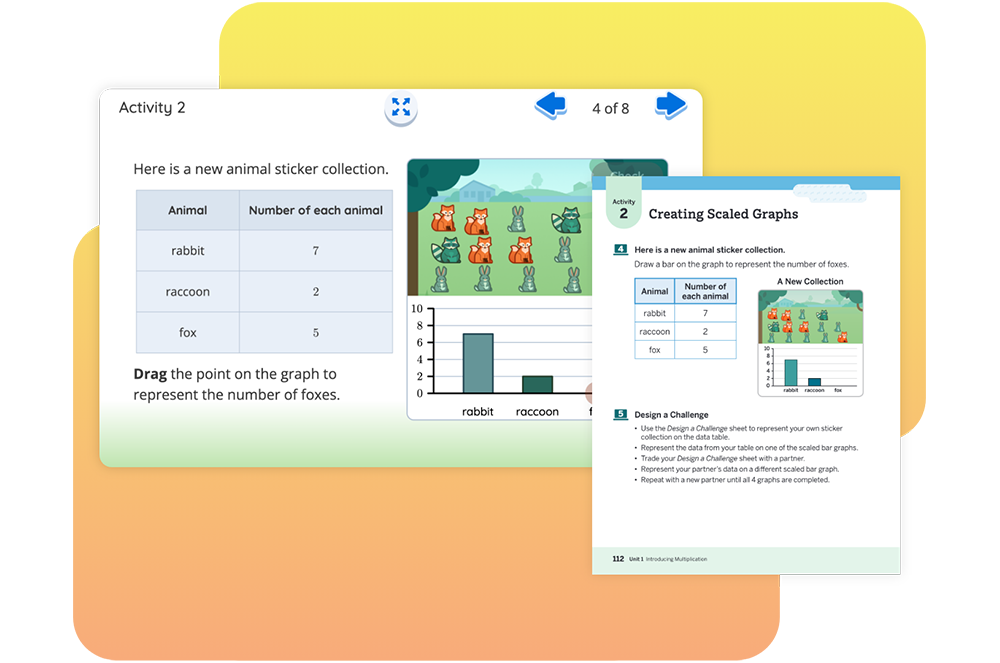
A page titled "Activity 2" features a table showing counts of rabbits, raccoons, and foxes, an image of animal stickers, and a bar graph representing the number of each animal, designed to amplify your New York math lesson with engaging visual data.

Students compare data represented on bar graphs with different scales by using animal stickers to create scaled bar graphs.

A course outline for Algebra 1 with 8 units, each detailing the number of instructional and optional days. The total suggested instructional days are 144 and 28 optional days, aligning with New York Math standards.
Program structure

Get to know the content and structure of Grade 4 Amplify Desmos Math.

Cover of "Amplify Desmos Math: Teacher Edition Grade 4" showing children learning New York Math outdoors, using large mathematical tools and numbers, with one child in a wheelchair.
Teacher Edition pages

Planning and instructional guidance is visual, organized, and easy-to-follow. To help you review the program, we have included samples from a complete sub-unit on this site: Unit 2, Sub-Unit 1: Size and Location of Fractions.

Educational screen showing an interactive activity from Amplify Desmos Math where a user drags a point to cut a log into quarters. The progress is 2 out of 10.
Digital experience

Explore our digital experience! Every lesson in Amplify Desmos Math has student print materials and digital recommendations.

Cover of "Amplify Desmos Math, Student Edition, Grade 4," showcasing students collaborating on math problems involving shapes and numbers against a vibrant backdrop that blends cityscapes and natural scenery, capturing the essence of New York math learning.
Student Edition pages

Motivate students with mathematics that is both rigorous and delightful.

Cover of the "Amplify Desmos Math" Grade 4 Centers Resources book, featuring a large, stylized blue letter "C" on a light blue background. This essential resource for New York math educators ensures engaging and effective instruction.
Centers Resources

Engaging, hands-on games for students to play collaboratively to strengthen their understanding of key skills and concepts.

Cover of "Amplify Desmos Math, Grade 4: Intervention and Extension Resources," featuring a geometric illustration and a blue and orange color scheme inspired by New York math standards.
Intervention and Extension Resources

Additional resources to reinforce and extend key concepts, including Mini-Lessons and Extensions.

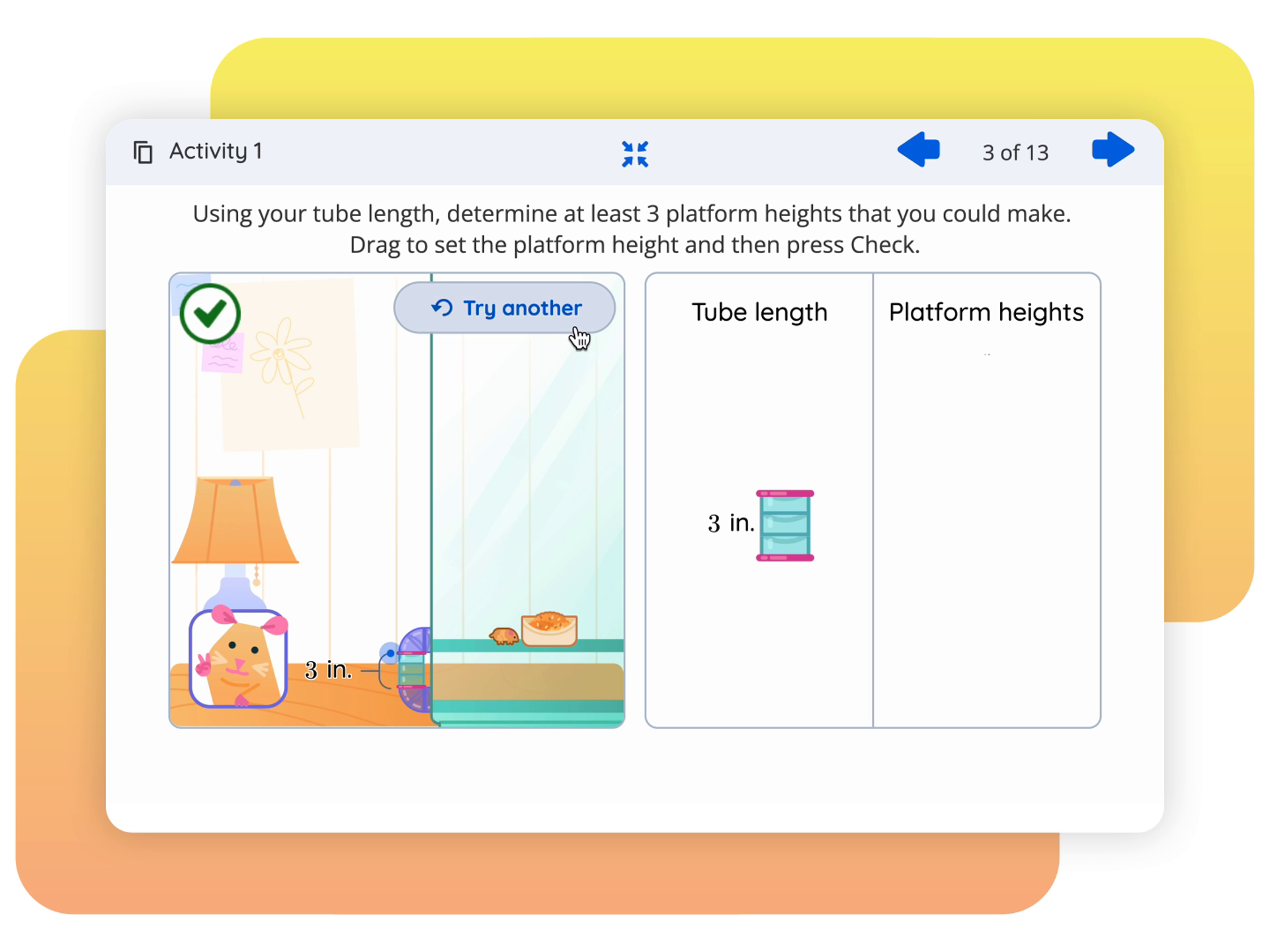
Interactive educational activity asking users to determine platform heights using a 3-inch tube. The interface, inspired by Desmos math tools, features a dragging function and feedback system with a checkbox and "Try another" option, amplifying the learning experience.

Students choose tube lengths to connect to platform heights for hamster homes, identifying possible heights using what they know about multiples.

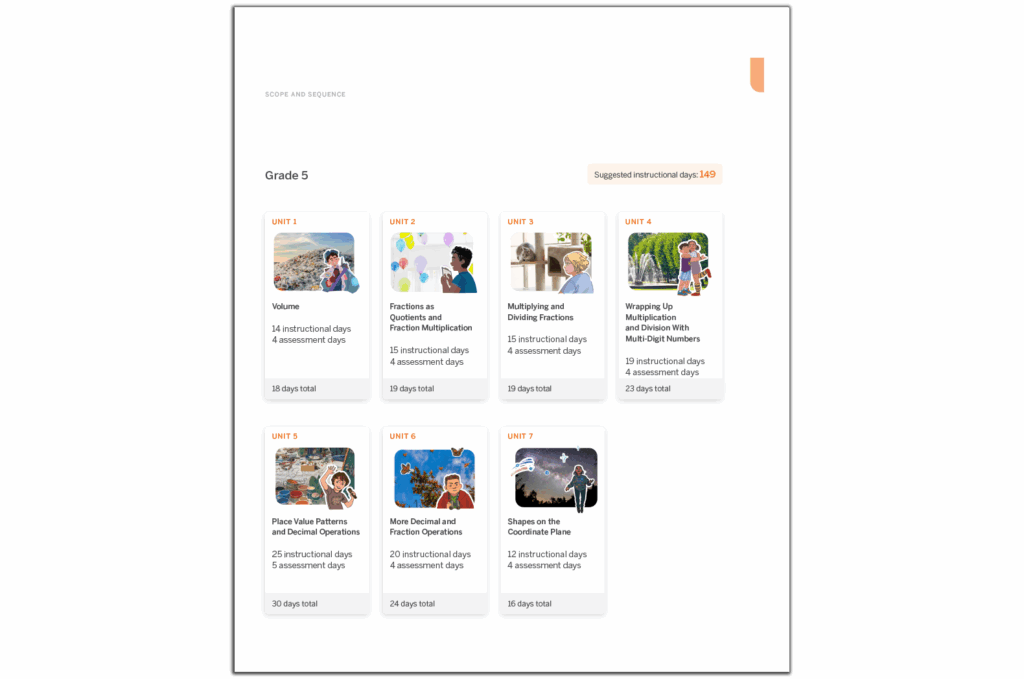
A Grade 5 curriculum scope and sequence chart with units covering volume, fractions, multiplication, shapes, place value, and measurement. Each unit lists instructional and assessment days to amplify Desmos Math activities.
Program structure

Get to know the content and structure of Grade 5 Amplify Desmos Math.

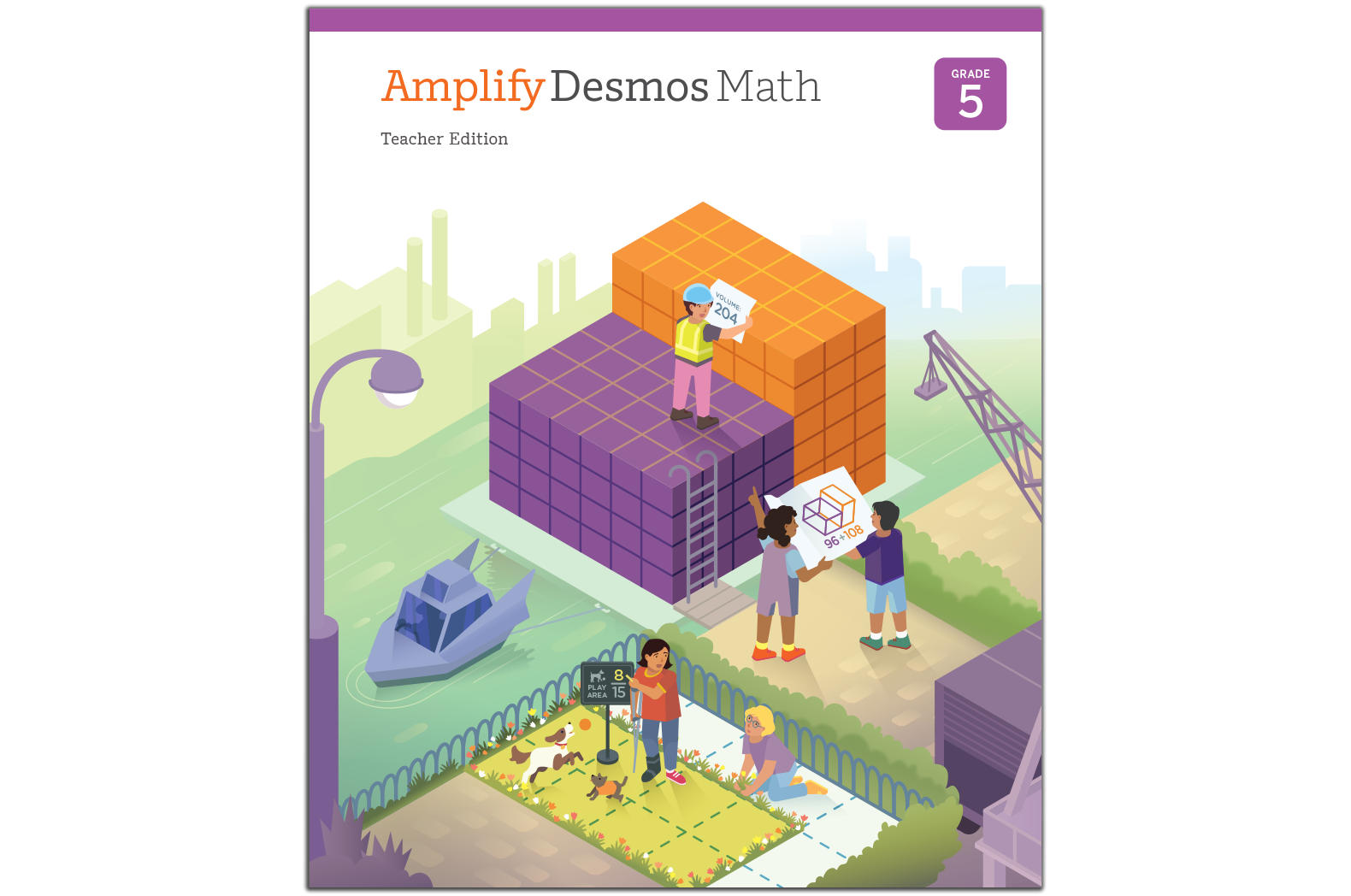
Illustration of three students engaging with various math activities outdoors and around large blocks. Text at the top reads "Amplify Desmos Math, Grade 5, Teacher Edition" - a perfect resource for New York math educators.
Teacher Edition pages

Planning and instructional guidance is visual, organized, and easy-to-follow. To help you review the program, we have included samples from a complete sub-unit on this site: Unit 2, Sub-Unit 1: Fractions as Quotients.

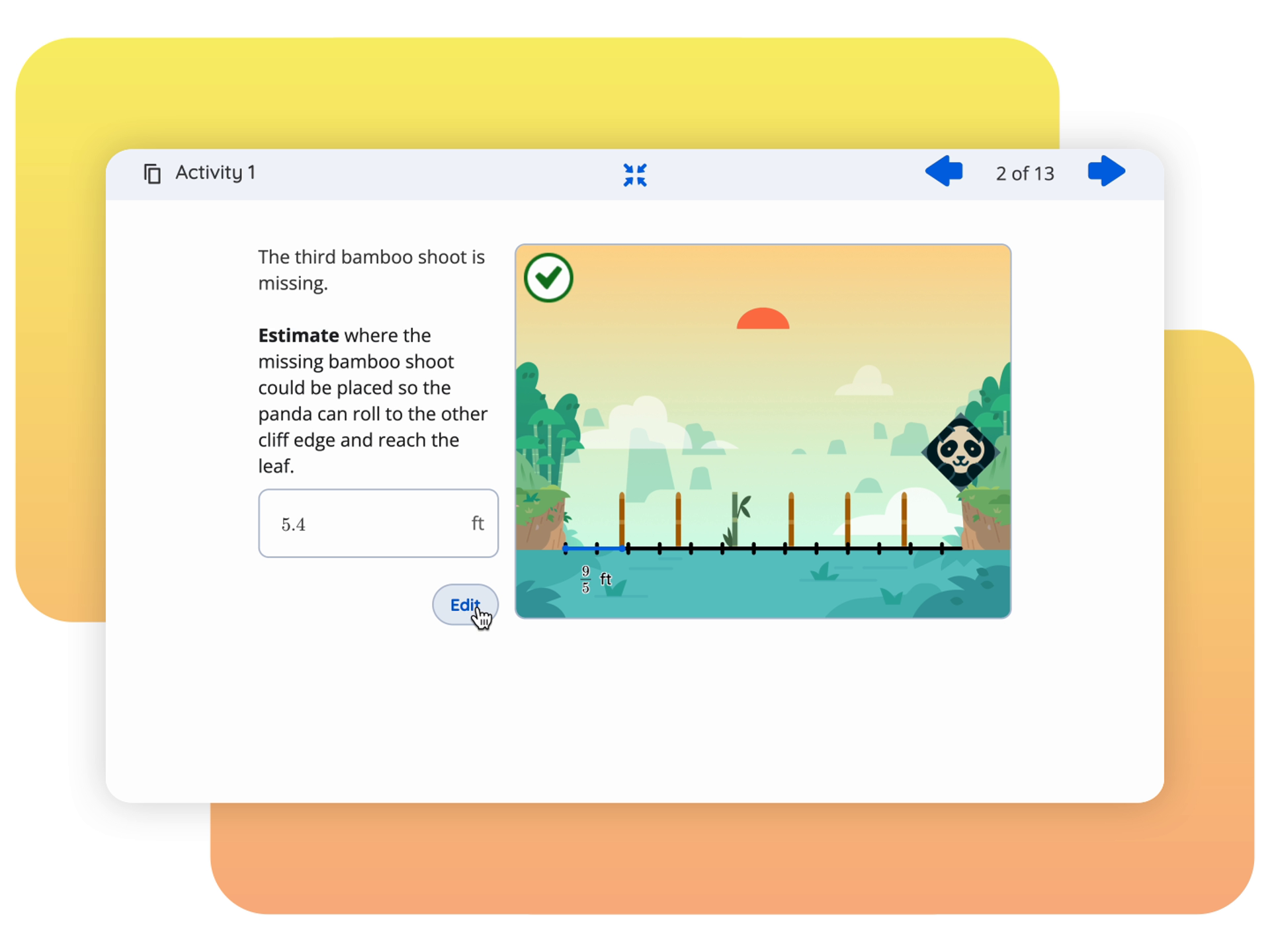
A digital activity prompt showing a scenic landscape with bamboo shoots and a panda. Using Desmos math tools, the task is to estimate the length where the third bamboo shoot should be placed for the panda to reach a leaf. This exercise is designed to amplify your understanding of spatial reasoning.
Digital experience

Explore our digital experience! Every lesson in Amplify Desmos Math has student print materials and digital recommendations.

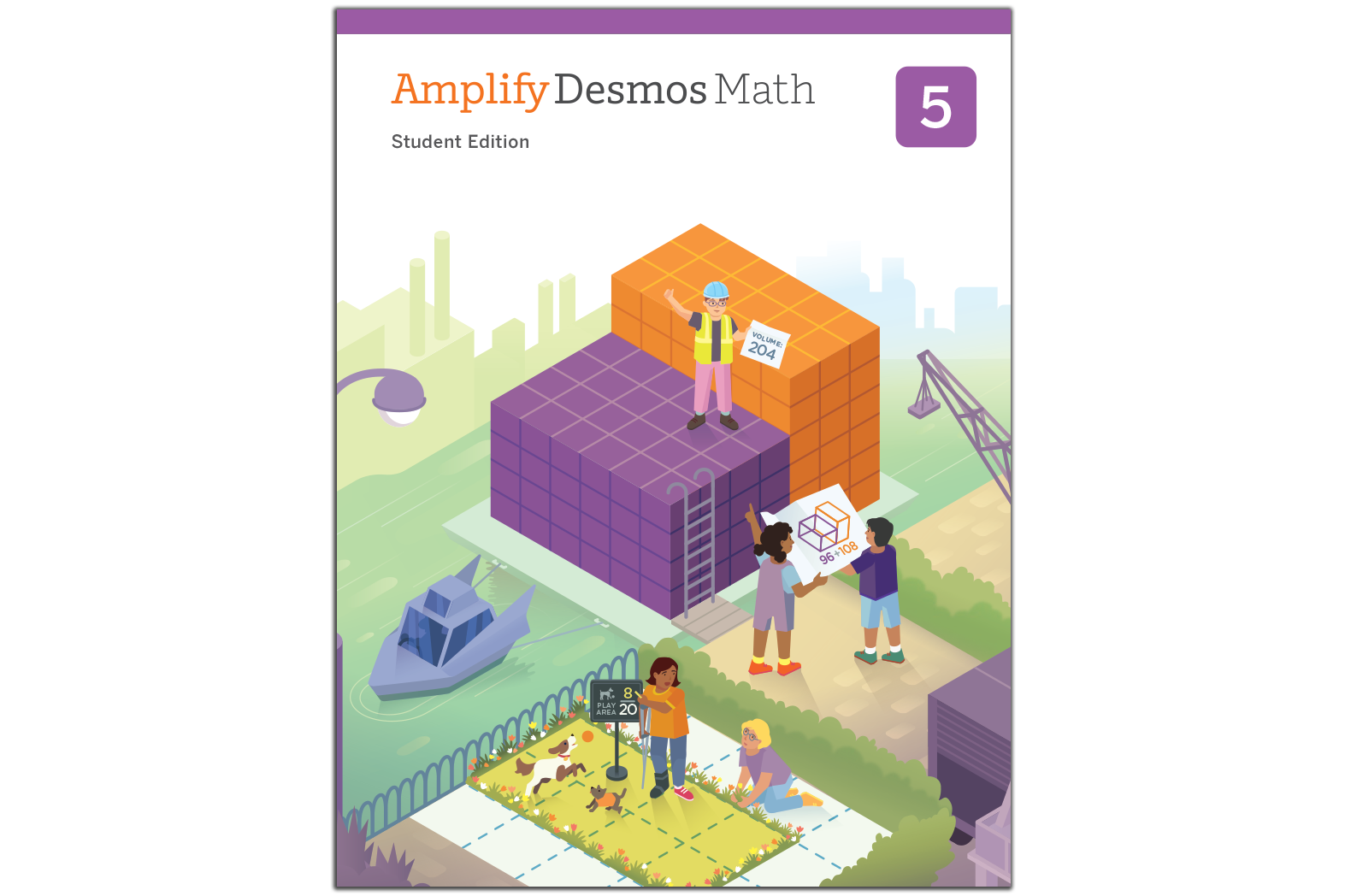
Cover of "Amplify Desmos Math: Student Edition, Grade 5" featuring students engaged in various mathematical activities outside, such as block building, measuring, and gardening—a perfect resource aligning with New York math standards.
Student Edition pages

Motivate students with mathematics that is both rigorous and delightful.

Cover image of "Amplify Desmos Math Grade 5 Centers Resources" featuring a large purple letter C on a light purple background, showcasing the innovative approach of Amplify Desmos Math that's making waves in New York math education.
Centers Resources

Engaging, hands-on games for students to play collaboratively to strengthen their understanding of key skills and concepts.

Cover of "Amplify Desmos Math Grade 5: Intervention and Extension Resources," featuring a large, stylized number five in purple against a light purple background with minimal geometric patterns, ideal for New York math curriculum support.
Intervention and Extension Resources

Additional resources to reinforce and extend key concepts, including Mini-Lessons and Extensions.

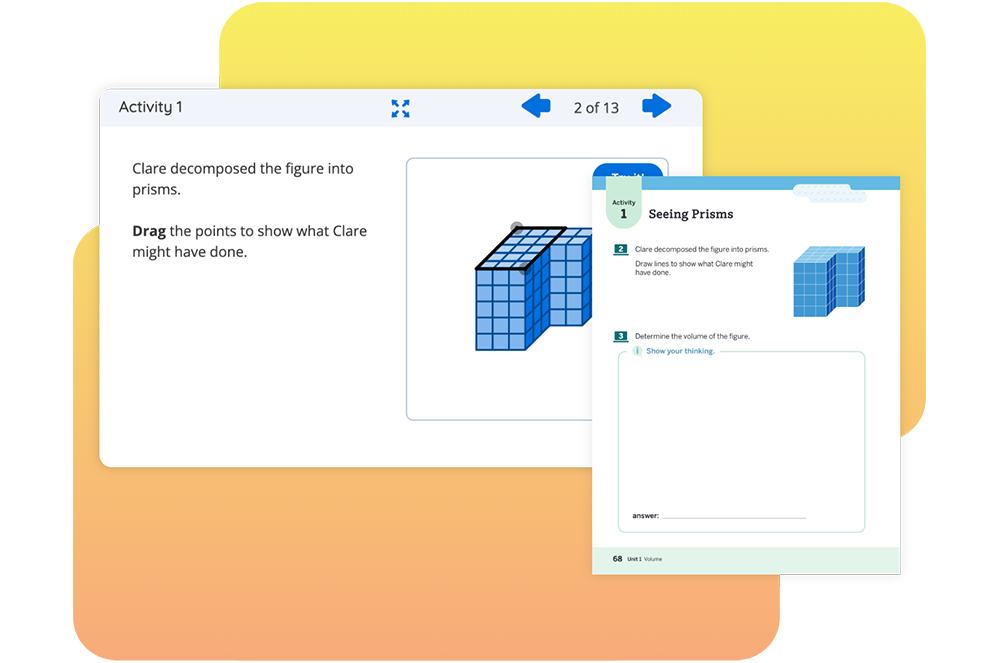
An interactive screen showing an activity about decomposing a figure into prisms, with a touch of Desmos Math integration. The user is asked to drag points to demonstrate the decomposition. Two prism illustrations are displayed, offering a glimpse of New York Math's approach.

Students decompose a figure into rectangular prisms and determine the volume of the figure by adding the volumes of the individual prisms.

Contact Us

If you have any questions throughout your review process or need additional samples, please don’t hesitate to contact:

Alicia O’Neil

Account Executive

425-890-6103

aoneil@amplify.com

Request additional samples

Ready to learn more? Connect with an Amplify Desmos Math expert to request additional program samples.

Program structure

Written by the curriculum experts at the University of California, Berkeley’s Lawrence Hall of Science, Amplify Science TK includes an emphasis on developing the oral language skills essential for success in elementary school. Through guided and independent activities, Amplify Science TK integrates successful approaches found in the research-proven Amplify Science K–8 curriculum to get your students thinking and talking like real scientists.

Amplify Science TK includes three units, one for each science domain: Earth science, life science, and physical science. The physical science unit includes an engineering design challenge.

Three circular icons representing Earth Science (sun over horizon), Life Science (butterfly and leaf), and Physical Science (book and magnet), each labeled below with its respective field.

Units are structured to allow you to make decisions about how best to teach your students and include options for whole-group, small-group, and center-based instruction.

What’s Included

Print Teacher’s GuideTeacher instructional guide for all three units
CopymastersCopymasters for all student-facing materials, including Science Notebooks and mini-books
Big BooksOne photo-based big book for each unit, used in classroom Read-Alouds

Preview a sample

Click the button below to preview an Amplify Science TK Teacher’s Guide and a Big Book

Program Guide

Click the button below to explore the Amplify Science TK Program Guide, which includes information about our approach, curriculum content, standards connections, and more.

Inspiring the next generation of California scientists, engineers, and curious citizens

Amplify Science California is an immersive and engaging core curriculum authored by UC Berkeley’s Lawrence Hall of Science and built specifically for the California NGSS.

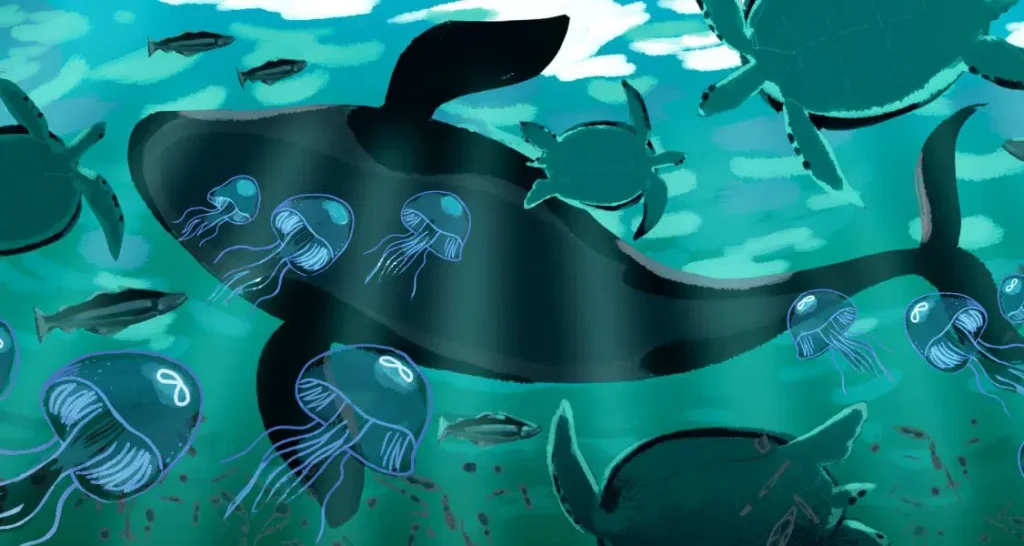
An illustration of a whale with jellyfish and turtles from Amplify Science

Program overview

Amplify Science California is a brand-new blended science curriculum for grades TK–8 that meets 100 percent of the Next Generation Science Standards and the California Science Framework. With Amplify Science California, students learn to talk, read, write, think, and argue like real scientists and engineers through investigations of real-world problems and scientific phenomena, gaining the skills needed to master the California NGSS.

In Amplify Science, students take on the role of a scientist or engineer and are introduced to a relevant, real-world problem. They engage in investigations using hands-on materials, reading selections, rich media, and more to draft, strengthen, and defend their claims about the unit anchor phenomenon and how to solve the problem.

The Amplify Science assessment system is grounded in the principle that students benefit from regular and varied opportunities to demonstrate understanding through performance. Read more about Amplify assessments in Grades K-5 and 6-8.

A powerful partnership

Amplify Science California was developed by the science education experts at the University of California, Berkeley’s Lawrence Hall of Science and the digital learning team at Amplify.

The logo for The Lawrence Hall of Science, University of California, Berkeley, features blue text on a light background and is recognized by educators using Amplify Science for middle school science programs.

The University of California, Berkeley’s Lawrence Hall of Science is a recognized leader in PreK-12 science education, producing groundbreaking curriculum products for more than 40 years, including the international award-winning Seeds of Science/Roots of Reading®. The Hall’s curriculum materials are used in one in four classrooms across the nation.

Read more about The Hall’s research-proven Do, Talk, Read, Write, Visualize multimodal learning model.

The word "Amplify." is written in large, orange serif font on a light gray background.

Amplify has been pioneering digital education products for more than 15 years, empowering teachers across the country to offer more personalized instruction and accelerate the potential of their students to become more active, engaged learners. Amplify has supported more than 200,000 educators and three million students in all 50 states.

Designed in California for California

Since their release in 2013, the Next Generation Science Standards (NGSS) have raised the bar for science education. Moving the focus of instruction away from memorization and toward active engagement and critical thinking, the standards teach students to think like scientists and engineers and grapple with core scientific principles, in addition to supporting deep learning of concepts that cut across science domains. Amplify Science has been designed from the ground up to meet 100 percent of the Next Generation Science Standards and respond to the instructional shifts called for by the National Research Council’s Framework for K–12 science education (2012).

Classroom Slides (grades K–8)

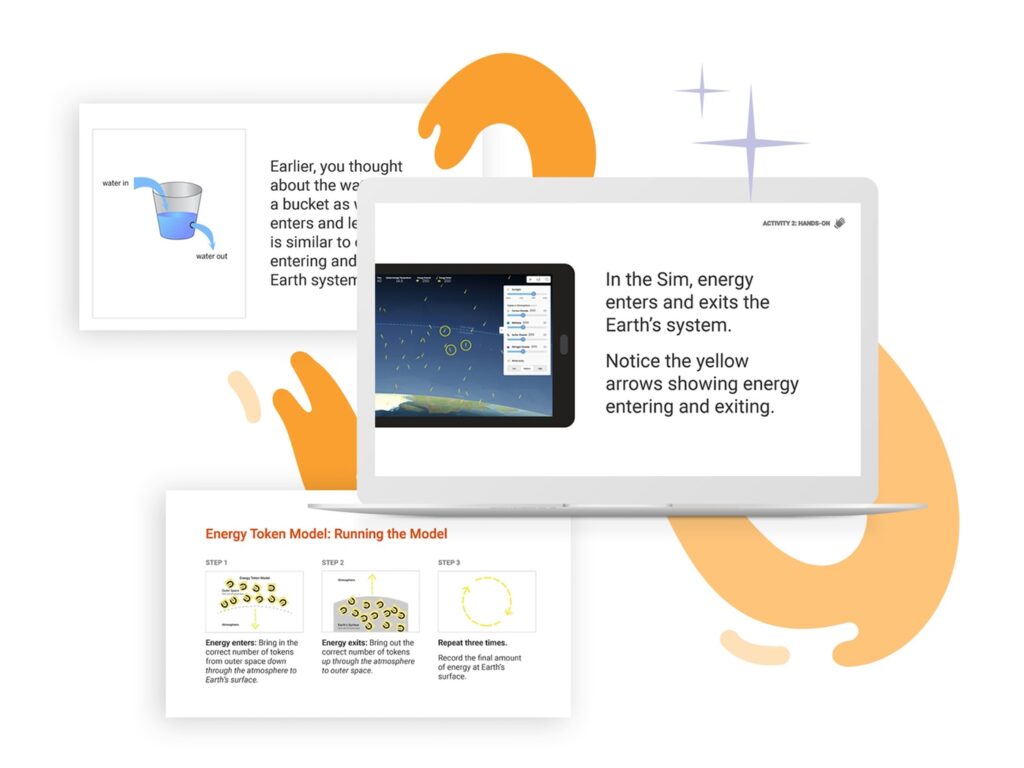
Digital collage of various devices displaying educational content about earth’s energy system, including graphs and text explanations.

Science time just got a whole lot easier. With our new Classroom Slides, you can put down the Teacher’s Guide and focus on what matters most—your students. Plus, with Classroom Slides, lesson prep is as quick as a click!

Classroom Slides are:

  • Available for back to school 2020–2021, for grades 6–8. Classroom slides are already rolling out for grades K–5.
  • Downloadable for offline use, which means no more sweating unreliable internet connections.
  • Streamlined for easy lesson delivery, including lesson visuals, activity instructions and transitions, animations, investigation setup videos, technology support, and more.
  • Fully editable, allowing you to incorporate your own flavor, flair, and favorite resources.

Classroom Slides are available as downloadable PowerPoint files to help guide you and your students through the lesson with images, videos, questions, and instructions. Slides for grades 6–8 will be released on a rolling basis over the course of the 2020-2021 school year. Below you’ll find a prototype from the Earth’s Changing Climate unit.

A brochure on K–5 slides can be downloaded here.
A flyer on 6–8 slides can be downloaded here.

Transitional Kindergarten

Amplify Science TK includes three units, one for each science domain: Earth science, life science, and physical science. The physical science unit includes an engineering design challenge.

Three circular icons representing Earth Science (sun over horizon), Life Science (butterfly and leaf), and Physical Science (book and magnet), each labeled below with its respective field.

Units are structured to allow you to make decisions about how best to teach your students and include options for whole-group, small-group, and center-based instruction.

Learn more about the program.

Start your review

If you have received Amplify Science California materials for review, fill out the form and select the course model you are interested in to access the digital Program Guide and supporting materials. For technical questions regarding your review, contact support at (844) 505-4621 or CAreviewersupport@amplify.com.

Amplify Desmos Math for the Archdiocese of Miami

Welcome Catholic school educators, 

Amplify Desmos Math thoughtfully combines conceptual understanding, procedural fluency, and application. Each math lesson is designed to tell a story by posing problems that invite a variety of approaches before guiding students to synthesize their understanding of the learning goals.

What is Amplify Desmos Math?

Amplify Desmos Math supports teachers in building students’ lifelong math proficiency. The program:

  • Supports social classrooms, invites mathematical creativity, and evokes wonder, creating a welcoming learning space where students are empowered to see themselves and their classmates as having brilliant mathematical ideas.
  • Provides teachers with clear, step-by-step moves to build systematically from students’ prior knowledge to grade-level learning.
  • Connects students to each other’s thinking and to an understanding that they can use math to make sense of the world.
  • Enables access to grade-level understanding for every student, every day.

A powerful suite of math resources

Amplify Desmos Math combines the best of problem-based lessons, intervention, personalized practice, and assessments into a coherent and engaging experience for both students and teachers.

Data informs instruction. Comprehensive student profiles provide full data on students’ assets and skills, empowering teachers to provide just-in-time scaffolds throughout core instruction and targeted intervention when needed.

Ready to Explore?

Ready to explore as a teacher? Follow these instructions:

Ready to explore as a student? Follow these instructions:

Educational software interface featuring a New York math problem about measuring platform heights using a 9-inch tube, illustrated with a playful, colorful design.

Experience Amplify Desmos Math

Click the links below to explore our interactive digital lessons, where you’ll also find print Teacher Edition and Student Edition pages for each lesson.

For helpful navigation tips and more program information, download our Grades K–5 and Grades 6–Algebra 1 program guides.

You can also watch a product expert walk through a lesson and the available program components with a lesson walkthrough video.

Personalized learning and support

Amplify Desmos Math includes digital, adaptive practice that provides the personalized support a student needs to access grade-level math every day. Personalized Learning activities target a skill or concept aligned to the day’s core lesson, with each student receiving personalized scaffolds based on what they already know. This technology complements daily learning and provides another layer of support to the in-lesson differentiation and instructional guidance provided to teachers. Click here to try a Boost Personalized Learning activity. More activities coming soon!

The Fluency Practice of Amplify Desmos Math uses an evidence-based approach to memory retention—spaced repetition—for the basic operations. Students around the world have answered more than 120 million multiplication questions within our application. Try it now! 

Educational software on a laptop screen showing a student activity to complete a bar graph by categorizing dragonflies, designed for the New York math curriculum.

Contact us

Support is always available. Our team is dedicated to helping you every step of the way. Contact your dedicated Florida representative here for program access, samples, and additional information.

A smiling man with short hair wears a green polo shirt against a plain background, exuding the kind of confidence that comes from teaching an inspiring math lesson.

Jeff Rutter

Field Manager
Miami-Dade and Monroe Counties
jrutter@amplify.com
(727) 407-5801

A smiling person with long blonde hair wears a textured blue top against a plain background, embodying the essence of personalized learning.

Amanda Shelley

Account Executive
Broward County Schools
ashelley@amplify.com
(321)-693-3518

A man with short, dark hair and a full beard smiles confidently. He is wearing a pink patterned shirt and a green jacket, reminiscent of an engaging math lesson. The light gray background subtly complements his dynamic style.

Tom Gantt

District Manager
Miami Resident
tgantt@amplify.com
(305)-546-2979

Welcome to Amplify Desmos Math California!

California educators, welcome to math that motivates. Introducing Amplify Desmos Math California, a new, curiosity-driven TK–12 program that builds lifelong math proficiency. Each lesson poses problems that invite a variety of approaches before guiding students to synthesize their understanding of the learning goals. Students encounter math problems they are eager to solve; teachers spend more time where it’s most impactful: creating a collaborative classroom of learners.

Scroll to learn more about the program and explore sample materials.

About the program

Amplify Desmos Math California is a TK–12 core math program designed to meet the CA Math Framework and the Common Core State Standards for Mathematics. Offered in English and Spanish, Amplify Desmos Math California thoughtfully combines conceptual understanding, procedural fluency, and application through a structured approach to problem-based learning. Through engaging activities, Amplify Desmos Math California invites curiosity and math discourse into the classroom to create lifelong math proficiency.

Please scroll to learn more about the K–8 program and explore sample materials. (TK and high school materials are in development and will be available soon.)

A powerful math suite

Amplify Desmos Math California combines the best of assessment, problem-based core lessons, personalized practice, and intervention into a coherent and engaging experience for both students and teachers.

Laptop displaying a math problem interface with student assessment reports in the background.

Assessment

mCLASS benchmark assessments, along with daily formative checks, measure not only what students know, but also how they think. The asset-based assessment system provides teachers with targeted, actionable insights, linked to core instruction and intervention resources. Unit- and lesson-level core assessments give teachers data at their fingertips to guide and differentiate instruction. In grades 3–8, core assessments and performance tasks are designed to prepare students for success on the Smarter Balanced Assessment Consortium (SBAC) testing.

Core instruction

Amplify Desmos Math California core lessons pair problems students are eager to solve with clear instructional moves for teachers. Each lesson is designed to tell a story by posing problems that invite a variety of approaches before guiding students to synthesize their understanding of the learning goals. With built-in differentiation and Multilingual / English Learner support, Amplify Desmos Math California will allow every student to find success in the math classroom.

An educational game screen with a worm on a log and numbered blocks. Adjacent is a worksheet titled "Finding the Missing Pair" with instructions and incomplete equations.
A digital educational screen showing a math problem about converting meters to centimeters. It involves a diving toy sinking 5 meters into a pool. Text prompts users to input the conversion.

Personalized learning

Boost Personalized Learning activities help students access grade-level math through engaging, independent digital practice. Responsive Feedback adjusts to students’ work, providing item-level adaptivity to further support their learning.

Intervention

Integrated resources like Mini-Lessons, Fluency Practice, and Math Adventures provide targeted intervention on a specific concept or skill connected to the daily lesson. Extensions are also available to stretch students’ understanding.

Two pages of a math workbook displaying exercises on determining coordinates after rotation. The pages include diagrams, tables, and practice problems.
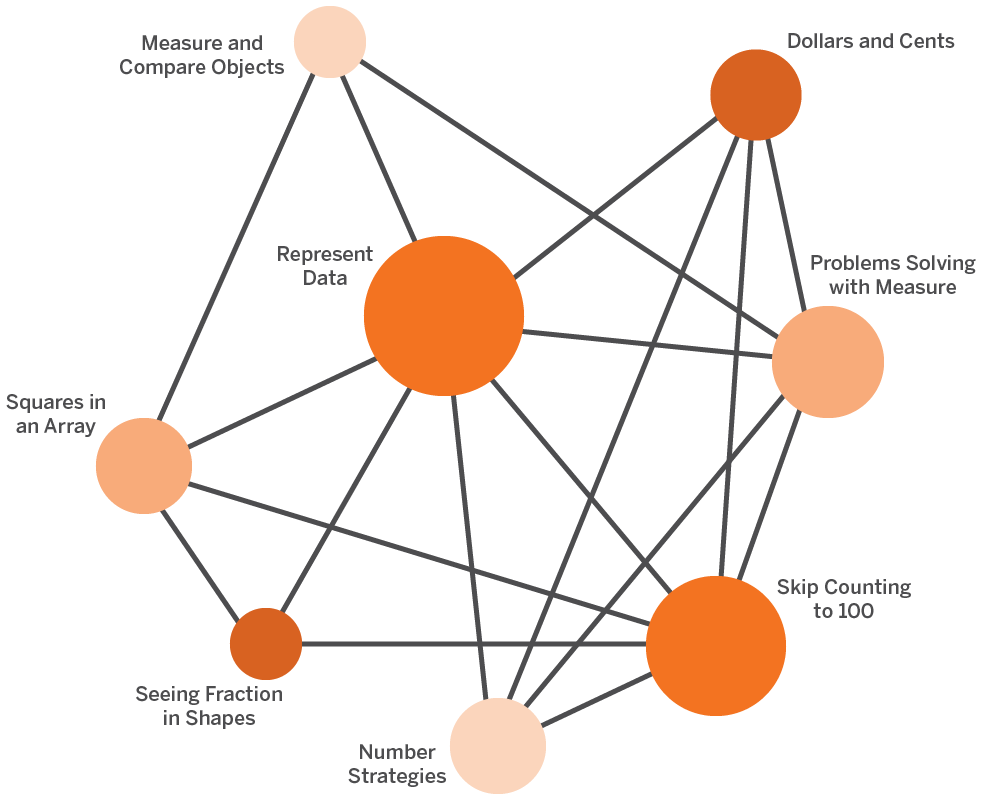
Network diagram with interconnected nodes labeled: Measure and Compare Objects, Represent Data, Dollars and Cents, Problem Solving with Measure, Skip Counting to 100, Number Strategies, Squares in an Array, Seeing Fraction in Shapes.

Big Ideas

The CA Mathematics Framework encourages a shift from power standards to thinking about math as a series of connected Big Ideas. Each Amplify Desmos Math California lesson supports one or more Big Ideas and the connections between Big Ideas. The grade-level diagram changes through the course based on the math concepts being addressed.

Focus, coherence, and rigor

Each lesson highlights why the content being covered is important, how students will engage with the mathematics, and what students will do with the learning. Our lesson opener helps teachers understand the most important concepts of the lesson, and includes the Drivers of Investigation (DI), Content Connections (CC), and Standards for Mathematical Practice (SMP) that drive learning in each lesson.

An educational slide on addition story problems, detailing goals for solving problems, language goals, and strategies using equal expressions, tens and ones, and number sense.
A screen titled "Match the Score" with a 2D target graph showing various scores. Instructions request four ordered pairs to total 400. Four pairs are listed: (4, 2), (7, 4), (7, 6), (10, 6). A "Try again" button is shown.

Built-in authentic tasks

Mathematics is not learning in isolation. Students are connected to each other’s thinking and can use math to understand the world. With accessible invitations to authentic tasks, all students can experience mathematical success. Amplify Desmos Math California provides these authentic invitations in a variety of ways:

Each unit begins with an “Explore” lesson, which allows students to engage with authentic exploration in low-floor, high-ceiling tasks. These tasks are designed in such a way that all students can access the basic mathematical concepts, but they also offer possibilities for advanced exploration and problem-solving for those ready for more complex work, promoting an inclusive and differentiated learning environment.

Our innovative course-level investigations are designed to facilitate multipart exploration. Students grapple with Big Ideas, diving deep into key concepts that encourage comprehensive understanding. Data science is infused into the approach, equipping students with a strong foundation in interpreting and applying data-driven solutions. The Environmental Principles and Concepts (EP&Cs) are also a focus of our investigations, enabling students to understand and appreciate the coherence and interrelationship of Earth’s environmental systems.

A focus on multilingual and English learners

Children sitting at desks in a classroom with a large illustrated caterpillar on the wall. Beside them are printed educational materials labeled “Amplify Desmos Math” and “Ying’s Aquarium Story.”.

In building Amplify Desmos Math California, we partnered with the English Learner Success Forum (ELSF) to provide guidance on our multilingual/English learner support for teachers. ELSF is a national nonprofit organization that advocates for high-quality instructional materials that are inclusive of multilingual learners. ELSF’s guiding documents reflect research-based instructional strategies that are critical to curriculum design and were created by researchers, linguists, and practitioners from across the country. ELSF reviewed our materials and provided directional guidance and feedback to ensure that the program fully supports multilingual/English learners.

A component of our K–5 curriculum is the engaging unit stories that interweave mathematics with real-life situations and relatable narratives. These unit stories are specifically crafted to inspire curiosity and foster a deep connection between the learner and the math concepts being explored. This unique approach not only makes learning fun and interesting, but also allows our young learners to see themselves in the math.

To help students grow their domain-specific and academic vocabulary, Amplify Desmos Math California provides embedded vocabulary routines, such as prompting teachers to use a Frayer Model. These routines allow students to make connections to new language and offer repeated opportunities to develop and refine language.

Amplify Desmos Math California recognizes the diverse language needs of our students and is designed to be inclusive. Each lesson in the program features a parallel language activity, designed to be available to all students, in the form of teacher guidance and student activities. The activities in the Math Language Development Resource has leveled ELD (Emerging, Expanding, Bridging) differentiation to support all levels of Multilingual and English Learners. This approach ensures that all students, regardless of their language skills, can participate fully, grasp the material, and excel in their mathematical journey.

Uploaded digital glossary for languages other than Spanish. Up to nine languages of translations will be provided for.

Amplify Desmos Math California will include support resources for Spanish-speaking students across TK–Algebra 1/Integrated I beginning in the 20262027 school year.

A computer displays an educational activity about measuring platform heights. A notebook page is layered behind it, with a colorful hamster-themed illustration.

K–5 sample materials

Click the links in the drop-down sections below to explore sample materials from each grade. 

For helpful navigation tips and more program information, download the Amplify Desmos Math Program Guide.

You can also watch a product expert walk through a lesson and the available program components.

Screenshot of a kindergarten curriculum outline featuring units like Math in Our World, Numbers 1-10, Positions and Shapes, Understanding Addition, Making 10, and Shapes All Around Us. This comprehensive program utilizes New York Math standards to build foundational skills.
Program structure

Get to know the content and structure of Kindergarten Amplify Desmos Math California.

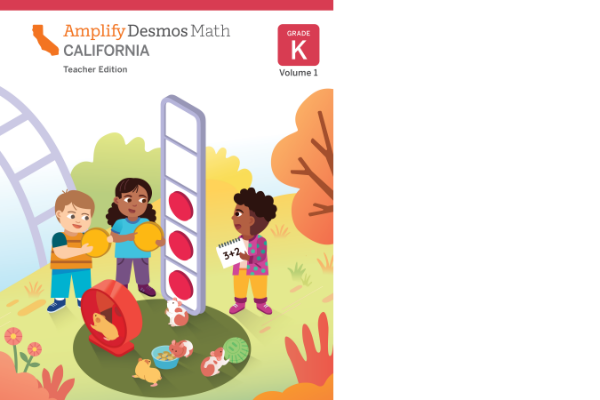
Cover of Amplify Desmos Math Grade K Teacher Edition featuring three children playing with math-related objects and a group of rabbits sitting nearby, aligning with the engaging curriculum seen in New York math classrooms.
Teacher Edition pages

Planning and instructional guidance is visual, organized, and easy-to-follow. To help you review the program, we have included samples from a complete sub-unit on this site: Unit 2, Sub-Unit 1: Counting and Comparing Objects.

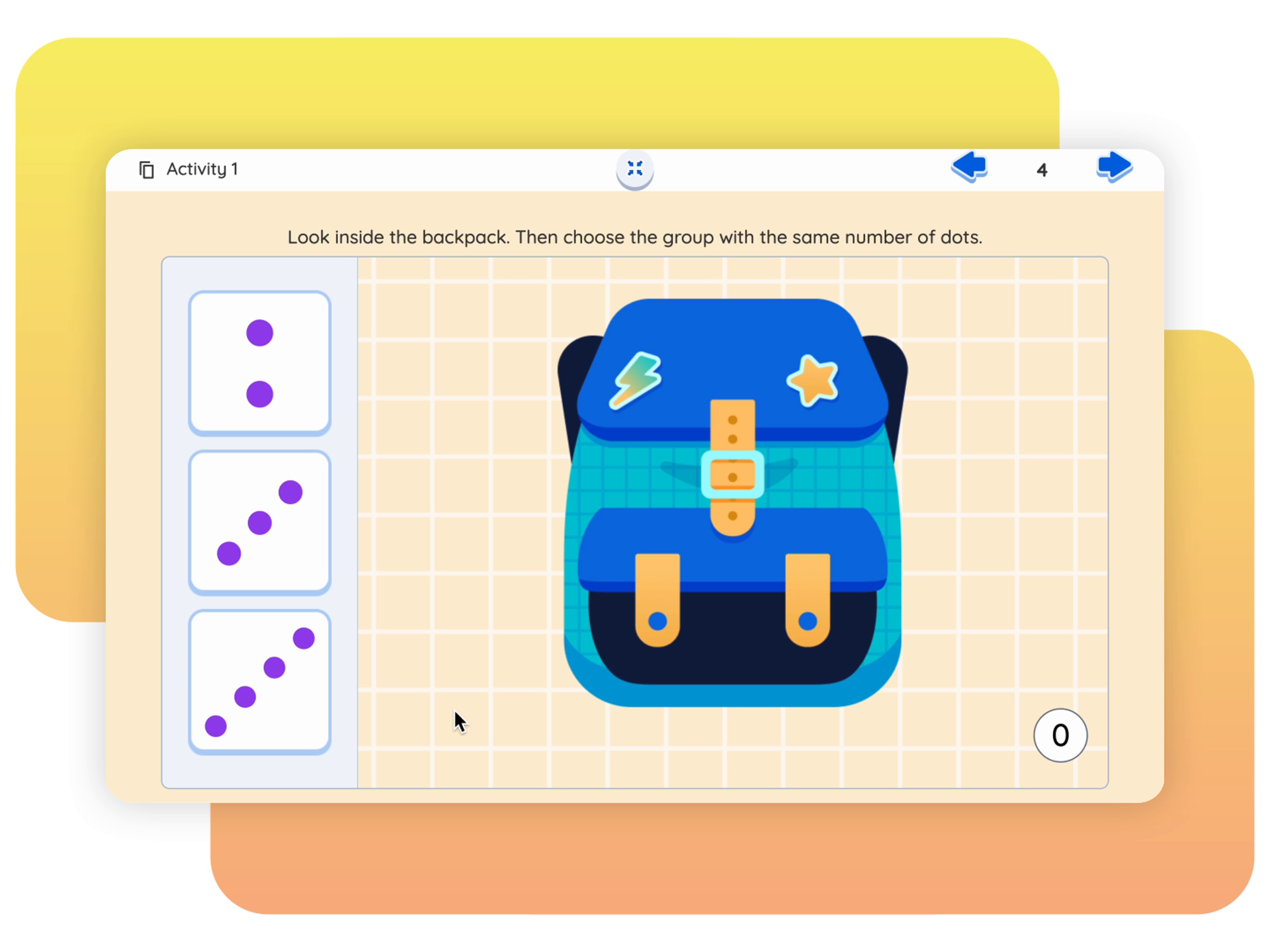
Digital educational activity showing a blue backpack illustration with dots, a task to match dots on cards, and printed sheet featuring a similar dot-matching exercise.
Digital experience

Explore our digital experience! Every lesson in Amplify Desmos Math California has student print materials and digital recommendations.

Cover of "Amplify Desmos Math: Student Edition Kindergarten," featuring an illustration of three children playing with math-related toys. A group of small white animals, possibly hamsters, play nearby. The scene brilliantly captures the joy of New York math exploration for young learners.
Student Edition pages

Motivate students with mathematics that is both rigorous and delightful.

Cover of "Amplify Desmos Math Grade K Centers Resources" featuring a large, stylized red and pink "C" on a light pink background with simple geometric designs. This distinctive cover complements New York math curriculums with its engaging visual elements.
Centers Resources

Engaging, hands-on games for students to play collaboratively to strengthen their understanding of key skills and concepts.

Cover of "Amplify Desmos Math: Grade K." The title is displayed with a geometric "I" illustration in the center. Subtitle reads "Intervention and Extension Resources" on a pink and white background, ideal for New York math standards.
Intervention and Extension Resources

Additional resources to reinforce and extend key concepts, including Mini-Lessons and Extensions.

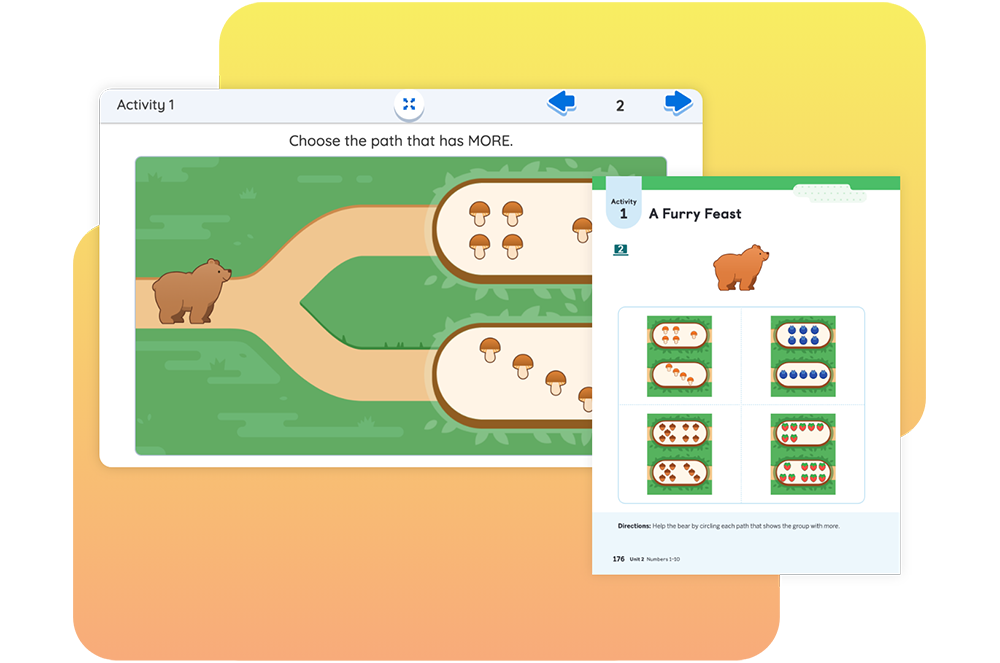
Illustration of a bear choosing a path with more mushrooms. Activity book page titled "A Furry Feast" with groups of objects to compare quantities.

In this lesson, students apply their understanding of how to compare groups of images as they determine which group has more or fewer and then compare their strategies by guiding a bear through a path that has more mushrooms than the other.

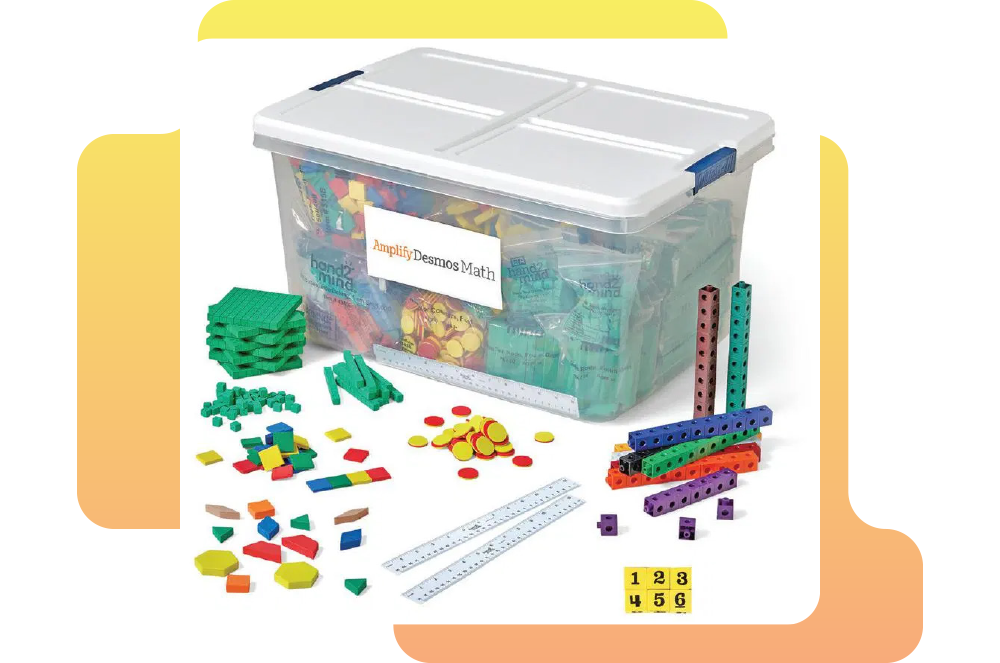
A clear plastic box contains various math manipulatives, including counting cubes, geometric shapes, rulers, and dice, displayed outside the box.
Hands-on manipulative kit

An optional add-on to your Amplify Desmos Math California program, the manipulative kit provides hands-on learning tools designed to simplify and illustrate complex mathematical concepts.

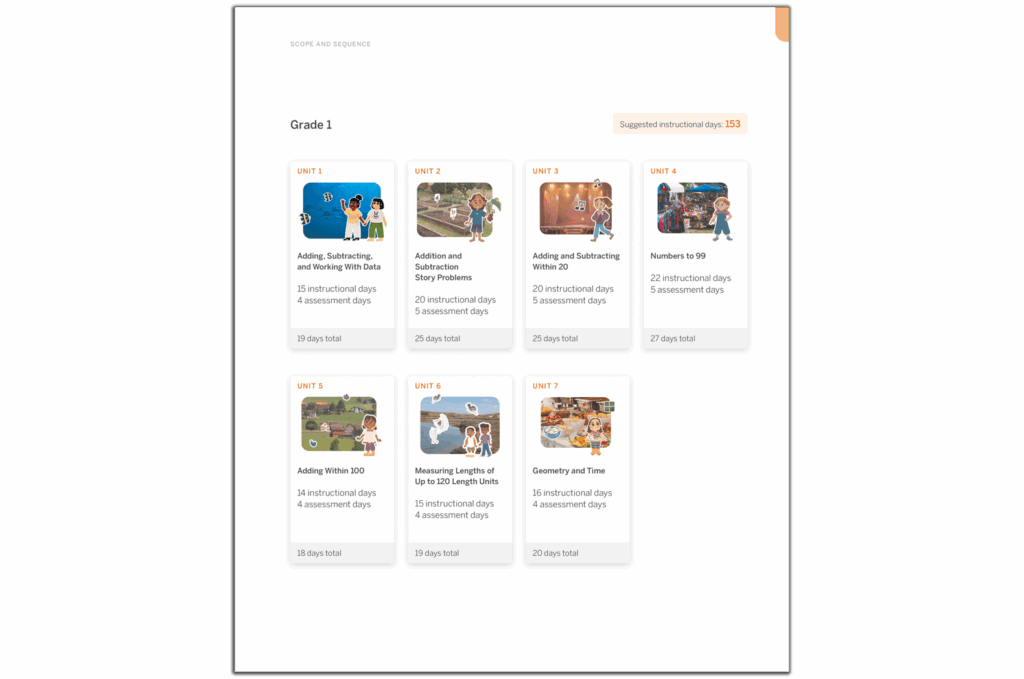
Grade 1 math curriculum overview displaying six units with instructional and assessment days: counting, addition, subtraction, numbers to 10, comparing numbers, measuring length, and geometry—aligned with the New York Math standards.
Program structure

Get to know the content and structure of Grade 1 Amplify Desmos Math California.

Children interact with math activities on a large tablet while observing fish illustrations. The text reads "Amplify Desmos Math Grade 1 Teacher Edition, aligned with New York Math standards.
Teacher Edition pages

Planning and instructional guidance is visual, organized, and easy-to-follow. To help you review the program, we have included samples from a complete sub-unit on this site: Unit 2, Sub-Unit 1: Story Problems in Maui.

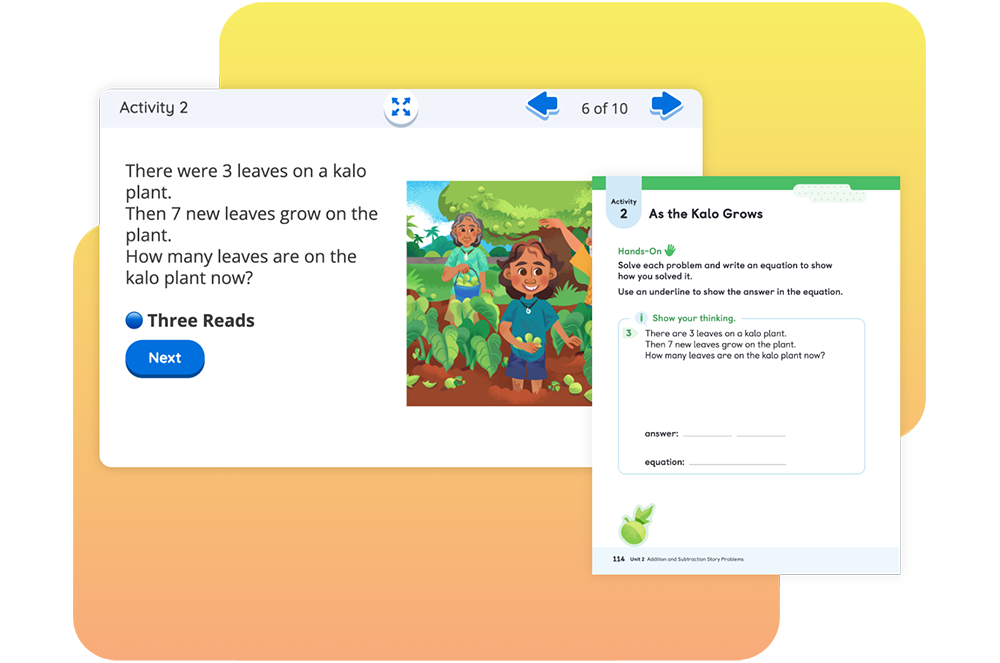
A digital educational activity showing a math problem about leaves on a kalo plant with a related worksheet on plant growth.
Digital experience

Explore our digital experience! Every lesson in Amplify Desmos Math California has student print materials and digital recommendations.

Illustration of three children engaged in math activities from the "Amplify Desmos Math: Student Edition 1" textbook. One child holds a number card, while the others manipulate counters and images, experiencing an exciting approach inspired by New York math techniques.
Student Edition pages

Motivate students with mathematics that is both rigorous and delightful.

Centers Resources

Engaging, hands-on games for students to play collaboratively to strengthen their understanding of key skills and concepts.

Intervention and Extension Resources

Additional resources to reinforce and extend key concepts, including Mini-Lessons and Extensions.

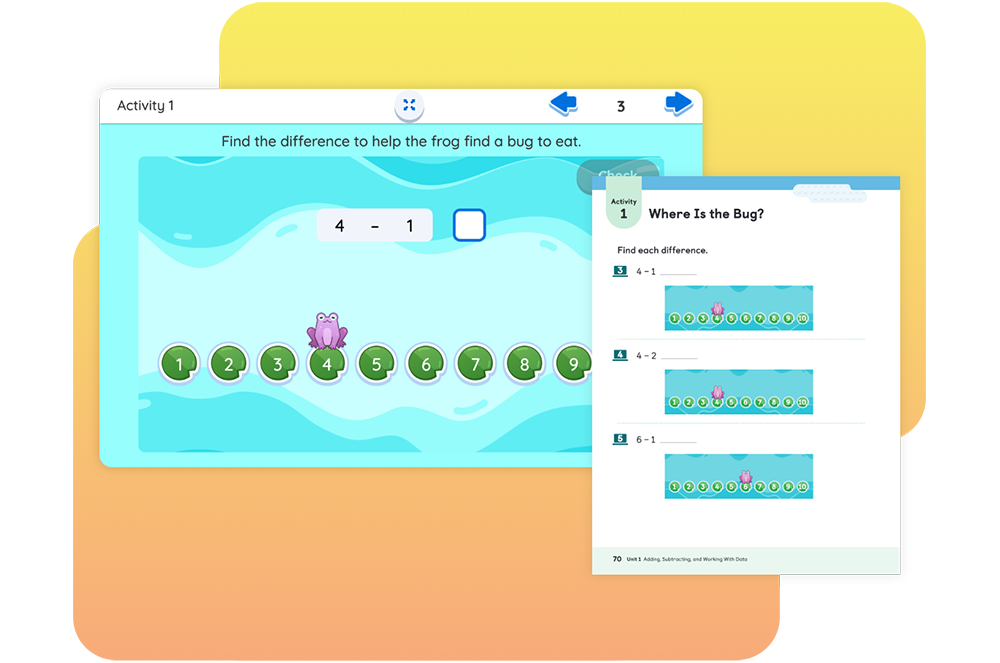
Interactive math activity for kids featuring a frog and number line for subtraction problems, asking to find differences to locate bugs.

In this lesson, students find differences when subtracting 1 and 2 from the same number by helping a frog reach a lily pad where it can eat a bug.

A clear plastic box contains various math manipulatives, including counting cubes, geometric shapes, rulers, and dice, displayed outside the box.
Hands-on manipulative kit

An optional add-on to your Amplify Desmos Math California program, the manipulative kit provides hands-on learning tools designed to simplify and illustrate complex mathematical concepts.

A curriculum overview for Grade 2 in New York Math displaying 8 units, including topics like comparisons, addition, subtraction, and geometric shapes, with details on the number of instructional and assessment days. This plan integrates resources from Amplify Desmos Math to enrich learning experiences.
Program structure

Get to know the content and structure of Grade 2 Amplify Desmos Math California.

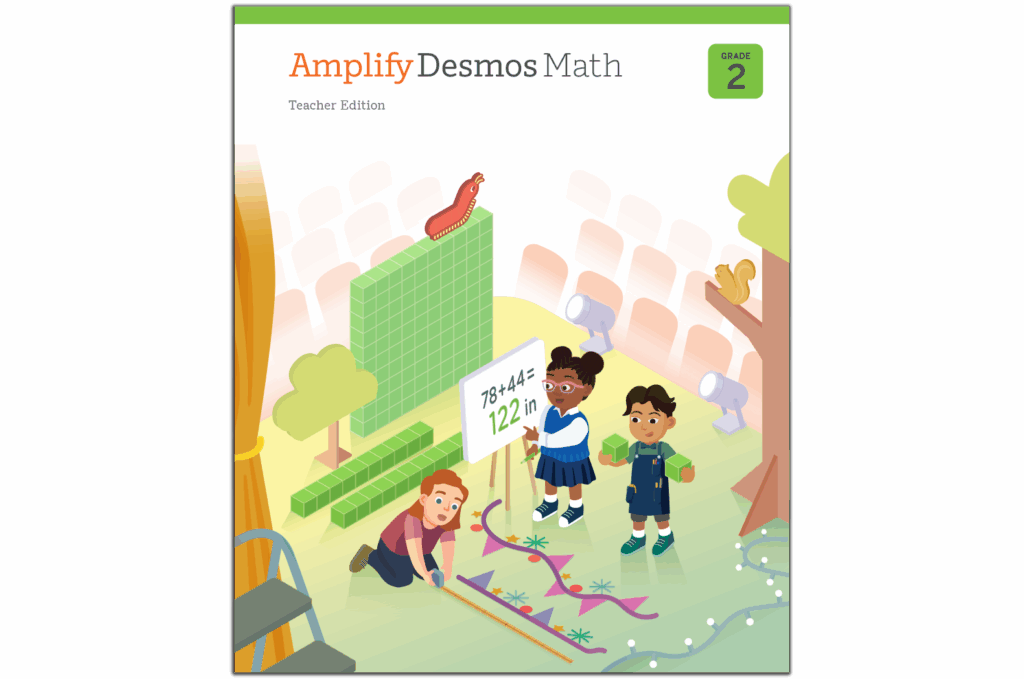
Cover of the "Amplify Desmos Math" Grade 2 Teacher Edition, showcasing children measuring with rulers and a poster displaying a mathematical equation, set against whimsical scenery with a colorful dragon. Perfect for New York math classrooms.
Teacher Edition pages

Planning and instructional guidance is visual, organized, and easy-to-follow. To help you review the program, we have included samples from a complete sub-unit on this site: Unit 2, Sub-Unit 1: Adding and Subtracting.

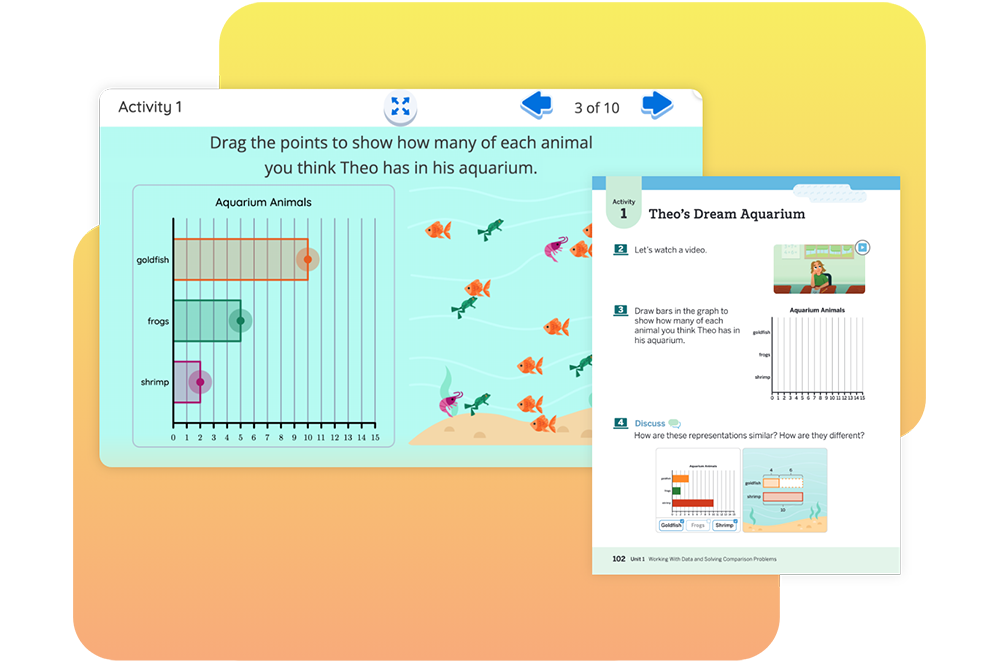
Two digital worksheets about Theo's aquarium with tasks to estimate animal quantities using draggable graphs and illustrations of fish, frogs, and shrimps.
Digital experience

Explore our digital experience! Every lesson in Amplify Desmos Math California has student print materials and digital recommendations.

Cover of "Amplify Desmos Math Student Edition 2" showing three children performing a New York math activity with blocks and measurements.
Student Edition pages

Motivate students with mathematics that is both rigorous and delightful.

Cover of an educational book titled "Amplify Desmos Math Grade 2 Centers Resources" featuring a green "C" on a light green background, perfect for enhancing New York math education.
Centers Resources

Engaging, hands-on games for students to play collaboratively to strengthen their understanding of key skills and concepts.

Cover of "Amplify Desmos Math Grade 2: Intervention and Extension Resources" featuring a green numeral 1 on a light green background, aligning with the New York math standards.
Intervention and Extension Resources

Additional resources to reinforce and extend key concepts, including Mini-Lessons and Extensions.

Educational activity on a screen showing a worm and blocks with numbers. Another page shows an activity titled "Finding the Missing Pair," with numbered options and a video prompt.

Students continue to develop fluency by finding the number that makes 10 by helping a millipede reach its favorite food – a clump of leaves!

A clear plastic box contains various math manipulatives, including counting cubes, geometric shapes, rulers, and dice, displayed outside the box.
Hands-on manipulative kit

An optional add-on to your Amplify Desmos Math California program, the manipulative kit provides hands-on learning tools designed to simplify and illustrate complex mathematical concepts.

An educational curriculum outline for Grade 3 with seven units covering various mathematics topics, including multiplication, shapes, fractions, and measurement. Suggested instructional days are provided. The New York Math approach ensures a thorough understanding of each concept.
Program structure

Get to know the content and structure of Grade 3 Amplify Desmos Math California.

Cover of a "Grade 3 Amplify Desmos Math Teacher Edition" book, featuring a cutaway building with diverse students and a teacher working on New York math problems and organizing materials.
Teacher Edition pages

Planning and instructional guidance is visual, organized, and easy-to-follow. To help you review the program, we have included samples from a complete sub-unit on this site: Unit 2, Sub-Unit 1: Concepts of Area Measurement.

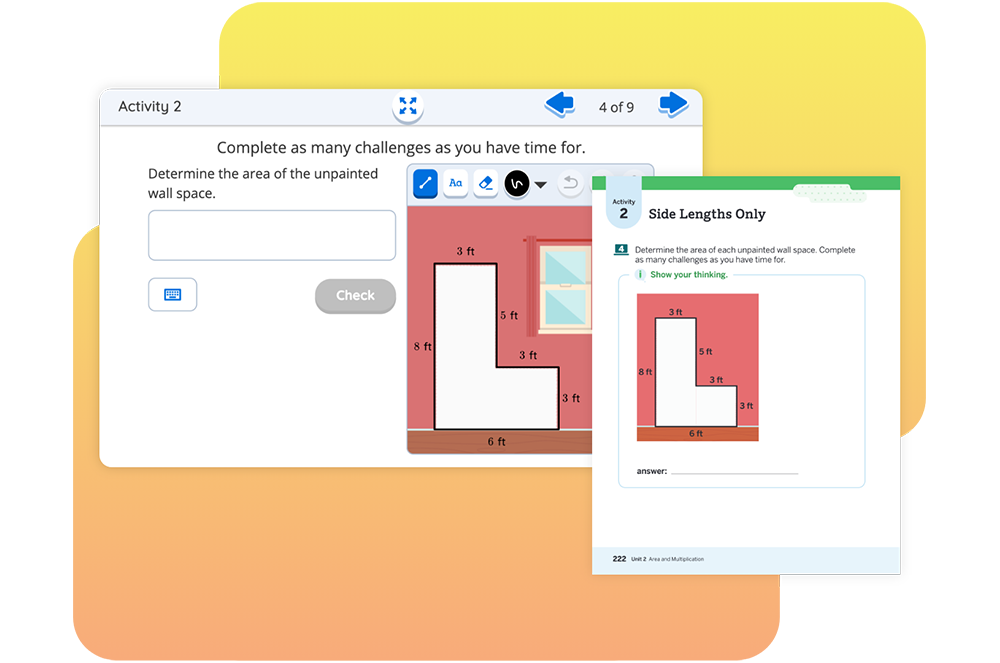
Math activity screenshot showing a problem to calculate the area of an unpainted wall space with given side lengths in a room diagram.
Digital experience

Explore our digital experience! Every lesson in Amplify Desmos Math California has student print materials and digital recommendations.

Cover of "Amplify Desmos Math Student Edition 3" showcasing illustrated children engaged in various mathematical activities inside a glass house structure, reflecting the dynamic energy of New York math.
Student Edition pages

Motivate students with mathematics that is both rigorous and delightful.

Cover of the Amplify Desmos Math Grade 3 Centers Resources book, featuring a 3D letter "C" in blue and white on a minimalistic background, perfect for aligning with New York math standards.
Centers Resources

Engaging, hands-on games for students to play collaboratively to strengthen their understanding of key skills and concepts.

Cover of an "Amplify Cover of the "Amplify Desmos Math" Grade 3 book featuring intervention and extension resources, with a blue geometric "I" on a light blue background, aligning with New York Math standards.
Intervention and Extension Resources

Additional resources to reinforce and extend key concepts, including Mini-Lessons and Extensions.

Activity sheets showing a bar graph and a table for counting animal stickers: 7 rabbits, 5 raccoons, and 2 foxes. Includes instructions for arranging data points on a graph.

Students compare data represented on bar graphs with different scales by using animal stickers to create scaled bar graphs.

A clear plastic box contains various math manipulatives, including counting cubes, geometric shapes, rulers, and dice, displayed outside the box.
Hands-on manipulative kit

An optional add-on to your Amplify Desmos Math California program, the manipulative kit provides hands-on learning tools designed to simplify and illustrate complex mathematical concepts.

A course outline for Algebra 1 with 8 units, each detailing the number of instructional and optional days. The total suggested instructional days are 144 and 28 optional days, aligning with New York Math standards.
Program structure

Get to know the content and structure of Grade 4 Amplify Desmos Math California.

Cover of "Amplify Desmos Math: Teacher Edition Grade 4" showing children learning New York Math outdoors, using large mathematical tools and numbers, with one child in a wheelchair.
Teacher Edition pages

Planning and instructional guidance is visual, organized, and easy-to-follow. To help you review the program, we have included samples from a complete sub-unit on this site: Unit 2, Sub-Unit 1: Size and Location of Fractions.

Screenshot of a digital math activity showing a fraction number line task with a log-cutting visual and an instruction page titled "Locating Fractions.
Digital experience

Explore our digital experience! Every lesson in Amplify Desmos Math California has student print materials and digital recommendations.

Cover of "Amplify Desmos Math, Student Edition, Grade 4," showcasing students collaborating on math problems involving shapes and numbers against a vibrant backdrop that blends cityscapes and natural scenery, capturing the essence of New York math learning.
Student Edition pages

Motivate students with mathematics that is both rigorous and delightful.

Cover of the "Amplify Desmos Math" Grade 4 Centers Resources book, featuring a large, stylized blue letter "C" on a light blue background. This essential resource for New York math educators ensures engaging and effective instruction.
Centers Resources

Engaging, hands-on games for students to play collaboratively to strengthen their understanding of key skills and concepts.

Cover of "Amplify Desmos Math, Grade 4: Intervention and Extension Resources," featuring a geometric illustration and a blue and orange color scheme inspired by New York math standards.
Intervention and Extension Resources

Additional resources to reinforce and extend key concepts, including Mini-Lessons and Extensions.

An educational activity displays a drag-and-drop task to determine platform heights using tube lengths, showing a room scene and instructions on a digital interface.

Students choose tube lengths to connect to platform heights for hamster homes, identifying possible heights using what they know about multiples.

A clear plastic box contains various math manipulatives, including counting cubes, geometric shapes, rulers, and dice, displayed outside the box.
Hands-on manipulative kit

An optional add-on to your Amplify Desmos Math California program, the manipulative kit provides hands-on learning tools designed to simplify and illustrate complex mathematical concepts.

A Grade 5 curriculum scope and sequence chart with units covering volume, fractions, multiplication, shapes, place value, and measurement. Each unit lists instructional and assessment days to amplify Desmos Math activities.
Program structure

Get to know the content and structure of Grade 5 Amplify Desmos Math California.

Illustration of three students engaging with various math activities outdoors and around large blocks. Text at the top reads "Amplify Desmos Math, Grade 5, Teacher Edition" - a perfect resource for New York math educators.
Teacher Edition pages

Planning and instructional guidance is visual, organized, and easy-to-follow. To help you review the program, we have included samples from a complete sub-unit on this site: Unit 2, Sub-Unit 1: Fractions as Quotients.

Activity worksheet and digital screen showing a panda on a cliff, with instructions about placing a missing bamboo shoot to help it reach the leaf.
Digital experience

Explore our digital experience! Every lesson in Amplify Desmos Math California has student print materials and digital recommendations.

Cover of "Amplify Desmos Math: Student Edition, Grade 5" featuring students engaged in various mathematical activities outside, such as block building, measuring, and gardening—a perfect resource aligning with New York math standards.
Student Edition pages

Motivate students with mathematics that is both rigorous and delightful.

Cover image of "Amplify Desmos Math Grade 5 Centers Resources" featuring a large purple letter C on a light purple background, showcasing the innovative approach of Amplify Desmos Math that's making waves in New York math education.
Centers Resources

Engaging, hands-on games for students to play collaboratively to strengthen their understanding of key skills and concepts.

Cover of "Amplify Desmos Math Grade 5: Intervention and Extension Resources," featuring a large, stylized number five in purple against a light purple background with minimal geometric patterns, ideal for New York math curriculum support.
Intervention and Extension Resources

Additional resources to reinforce and extend key concepts, including Mini-Lessons and Extensions.

Screen showing a student activity about decomposing a figure into prisms, with a drag-and-drop exercise and an adjacent worksheet labeled "Seeing Prisms.

Students decompose a figure into rectangular prisms and determine the volume of the figure by adding the volumes of the individual prisms.

A clear plastic box contains various math manipulatives, including counting cubes, geometric shapes, rulers, and dice, displayed outside the box.
Hands-on manipulative kit

An optional add-on to your Amplify Desmos Math California program, the manipulative kit provides hands-on learning tools designed to simplify and illustrate complex mathematical concepts.

6–A1 sample materials

Click the links in the drop-down sections below to explore sample materials from each grade. 

For helpful navigation tips and more program information, download the Amplify Desmos Math Program Guide.

You can also watch a product expert walk through a lesson and the available program components.

Laptop showing a math activity with geometric shapes. Two textbooks titled "Amplify Desmos Math" are displayed above.
An educational document titled "Scope and Sequence" for Grade 6 math, designed in collaboration with Amplify Desmos Math, outlining six units with instructional and optional days for topics such as fractions, integers, and expressions.
Program structure

Get to know the content and structure of Grade 6 Amplify Desmos Math California.

Cover of the Grade 6 Amplify Desmos Math Teacher Edition, showcasing students engaging in various mathematical activities around a balance scale with variables, inspired by New York math educational standards.
Teacher Edition pages

Planning and instructional guidance is visual, organized, and easy-to-follow. To help you review the program, we have included samples from three sub-units on this site: Unit 1, Sub-Unit 1: Area; Unit 3, Sub-Unit 1: Units and Measurement; and Unit 6, Sub-Unit 1: Solving Equations.

A digital activity showing two model trains on a track with a question about speed. A printed page on the right is titled "Model Trains" with warm-up instructions.
Digital experience

Explore our digital experience! Every lesson in Amplify Desmos Math California has student print materials and digital recommendations.

Cover of “Amplify Desmos Math, Student Edition, Grade 6” featuring an illustration of children engaging in various New York math-related activities outdoors.
Student Edition pages

Motivate students with mathematics that is both rigorous and delightful.

Cover image of "Amplify Desmos Math" for Grade 6, featuring a 3D pink letter "I" and the text "Intervention and Extension Resources." This New York math edition supports students with comprehensive resources.
Intervention and Extension Resources

Additional resources to reinforce and extend key concepts, including Mini-Lessons and Extensions.

A digital illustration of math balancing scales featuring boxes and a fox, alongside a worksheet displaying similar content and activities for learning math concepts.

Students use equations and tape diagrams to represent seesaw situations and to determine unknown animal weights, helping them make connections between diagrams that represent equations of the form `x+p=q` or `px=q`.

A clear plastic storage box filled with educational math manipulatives, including colorful blocks, shapes, measuring tools, and counting cubes displayed outside the box.
Hands-on manipulative kit

An optional add-on to your Amplify Desmos Math California program, the manipulative kit provides hands-on learning tools designed to simplify and illustrate complex mathematical concepts.

A Grade 7 math curriculum outline, featuring units on scale drawings, proportional relationships, measuring circles, rational numbers, operations, equations, angles, area, and probability with sequencing and days allocated. Perfectly aligned with Amplify Desmos Math for New York Math standards.
Program structure

Get to know the content and structure of Grade 7 Amplify Desmos Math California.

Cover image of "Amplify Desmos Math Teacher Edition Grade 7" featuring an illustration of students engaging in math-related activities with geometric shapes and construction elements against a New York cityscape background.
Teacher Edition pages

Planning and instructional guidance is visual, organized, and easy-to-follow. To help you review the program, we have included samples from three sub-units on this site: Unit 1, Sub-Unit 1: Scaled Copies; Unit 4, Sub-Unit 1: Percentages as Proportional Relationships; and Unit 6, Sub-Unit 1: Equations and Tape Diagrams.

Activity page showing a grid for shape creation with an area of 8 square centimeters. Includes shape options and instructions on rotation. A booklet page displays area challenges and warm-up tasks.
Digital experience

Explore our digital experience! Every lesson in Amplify Desmos Math California has student print materials and digital recommendations.

Cover of "Amplify Desmos Math, Student Edition, Grade 7" showing students engaged in math activities against a cityscape reminiscent of New York, with purple geometric structures and a crane in the background.
Student Edition pages

Motivate students with mathematics that is both rigorous and delightful.

Cover of "Amplify Desmos Math: Grade 7 – Intervention and Extension Resources" featuring a stylized 3D "I" on a light purple background, ideal for both New York math and national curricula.
Intervention and Extension Resources

Additional resources to reinforce and extend key concepts, including Mini-Lessons and Extensions.

Screenshot of an educational website showing a math activity featuring a sheep named Shira. There is a graph and a worksheet on inequalities displayed.

Students solve inequalities with positive and negative coefficients to solve a variety of challenges featuring a fictional sheep who eats grass according to an inequality.

A clear plastic storage box filled with educational math manipulatives, including colorful blocks, shapes, measuring tools, and counting cubes displayed outside the box.
Hands-on manipulative kit

An optional add-on to your Amplify Desmos Math California program, the manipulative kit provides hands-on learning tools designed to simplify and illustrate complex mathematical concepts.

Grade 8 math curriculum chart featuring 9 units, such as Rigid Transformations and Congruence, with Suggested Instructional days. Each unit outlines instructional days, assessment days, and optional days—complemented by insights from Amplify Desmos Math to enhance your New York math learning experience.
Program structure

Get to know the content and structure of Grade 7 Amplify Desmos Math California.

Illustration of children engaging in learning activities outdoors near a large slide. The title "Amplify Desmos Math Grade 8 Teacher Edition" is shown at the top, highlighting its relevance to New York math curriculum standards.
Teacher Edition pages

Planning and instructional guidance is visual, organized, and easy-to-follow. To help you review the program, we have included samples from three sub-units on this site: Unit 1, Sub-Unit 1: Rigid Transformations; Unit 3, Sub-Unit 2: Linear Relationships; and Unit 6, Sub-Unit 2: Analyzing Numerical Data.

Image of a digital math activity titled "Line Capture #2" featuring a grid, equations, and instructions. A paper worksheet with graphs and a "Line Zapper" title is displayed alongside.
Digital experience

Explore our digital experience! Every lesson in Amplify Desmos Math California has student print materials and digital recommendations.

Cover of the "Amplify Desmos Math" Student Edition for Grade 8, featuring students engaging in various mathematical activities in a stylized outdoor New York setting.
Student Edition pages

Motivate students with mathematics that is both rigorous and delightful.

Cover of "Amplify Desmos Math Grade 8: Intervention and Extension Resources" featuring a stylized "I" on a gray background, tailored for New York math standards.
Intervention and Extension Resources

Additional resources to reinforce and extend key concepts, including Mini-Lessons and Extensions.

An educational worksheet on robots, featuring a graph with red, purple, and blue robot icons, and instructions for a warm-up activity.

Students connect points on a scatter plot with individuals in a population and rows of data in a table. The analysis of scatter plots continues with data about the eye distances and heights of robots.

A clear plastic storage box filled with educational math manipulatives, including colorful blocks, shapes, measuring tools, and counting cubes displayed outside the box.
Hands-on manipulative kit

An optional add-on to your Amplify Desmos Math California program, the manipulative kit provides hands-on learning tools designed to simplify and illustrate complex mathematical concepts.

A course outline for Algebra 1 with 8 units, each detailing the number of instructional and optional days. The total suggested instructional days are 144 and 28 optional days, aligning with New York Math standards.
Program structure

Get to know the content and structure of Algebra 1 Amplify Desmos Math California.

Cover of "Amplify Desmos Math: Algebra 1, Teacher Edition" featuring diverse characters engaged in mathematical activities, with a graph and a bridge in the background, illustrating the vibrant energy of New York math.
Teacher Edition pages

Planning and instructional guidance is visual, organized, and easy-to-follow. To help you review the program, we have included samples from two complete sub-units on this site: Unit 2, Sub-Units 1–2: One-Variable Equations and Multi-Variable Equations.

A digital educational interface shows a graph with data points and textual instructions comparing year and breeding pairs. Adjacent is a page discussing penguin populations with charts and illustrations.
Digital experience

Explore our digital experience! Every lesson in Amplify Desmos Math California has student print materials and digital recommendations.

Cover of "Amplify Desmos Math" Student Edition A1, featuring an illustration of diverse characters engaging in New York math activities against a backdrop of graphs and mathematical concepts.
Student Edition pages

Motivate students with mathematics that is both rigorous and delightful.

A digital math activity screen showing block arrangements and a worksheet page titled "Shelley the Snail" with related graphics.

Students represent the solutions of a situation using a table, a graph, and multiple forms of an equation to identify multiple combinations of blocks that can help Shelley the Snail cross a gap.

Contact us

For questions, samples, or more information, please contact your local Amplify Account Executive:

Erin King
Sales Director, CA
(512) 736-3162
eking@amplify.com

Northern CA
Wendy Garcia
Senior Account Executive
(510) 368-7666
wgarcia@amplify.com

Bay Area
Lance Burbank
Account Executive
(415) 830-5348
lburbank@amplify.com

Central Valley and Central Coast
Demitri Gonos
Senior Account Executive
(559) 355-3244
dgonos@amplify.com

Ventura and L.A. County
Jeff Sorenson
Associate Account Executive
(310) 902-1407
jsorenson@amplify.com

Orange and L.A. County
Lauren Sherman
Senior Account Executive
(949) 397-5766
lsherman@amplify.com

San Bernardino and L.A. County
Michael Gruber
Senior Account Executive
(951) 520-6542
migruber@amplify.com

Riverside and L.A. County
Brian Roy
Account Executive
(818) 967-1674
broy@amplify.com

San Diego County
Kirk Van Wagoner
Senior Account Executive
(760) 696-0709
kvanwagoner@amplify.com

Under 2300 students in Bay Area, Sacramento Valley, and Northern Counties
Kevin Mauser
Lead Account Executive
(815) 534-0148
kmauser@amplify.com

Under 2300 students in Southern CA, Central Coast, and Southern Central Valley Counties
Charissa Snyder
Account Executive
(720) 936-6802
chsnyder@amplify.com

Request additional samples.

Ready to learn more? Connect with an Amplify Desmos Math California expert to request additional program samples.

Amplify Desmos Math for Washoe County

To view this protected page, enter the password below:


A closer look at grades 6–8

Amplify Science is based on the latest research on teaching and learning and helps teachers deliver rigorous and riveting lessons through hands-on investigations, literacy-rich activities, and interactive digital tools that empower students to think, read, write, and argue like real scientists.

In the 6–8 classroom, this looks like students:

  • Collecting evidence from a variety of sources.
  • Making sense of evidence in a variety of ways.
  • Formulating convincing scientific arguments.

Is your school implementing the domain model? Click here.

Collage of four images showing children engaged in educational activities such as conducting experiments and crafting in a classroom setting.
A four-step process diagram: Spark intrigue, Explore evidence, Explain and elaborate, and Evaluate claims, connected by arrows, with an engagement statement below.

Program structure

Our cyclical lesson design ensures students receive multiple exposures to concepts through a variety of modalities. As they progress through the lessons within a unit, students build and deepen their understanding, increasing their ability to develop and refine complex explanations of the unit’s phenomenon.

It’s this proven program structure and lesson design that enables Amplify Science to teach less, but achieve more. Rather than asking teachers to wade through unnecessary content, we designed our 6–8 program to address 100% of the NGSS in fewer lessons than other programs.

Scope and sequence

Every year our grades 6–8 sequence consists of 9 units, with each unit containing 10–19 lessons. Lessons are written to last a minimum of 45-minutes, though teachers can expand or contract the timing to meet their needs.
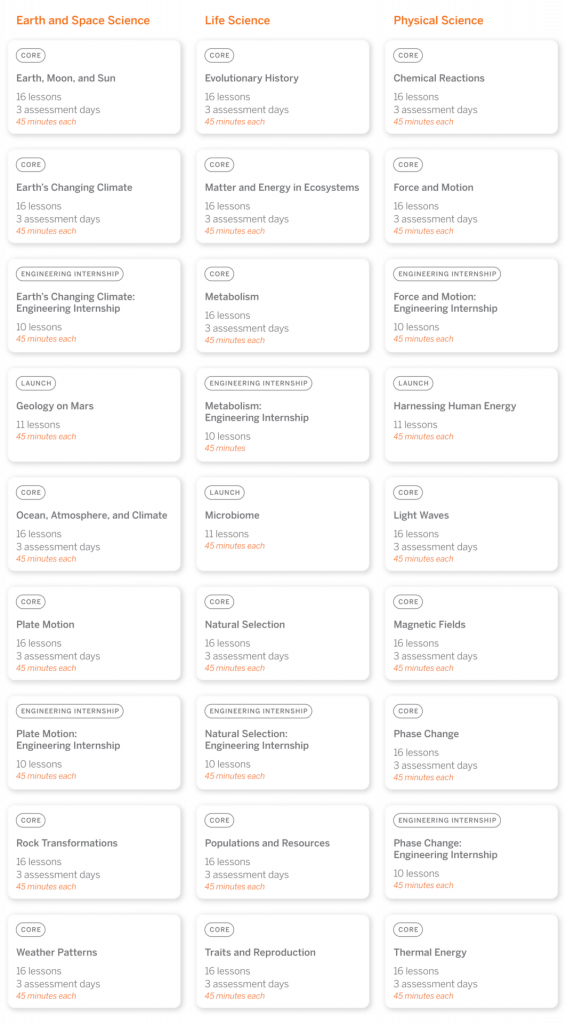
A grid of educational icons, each representing a different science topic, such as earth and space science, life science, and physical science, with titles and lesson counts.

Unit types

Each unit delivers three-dimensional learning experiences and engages students in gathering evidence from a rich collection of sources, while also serving a unique purpose.

In grades 6–8, there are three types of units:

  • One unit is a launch unit.
  • Three units are core units.
  • Two units are engineering internships.
Launch units

Launch units are the first units taught in each year of Amplify Science. The goal of the Launch unit is to introduce students to norms, routines, and practices that will be built on throughout the year, including argumentation, active reading, and using the program’s technology. For example, rather than taking the time to explain the process of active reading in every unit in a given year, it is explained thoroughly in the Launch unit, thereby preparing students to read actively in all subsequent units.

Core units

Core units establish the context of the unit by introducing students to a real-world problem. As students move through lessons in a Core unit, they figure out the unit’s anchoring phenomenon, gain an understanding of the unit’s disciplinary core ideas and science and engineering practices, and make linkages across topics through the crosscutting concepts. Each Core unit culminates with a Science Seminar and final writing activity.

Engineering Internship units

Engineering Internship units invite students to design solutions for real-world problems as interns for a fictional company called Futura. Students figure out how to help those in need, from tsunami victims in Sri Lanka to premature babies, through the application of engineering practices. In the process, they apply and deepen their learning from Core units.

Units at a glance
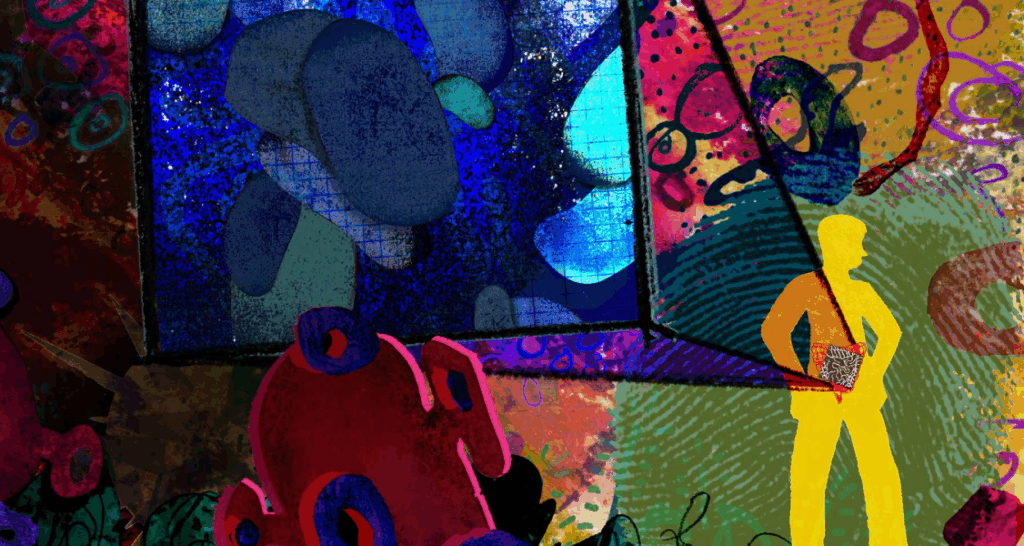
Abstract digital artwork featuring a yellow human figure, red shapes, and a blue-toned screen, with vibrant, multicolored patterns and textures in the background.
Microbiome

Domain: Life Science

Unit type: Launch

Student role: Microbiological researchers

Phenomenon: The presence of 100 trillion microorganisms living on and in the human body may keep the body healthy.  
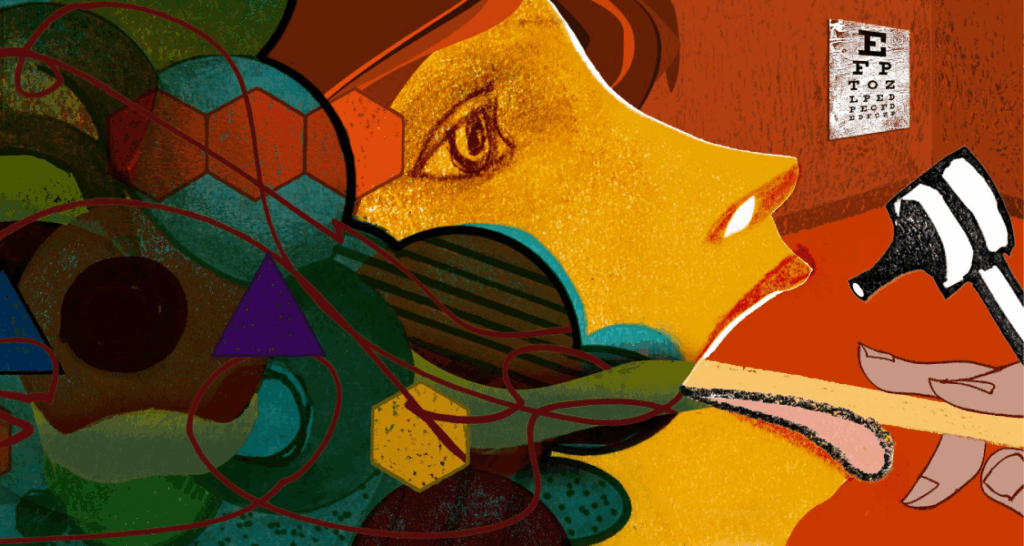
An abstract illustration of a person receiving an oral examination, with colorful geometric shapes and an eye chart in the background.
Metabolism

Domain: Life Science

Unit type: Core

Student role: Medical researchers

Phenomenon: Elisa, a young patient, feels tired all the time.  

Abstract orange background with geometric shapes, featuring icons of a vest, bar chart, leaf, beaker, fruit, medical stethoscope, and an envelope within a hexagonal frame.
Metabolism Engineering Internship

Domains: Life Science, Engineering Design

Unit type: Engineering internship

Student role: Food engineers

Phenomenon: Designing health bars with different molecular compositions can effectively meet the metabolic needs of patients or rescue workers.  
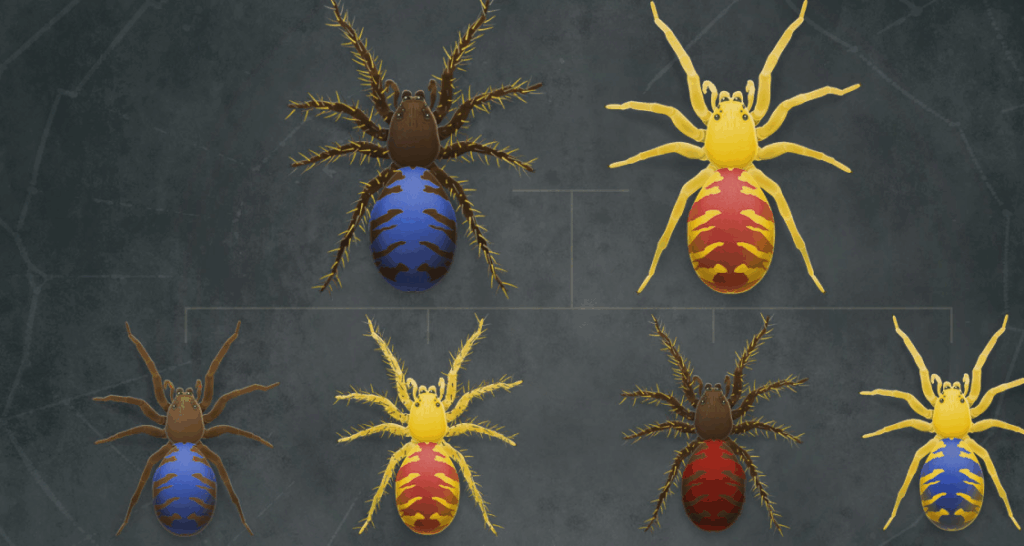
Six spiders with varying body colors (brown, yellow, blue, and red) and patterns are arranged on a dark, textured background, seemingly in a diagram or chart formation.
Traits and Reproduction

Domain: Life Science

Unit type: Core

Student role: Biomedical students

Phenomenon: Darwin’s bark spider offspring have different silk flexibility traits, even though they have the same parents.  

Illustration of a person with closed eyes in a red winter coat and hat, surrounded by falling snow and orange circles on a dark background.
Thermal Energy

Domain: Physical Science

Unit type: Core

Student role: Thermal scientists

Phenomenon: One of two proposed heating systems for Riverdale School will best heat the school. 

Abstract illustration of a sun with blue and orange rays over a colorful landscape featuring green hills and a vibrant sky.
Ocean, Atmosphere, and Climate

Domains: Earth and Space Science, Physical Science

Unit type: Core

Student role: Climatologists

Phenomenon: During El Niño years, the air temperature in Christchurch, New Zealand is cooler than usual.  

Illustration of clouds above a small town and farmland, with wind currents depicted swirling through the landscape under a blue sky.
Weather Patterns

Domains: Earth and Space Science, Physical Science

Unit type: Core

Student role: Forensic meteorologists

Phenomenon: In recent years, rainstorms in Galetown have been unusually severe.  

A polar bear stands on a small floating ice sheet in the ocean, surrounded by melting ice, with a red sun in the sky.
Earth’s Changing Climate

Domains: Earth and Space Science, Life Science

Unit type: Core

Student role: Climatologists

Phenomenon: The ice on Earth’s surface is melting.  

A purple hexagonal graphic with icons including a building, wrench, screwdriver, sun, molecules, paint bucket, and tiles on a geometric patterned background.
Earth’s Changing Climate Engineering Internship

Domains: Earth and Space Science, Engineering Design

Unit type: Engineering internship

Student role: Civil engineers

Phenomenon: Designing rooftops with different modifications can reduce a city’s impact on climate change.  
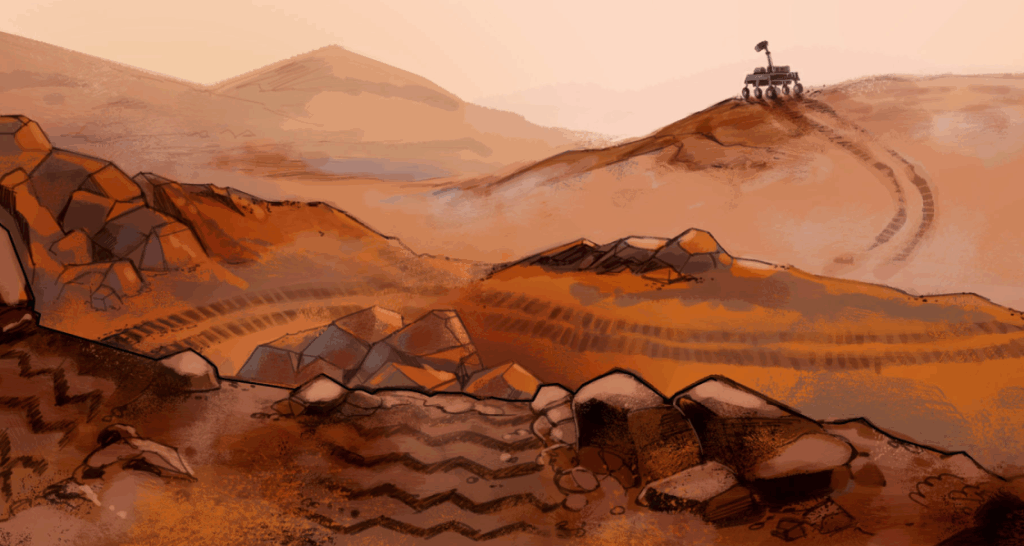
A robotic rover sits on a hill in a rocky, reddish landscape, with visible tracks in the dust leading to its current position under a hazy sky.
Geology on Mars

Domain: Earth and Space Science

Unit type: Launch

Student role: Planetary geologists

Phenomenon: Analyzing data about landforms on Mars can provide evidence that Mars may have once been habitable. 

Two green prehistoric reptiles with long snouts are near the shore; one is on land while the other swims in blue water, with plants, rocks, and an island in the background.
Plate Motion

Domain: Earth and Space Science

Unit type: Core

Student role: Geologists

Phenomenon: Mesosaurus fossils have been found on continents separated by thousands of kilometers of ocean, even though the Mesosaurus species once lived all together.  

A purple geometric background featuring a hexagonal badge with a telescope, mountain, audio wave, and star symbols inside.
Plate Motion Engineering Internship

Domains: Earth and Space Science, Engineering Design

Unit type: Engineering internship

Student role: Mechanical engineering interns

Phenomenon: Patterns in earthquake data can be used to design an effective tsunami warning system.  

Illustration showing an ocean, forest, and mountains with a smoking volcano, plus a cross-section of underground tectonic plates.
Rock Transformations

Domain: Earth and Space Science

Unit type: Core

Student role: Geologists

Phenomenon: Rock samples from the Great Plains and from the Rocky Mountains — regions hundreds of miles apart — look very different, but have surprisingly similar mineral compositions.  

Four stages of an orange popsicle melting on a stick, from fully frozen on the left to completely melted on the right, against a plain background.
Phase Change

Domains: Physical Science, Earth and Space Science

Unit type: Core

Student role: Chemists

Phenomenon: A methane lake on Titan no longer appears in images taken by a space probe two years apart

Green geometric background with an outlined hexagon containing icons: a parachute, ruler, letter "A," bandage, stacked blocks, and a folded corner paper.
Force and Motion Engineering Internship

Domains: Engineering Design, Physical Science

Unit type: Engineering internship

Student role: Chemical engineering interns

Phenomenon: Designing portable baby incubators with different combinations of phase change materials can keep babies at a healthy temperature. Domains: Engineering Design, Physical Science
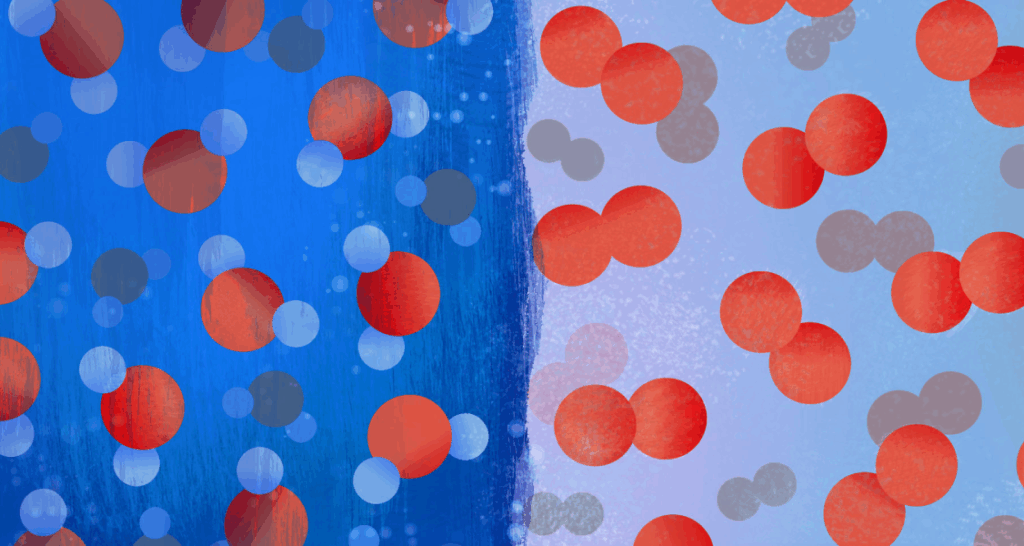
Abstract illustration showing red and blue circles on a split blue and light background, representing molecular movement across a membrane or barrier.
Chemical Reactions

Domains: Physical Science, Life Science, Earth and Space Science

Unit type: Core

Student role: Forensic chemists

Phenomenon: A mysterious brown substance has been detected in the tap water of Westfield.  

An underwater scene with a large whale surrounded by turtles, jellyfish, and various fish swimming in different directions.
Populations and Resources

Domains: Life Science, Earth and Space Science

Unit type: Core

Student role: Biologists

Phenomenon: The size of the moon jelly population in Glacier Sea has increased. 
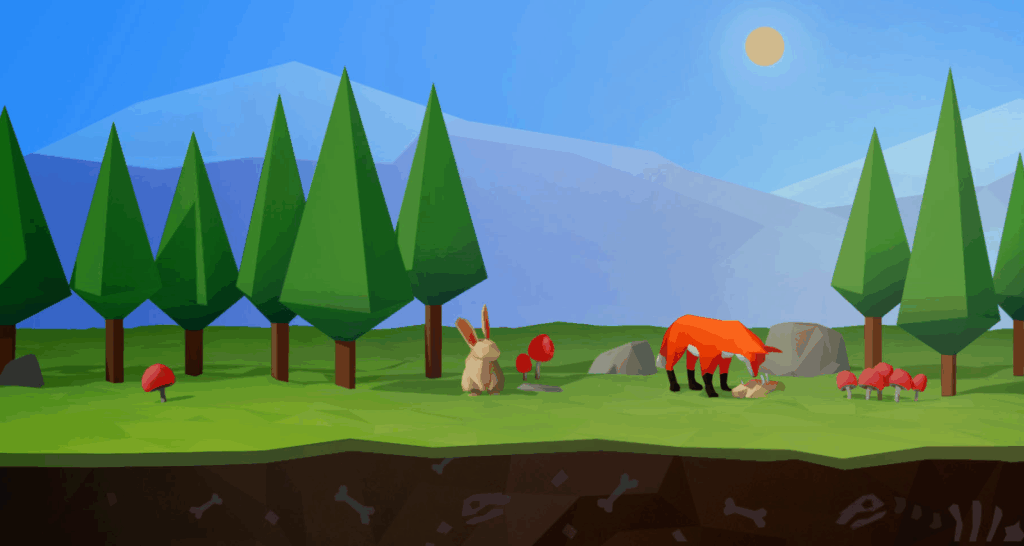
Low-poly digital illustration of a fox hunting a rabbit in a forest with pine trees, mushrooms, mountains, and the sun in the background. Another rabbit sits near the trees.
Matter and Energy in Ecosystems

Domains: Life Science, Earth and Space Science, Physical Science

Unit type: Core

Student role: Ecologists

Phenomenon: The biodome ecosystem has collapsed.  

Two people climb over rocks filled with electronic devices; inset illustrations show a boot, a belt of batteries, and a radio.
Harnessing Human Energy

Domains: Physical Science, Earth and Space Science, Engineering Design

Unit type: Launch

Student role: Energy scientists

Phenomenon: Rescue workers can use their own human kinetic energy to power the electrical devices they use during rescue missions.  

A spacecraft approaches and docks with a modular space station featuring large blue solar panels, set against a black space background.
Force and Motion

Domain: Physical Science

Unit type: Core

Student role: Physicists

Phenomenon: The asteroid sample-collecting pod failed to dock at the space station as planned.

Green graphic with hexagonal emblem showing an infant, a thermometer, layered materials, a medical symbol, and a flame icon.
Force and Motion Engineering Internship

Domains: Engineering Design, Physical Science

Unit type: Engineering internship

Student role: Chemical engineering interns

Phenomenon: Designing emergency supply delivery pods with different structures can maintain the integrity of the supply pods and their contents.

Illustration of a roller coaster car with passengers raising their arms as they descend a steep track against a blue sky with clouds.
Magnetic Fields

Domain: Physical Science

Unit type: Core

Student role: Physicists

Phenomenon: During a test launch, a spacecraft traveled much faster than expected.  

Illustration of the Earth with arrows representing radiation or energy entering the atmosphere from space, focused on the Asia-Pacific region.
Light Waves

Domains: Physical Science, Life Science, Earth and Space Science

Unit type: Core

Student role: Spectroscopists

Phenomenon: The rate of skin cancer is higher in Australia than in other parts of the world.

A city skyline at night with illuminated windows, a large full moon, stars in the sky, and a bridge visible on the left side.
Earth, Moon, and Sun

Domains: Earth and Space Science, Physical Science

Unit type: Core

Student role: Astronomers

Phenomenon: An astrophotographer can only take pictures of specific features on the Moon at certain times.  
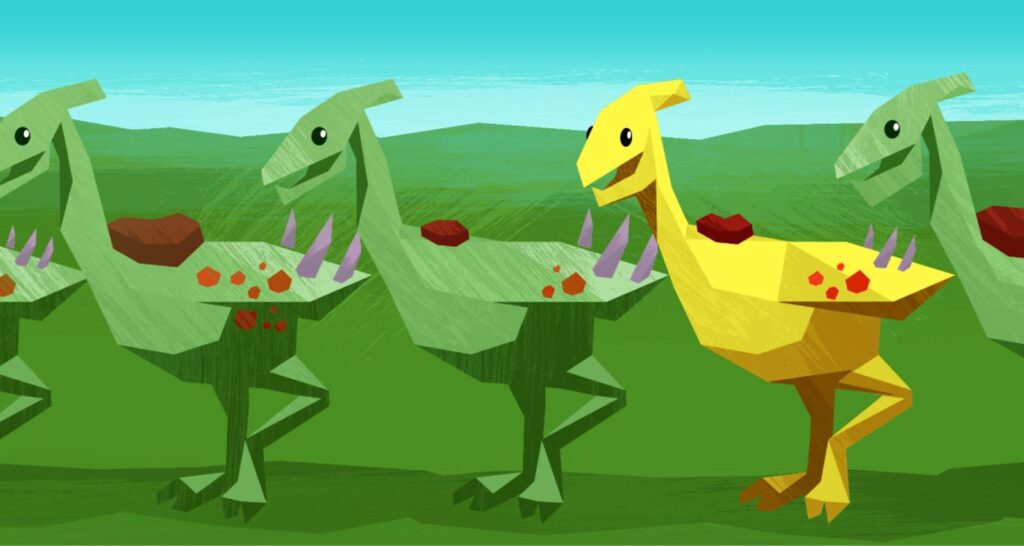
Four polygonal dinosaurs walking in a row, three green and one yellow, each with a rock and purple spikes on their backs, set against a grassy background with a blue sky.
Natural Selection

Domains: Life Science, Earth and Space Science

Unit type: Core

Student role: Biologists

Phenomenon: The newt population in Oregon State Park has become more poisonous over time.  

Red geometric background featuring a hexagonal emblem with icons of a world map, mosquito, DNA strand, bar chart, and interconnected blocks.
Natural Selection Engineering Internship

Domains: Engineering Design, Life Science

Unit type: Engineering internship

Student role: Clinical engineers

Phenomenon: Designing malaria treatment plans that use different combinations of drugs can reduce drug resistance development while helping malaria patients.  

Two tortoises with long necks are by a river; one is browsing leaves from a bush while the other is walking near the water's edge.
Evolutionary History

Domains: Life Science, Earth and Space Science

Unit type: Core

Student role: Paleontologists

Phenomenon: A mystery fossil at the Natural History Museum has similarities with both wolves and whales.    
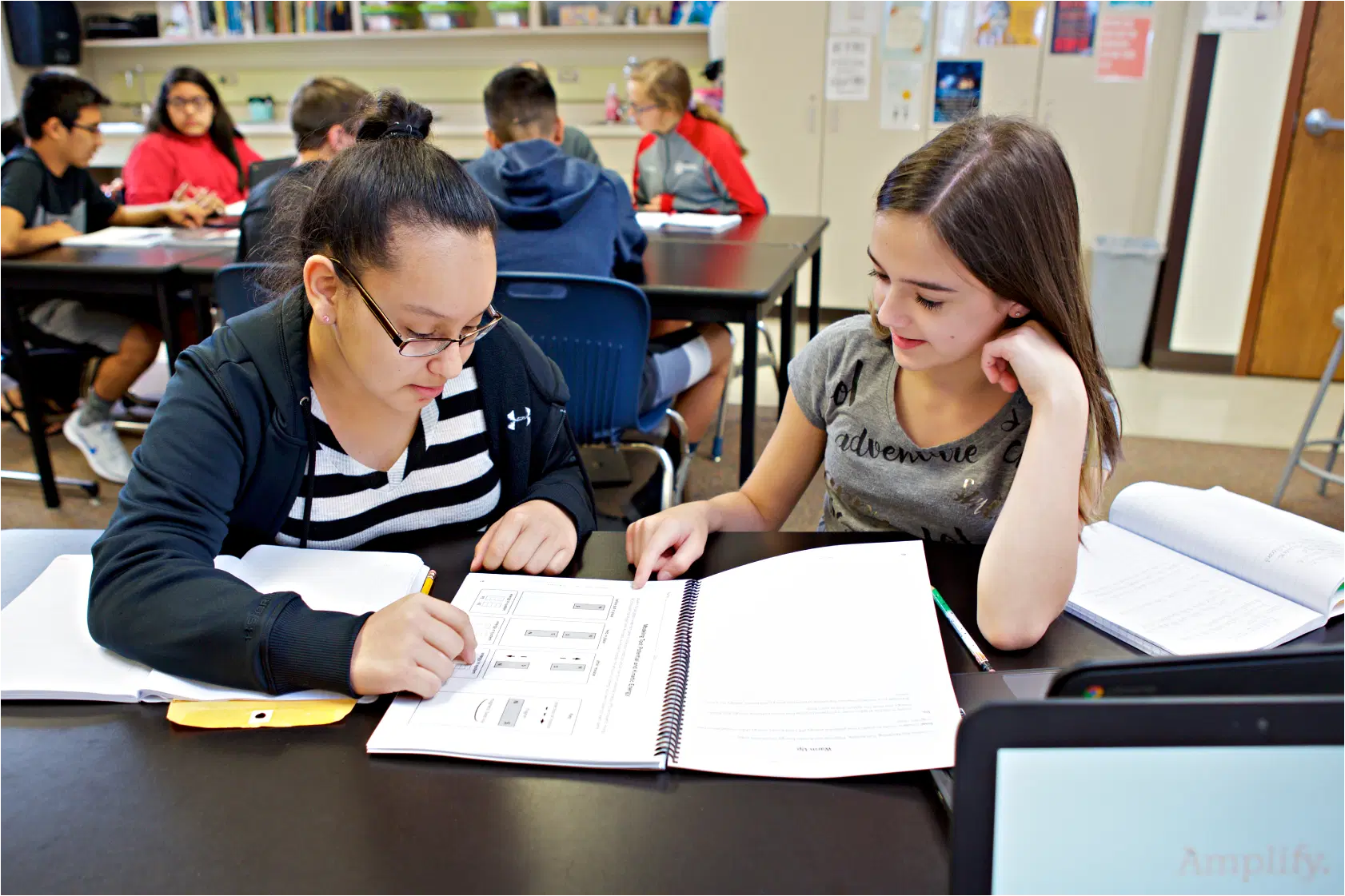
Grade 6

Chapter 1: Numerical Expressions and Factors

Big IdeasDesmos Math 6–A1
Lesson 1: Powers and ExponentsUnit 6
Lesson 10: Powers
Lesson 11: Exponent Expressions (Print available)
Practice Day 2 (Print available)
Lesson 2: Order of OperationsUnit 6
Lesson 11: Exponent Expressions (Print available)
Lesson 3: Prime Factorization
Lesson 4: Greatest Common FactorUnit 5
Lesson 15: Common factors
Lesson 5: Least Common MultipleUnit 5
Lesson 14: Common Multiples
Practice Day 2 (Print available)

Chapter 2: Fractions and Decimals

Lesson 1: Multiplying FractionsUnit 4
Lesson 12: Puzzling Areas (Print available) [Free lesson]
Lesson 13: Volume Challenges
Lesson 14: Planter Planner (Print available)
Lesson 2: Dividing FractionsUnit 4
Lesson 1: Cookie Cutter
Lesson 2: Making Connections (Print available)
Lesson 3: Flour Planner [Free lesson]
Lesson 4: Flower Planters
Practice Day (Print available)
Lesson 3: Dividing Mixed NumbersUnit 4
Lesson 5: Garden Bricks (Print available)
Lesson 7: Break It Down
Lesson 8: Potting Soil
Lesson 9: Division Challenges
Lesson 14: Planter Planner (Print available)
Practice Day
Lesson 4: Adding and Subtracting DecimalsUnit 5
Lesson 1: Dishing Out Decimals (Print available) [Free lesson]
Lesson 2: Decimal Diagrams [Free lesson]
Lesson 3: Fruit by the Pound
Lesson 4: Missing Digits
Lesson 5: Decimal Multiplication
Lesson 12: Budget Vehicles (Print available)
Lesson 5: Multiplying DecimalsUnit 5
Lesson 1: Dishing Out Decimals (Print available) [Free lesson]
Lesson 2: Decimal Diagrams 
Lesson 3: Fruit by the Pound
Lesson 4: Missing Digits
Lesson 5: Decimal Multiplication
Lesson 12: Budget Vehicles (Print available)
Practice Day 1 (Print available)
Practice Day 2 (Print available)
Lesson 6: Dividing Whole NumbersUnit 5
Lesson 8: Division Diagrams
Lesson 9: Long Division Launch
Lesson 10: Return of the Long Division (Print available)
Lesson 11: Movie Time [Free lesson] 
Lesson 12: Budget Vehicles (Print available)
Lesson 7: Dividing DecimalsUnit 5
Lesson 8: Division Diagrams
Lesson 9: Long Division Launch
Lesson 10: Return of the Long Division (Print available)
Lesson 11: Movie Time [Free lesson] 
Lesson 12:(Print available) Budget Vehicles 
Practice Day 1 (Print available)
Practice Day 2 (Print available)

Chapter 3: Ratios and Rates

Chapter 4: Percents

Chapter 5: Algebraic Expressions and Properties

Chapter 6: Equations

Chapter 7: Area, Surface Area, and Volume

Chapter 8: Integers, Number Lines, and the Coordinate Plane

Chapter 9: Statistical Measures

Chapter 10: Data Displays

Grade 7

Chapter 1: Adding and Subtracting Rational Numbers

Chapter 2: Multiplying and Dividing Rational Numbers

Lesson 1: Multiplying IntegersUnit 5
Lesson 6: Floating in Groups
Lesson 7: Back in Time
Lesson 8: Speeding Turtles
Lesson 10: Integer Puzzles [Free lesson]
Practice Day 2 (Print available)
Lesson 2: Dividing IntegersUnit 5
Lesson 8: Speeding Turtles
Lesson 3: Converting Between Fractions and DecimalsUnit 4
Lesson 13: Decimal Deep Dive (Print available)
Lesson 4: Multiplying Rational NumbersUnit 5
Lesson 7: Back in Time
Lesson 5: Dividing Rational NumbersUnit 5
Lesson 8: Speeding Turtles

Chapter 3: Expressions

Chapter 4: Equations and Inequalities

Chapter 5: Ratios and Proportions

Chapter 6: Percents

Chapter 7: Probability

Chapter 8: Statistics

Chapter 9: Geometric Shapes and Angles

Chapter 10: Surface Area and Volume

Lesson 1: Surface Area of Prisms
Lesson 2: Surface Area of Cylinders
Lesson 3: Surface Area of Pyramids
Unit 7
Lesson 10: Simple Prisms
Lesson 11: More Complicated Prisms
Lesson 12: Surface Area Strategies (Print available)
Lesson 13: Popcorn Possibilities
Lesson 4: Volumes of Prisms
Lesson 5: Volumes of Pyramids
Unit 7
Lesson 10: Simple Prisms
Lesson 11: More Complicated Prisms
Lesson 13: Popcorn Possibilities
Practice Day 2 (Print available)
Lesson 6: Cross Sections of Three-Dimensional FiguresUnit 7
Lesson 9: Slicing Solids

Grade 8

Chapter 1: Equations

Chapter 2: Transformations

Chapter 3: Angles and Triangles

Chapter 4: Graphing and Writing Linear Equations

Chapter 5: Systems of Linear Equations

Lesson 1: Solving Systems of Linear Equations by GraphingUnit 4
Lesson 8: When Are They the Same?
Lesson 9: On or Off the Line?
Lesson 10: On Both Lines
Lesson 11: Make Them Balance [Free lesson]
Lesson 12: Line Zapper [Free lesson]
Practice Day 2 (Print available)
Lesson 2: Solving Systems of Linear Equations by Substitution
Lesson 3: Solving Systems of Linear Equations by Elimination 
Lesson 4: Solving Special Systems of Linear Equations 
Lesson 6: Scale Drawings

Chapter 6: Data Analysis and Displays

Chapter 7: Functions

Lesson 1: Relations and FunctionsUnit 5
Lesson 1: Turtle Crossing [Free lesson]
Lesson 2: Guess My Rule [Free lesson]
Lesson 2: Representations of FunctionsUnit 5
Lesson 3: Function or Not?
Lesson 5: The Tortoise and the Hare [Free lesson]
Lesson 3: Linear FunctionsUnit 5
Lesson 6: Graphing Stories
Lesson 7: Feel the Burn (Print available) [Free lesson]
Lesson 8: Charge! (Print available)
Lesson 4: Comparing Linear and Nonlinear FunctionsUnit 5
Lesson 4: Window Frames
Lesson 5: Analyzing and Sketching GraphsUnit 5  
Lesson 6: Graphing Stories

Chapter 8: Exponents and Scientific Notation

Chapter 9: Real Numbers and the Pythagorean Theorem

Lesson 1: Finding Square RootsUnit 8
Lesson 2: From Squares to Roots
Lesson 3: Between Squares
Lesson 4: Root Down [Free lesson]
Lesson 2: The Pythagorean Theorem
Lesson 3: Finding Cube RootsUnit 8
Lesson 2: From Squares to Roots
Lesson 3: Between Squares
Lesson 4: Root Down [Free lesson]
Lesson 4: Rational Numbers 
Lesson 5: Irrational NumbersUnit 8
Lesson 14: Hit the Target
Lesson 6: The Converse of the Pythagorean TheoremUnit 8
Lesson 9: Make It Right

Chapter 10: Volume and Similar Solids

Welcome, Ellensburg, to Amplify Desmos Math!

Amplify Desmos Math K-5 thoughtfully combines conceptual understanding, procedural fluency, and application. Each lesson is designed to tell a story by posing problems that invite a variety of approaches before guiding students to synthesize their understanding of the learning goals.

Scroll to learn more about the program and explore sample materials.

About the program

We believe in math that motivates. Our structured approach to problem-based learning builds on students’ curiosity to develop lasting grade-level understandings for all students. 

The program motivates students with interesting problems they are eager to solve. Teachers can spend more time where it’s most impactful: creating a collaborative classroom of learners.

A powerful suite of math resources

Amplify Desmos Math combines the best of problem-based lessons, intervention, personalized practice, and assessments into a coherent and engaging experience for both students and teachers.  Feel free to explore our grade-level ancillary samplers to learn more about assessment and reporting, intervention, and differentiation:

Grade K Ancillary Sampler

Grade 1 Ancillary Sampler

Grade 2 Ancillary Sampler

Grade 3 Ancillary Sampler

Grade 4 Ancillary Sampler

Grade 5 Ancillary Sampler

A laptop displays a math problem with illustrated students and a virtual keyboard. Behind it, a chart shows percentages for a Math 2 Beginning-of-Year Screener assessment.

Assessment

mCLASS® Assessments, along with daily formative checks, measure not only what students know, but how they think. The asset-based assessment system provides teachers with targeted, actionable insights, linked to core and intervention resources. Visit our mClass Math site to learn more.

Two side-by-side math activities for children: on the left, a caterpillar-themed block challenge, and on the right, a worksheet for finding pairs that sum to 10. These exercises are fantastic ways to amplify children's engagement with math concepts.

Core instruction

Amplify Desmos Math lessons pair problems students are eager to solve with clear instructional moves for teachers. With low-floor, high-ceiling tasks every student can actively participate and be a part of the math community. Unit- and lesson-level core assessments give teachers data at their fingertips to guide and differentiate instruction.

A math lesson screen shows a toy sinking 5 meters into a pool. A textbox asks how many centimeters that is, with space for an answer and a "Try again" button. An avatar explains the question, using Desmos math tools to amplify understanding.

Differentiation

Personalized Learning activities help students access grade-level math through engaging, independent digital practice. Responsive Feedback adjusts to students’ work, providing item-level adaptivity to further support their learning and offer personalized differentiation. Visit our Boost Math site to learn more. 

Two pages from a New York math textbook on determining coordinates after a rotation. Includes sections on modeled review, guided practice, and teacher's notes, with diagrams and examples that amplify the learning experience.

Embedded intervention

Integrated resources like Mini-Lessons, Fluency Practice, and Math Adventures provide targeted intervention on a specific concept or skill connected to the daily lesson. Extensions are also available to stretch students’ understanding.

Multilingual Learners

To support multilingual/English learners, Amplify Desmos Math incorporates research-based Math Language Routines (MLRs) by providing language modality strategies like sentence frames where appropriate, both in the teacher language provided for each task and in the differentiation support section found throughout the program. For further information on math language development, please see pg. 82 of the Amplify Desmos Math Program Guide.

Una profesora con un polo rojo ayuda a una estudiante con cabello largo y rizado que está leyendo un libro en su escritorio en un salón de clases. En la pared detrás de ellos se exhiben carteles con temas educativos.

Review Resources

To support your review of Amplify Desmos Math here are links to important K-5 review resources:

Two women in an office setting are smiling while looking at a tablet. Various educational icons surround the image.

K-5 sample materials

Click the links in the drop-down sections below to explore sample materials from each grade.  To see sample student responses, please click on the Teacher Edition pages and scroll to “Sample Student Work” (first one is about 30 pages in) or click on Intervention and Extension resources.   

For helpful navigation tips and more program information, download the Amplify Desmos Math Program Guide.

You can also watch a product expert walk through a lesson and the available program components.

Digital educational material showing an activity named "Hamster Homes" involving tube length and platform heights for a hamster cage. Includes a diagram with platforms measuring 9 inches.
Screenshot of a kindergarten curriculum outline featuring units like Math in Our World, Numbers 1-10, Positions and Shapes, Understanding Addition, Making 10, and Shapes All Around Us. This comprehensive program utilizes New York Math standards to build foundational skills.
Program structure

Get to know the content and structure of Kindergarten Amplify Desmos Math.

Cover of Amplify Desmos Math Grade K Teacher Edition featuring three children playing with math-related objects and a group of rabbits sitting nearby, aligning with the engaging curriculum seen in New York math classrooms.
Teacher Edition pages

Planning and instructional guidance is visual, organized, and easy-to-follow. To help you review the program, we have included samples from a complete sub-unit on this site: Unit 2, Sub-Unit 1: Counting and Comparing Objects.

Educational activity screen displaying a blue backpack with icons, dot groups on the left, and a grid background. Prompt reads, "Look inside the backpack. Then choose the group with the same number of dots." A great tool to amplify Desmos math learning in line with New York math standards.
Digital experience

Explore our digital experience! Every lesson in Amplify Desmos Math has student print materials and digital recommendations.

Cover of "Amplify Desmos Math: Student Edition Kindergarten," featuring an illustration of three children playing with math-related toys. A group of small white animals, possibly hamsters, play nearby. The scene brilliantly captures the joy of New York math exploration for young learners.
Student Edition pages

Motivate students with mathematics that is both rigorous and delightful.

Cover of "Amplify Desmos Math Grade K Centers Resources" featuring a large, stylized red and pink "C" on a light pink background with simple geometric designs. This distinctive cover complements New York math curriculums with its engaging visual elements.
Centers Resources

Engaging, hands-on games for students to play collaboratively to strengthen their understanding of key skills and concepts.

Cover of "Amplify Desmos Math: Grade K." The title is displayed with a geometric "I" illustration in the center. Subtitle reads "Intervention and Extension Resources" on a pink and white background, ideal for New York math standards.
Intervention and Extension Resources

Additional resources to reinforce and extend key concepts, including Mini-Lessons and Extensions.

A digital activity screen, crafted in the style of Amplify Desmos Math, shows two paths with different quantities of mushrooms. The user is prompted to choose the path with more mushrooms. A bear is on the left side of the screen.

In this lesson, students apply their understanding of how to compare groups of images as they determine which group has more or fewer and then compare their strategies by guiding a bear through a path that has more mushrooms than the other.

Grade 1 math curriculum overview displaying six units with instructional and assessment days: counting, addition, subtraction, numbers to 10, comparing numbers, measuring length, and geometry—aligned with the New York Math standards.
Program structure

Get to know the content and structure of Grade 1 Amplify Desmos Math.

Children interact with math activities on a large tablet while observing fish illustrations. The text reads "Amplify Desmos Math Grade 1 Teacher Edition, aligned with New York Math standards.
Teacher Edition pages

Planning and instructional guidance is visual, organized, and easy-to-follow. To help you review the program, we have included samples from a complete sub-unit on this site: Unit 2, Sub-Unit 1: Story Problems in Maui.

A digital math exercise, amplified by Desmos Math, showcases a story problem about adding kalo plants with three illustrations and a filled-out number sentence 3 + 4 = 7. A "Check" button is present. This tool aligns perfectly with New York math standards.
Digital experience

Explore our digital experience! Every lesson in Amplify Desmos Math has student print materials and digital recommendations.

Illustration of three children engaged in math activities from the "Amplify Desmos Math: Student Edition 1" textbook. One child holds a number card, while the others manipulate counters and images, experiencing an exciting approach inspired by New York math techniques.
Student Edition pages

Motivate students with mathematics that is both rigorous and delightful.

Cover of "Amplify Desmos Math Centers Resources" for Grade 1, featuring a yellow and white 3D letter "C" on a light background.
Centers Resources

Engaging, hands-on games for students to play collaboratively to strengthen their understanding of key skills and concepts.

Cover of "Amplify Desmos Math, Grade 1: Intervention and Extension Resources" depicting a large, blocky number one and a yellow-themed design. Ideal for enhancing New York math curriculum.
Intervention and Extension Resources

Additional resources to reinforce and extend key concepts, including Mini-Lessons and Extensions.

An educational game screen, inspired by New York math standards, shows a subtraction problem, "4 - 1," with a frog moving along numbered lily pads to reveal the answer "3.

In this lesson, students find differences when subtracting 1 and 2 from the same number by helping a frog reach a lily pad where it can eat a bug.

A curriculum overview for Grade 2 in New York Math displaying 8 units, including topics like comparisons, addition, subtraction, and geometric shapes, with details on the number of instructional and assessment days. This plan integrates resources from Amplify Desmos Math to enrich learning experiences.
Program structure

Get to know the content and structure of Grade 2 Amplify Desmos Math.

Cover of the "Amplify Desmos Math" Grade 2 Teacher Edition, showcasing children measuring with rulers and a poster displaying a mathematical equation, set against whimsical scenery with a colorful dragon. Perfect for New York math classrooms.
Teacher Edition pages

Planning and instructional guidance is visual, organized, and easy-to-follow. To help you review the program, we have included samples from a complete sub-unit on this site: Unit 2, Sub-Unit 1: Adding and Subtracting.

Activity screen displaying a task to estimate the number of animals in an aquarium, featuring a bar chart for goldfish, frogs, and shrimp. Utilizing Desmos math tools, an illustration of an aquarium with various animals is also included to amplify learning.
Digital experience

Explore our digital experience! Every lesson in Amplify Desmos Math has student print materials and digital recommendations.

Cover of "Amplify Desmos Math Student Edition 2" showing three children performing a New York math activity with blocks and measurements.
Student Edition pages

Motivate students with mathematics that is both rigorous and delightful.

Cover of an educational book titled "Amplify Desmos Math Grade 2 Centers Resources" featuring a green "C" on a light green background, perfect for enhancing New York math education.
Centers Resources

Engaging, hands-on games for students to play collaboratively to strengthen their understanding of key skills and concepts.

Cover of "Amplify Desmos Math Grade 2: Intervention and Extension Resources" featuring a green numeral 1 on a light green background, aligning with the New York math standards.
Intervention and Extension Resources

Additional resources to reinforce and extend key concepts, including Mini-Lessons and Extensions.

An educational activity where users must select the block with the correct number to make a total of 10 using the given block numbers. The UI, inspired by New York math standards, features a caterpillar and two tree stumps to amplify engagement with Desmos Math tools.

In this lesson, students find differences when subtracting 1 and 2 from the same number by helping a frog reach a lily pad where it can eat a bug.

An educational curriculum outline for Grade 3 with seven units covering various mathematics topics, including multiplication, shapes, fractions, and measurement. Suggested instructional days are provided. The New York Math approach ensures a thorough understanding of each concept.
Program structure

Get to know the content and structure of Grade 3 Amplify Desmos Math.

Cover of a "Grade 3 Amplify Desmos Math Teacher Edition" book, featuring a cutaway building with diverse students and a teacher working on New York math problems and organizing materials.
Teacher Edition pages

Planning and instructional guidance is visual, organized, and easy-to-follow. To help you review the program, we have included samples from a complete sub-unit on this site: Unit 2, Sub-Unit 1: Concepts of Area Measurement.

Educational software displays a challenge to determine the area of an unpainted wall. The wall features a door and window with given dimensions, and a mouse pointer hovers near the question, amplifying the student's engagement.
Digital experience

Explore our digital experience! Every lesson in Amplify Desmos Math has student print materials and digital recommendations.

Cover of "Amplify Desmos Math Student Edition 3" showcasing illustrated children engaged in various mathematical activities inside a glass house structure, reflecting the dynamic energy of New York math.
Student Edition pages

Motivate students with mathematics that is both rigorous and delightful.

Cover of the Amplify Desmos Math Grade 3 Centers Resources book, featuring a 3D letter "C" in blue and white on a minimalistic background, perfect for aligning with New York math standards.
Centers Resources

Engaging, hands-on games for students to play collaboratively to strengthen their understanding of key skills and concepts.

Cover of an "Amplify Cover of the "Amplify Desmos Math" Grade 3 book featuring intervention and extension resources, with a blue geometric "I" on a light blue background, aligning with New York Math standards.
Intervention and Extension Resources

Additional resources to reinforce and extend key concepts, including Mini-Lessons and Extensions.

A page titled "Activity 2" features a table showing counts of rabbits, raccoons, and foxes, an image of animal stickers, and a bar graph representing the number of each animal, designed to amplify your New York math lesson with engaging visual data.

Students compare data represented on bar graphs with different scales by using animal stickers to create scaled bar graphs.

A course outline for Algebra 1 with 8 units, each detailing the number of instructional and optional days. The total suggested instructional days are 144 and 28 optional days, aligning with New York Math standards.
Program structure

Get to know the content and structure of Grade 4 Amplify Desmos Math.

Cover of "Amplify Desmos Math: Teacher Edition Grade 4" showing children learning New York Math outdoors, using large mathematical tools and numbers, with one child in a wheelchair.
Teacher Edition pages

Planning and instructional guidance is visual, organized, and easy-to-follow. To help you review the program, we have included samples from a complete sub-unit on this site: Unit 2, Sub-Unit 1: Size and Location of Fractions.

Educational screen showing an interactive activity from Amplify Desmos Math where a user drags a point to cut a log into quarters. The progress is 2 out of 10.
Digital experience

Explore our digital experience! Every lesson in Amplify Desmos Math has student print materials and digital recommendations.

Cover of "Amplify Desmos Math, Student Edition, Grade 4," showcasing students collaborating on math problems involving shapes and numbers against a vibrant backdrop that blends cityscapes and natural scenery, capturing the essence of New York math learning.
Student Edition pages

Motivate students with mathematics that is both rigorous and delightful.

Cover of the "Amplify Desmos Math" Grade 4 Centers Resources book, featuring a large, stylized blue letter "C" on a light blue background. This essential resource for New York math educators ensures engaging and effective instruction.
Centers Resources

Engaging, hands-on games for students to play collaboratively to strengthen their understanding of key skills and concepts.

Cover of "Amplify Desmos Math, Grade 4: Intervention and Extension Resources," featuring a geometric illustration and a blue and orange color scheme inspired by New York math standards.
Intervention and Extension Resources

Additional resources to reinforce and extend key concepts, including Mini-Lessons and Extensions.

Interactive educational activity asking users to determine platform heights using a 3-inch tube. The interface, inspired by Desmos math tools, features a dragging function and feedback system with a checkbox and "Try another" option, amplifying the learning experience.

Students choose tube lengths to connect to platform heights for hamster homes, identifying possible heights using what they know about multiples.

A Grade 5 curriculum scope and sequence chart with units covering volume, fractions, multiplication, shapes, place value, and measurement. Each unit lists instructional and assessment days to amplify Desmos Math activities.
Program structure

Get to know the content and structure of Grade 5 Amplify Desmos Math.

Illustration of three students engaging with various math activities outdoors and around large blocks. Text at the top reads "Amplify Desmos Math, Grade 5, Teacher Edition" - a perfect resource for New York math educators.
Teacher Edition pages

Planning and instructional guidance is visual, organized, and easy-to-follow. To help you review the program, we have included samples from a complete sub-unit on this site: Unit 2, Sub-Unit 1: Fractions as Quotients.

A digital activity prompt showing a scenic landscape with bamboo shoots and a panda. Using Desmos math tools, the task is to estimate the length where the third bamboo shoot should be placed for the panda to reach a leaf. This exercise is designed to amplify your understanding of spatial reasoning.
Digital experience

Explore our digital experience! Every lesson in Amplify Desmos Math has student print materials and digital recommendations.

Cover of "Amplify Desmos Math: Student Edition, Grade 5" featuring students engaged in various mathematical activities outside, such as block building, measuring, and gardening—a perfect resource aligning with New York math standards.
Student Edition pages

Motivate students with mathematics that is both rigorous and delightful.

Cover image of "Amplify Desmos Math Grade 5 Centers Resources" featuring a large purple letter C on a light purple background, showcasing the innovative approach of Amplify Desmos Math that's making waves in New York math education.
Centers Resources

Engaging, hands-on games for students to play collaboratively to strengthen their understanding of key skills and concepts.

Cover of "Amplify Desmos Math Grade 5: Intervention and Extension Resources," featuring a large, stylized number five in purple against a light purple background with minimal geometric patterns, ideal for New York math curriculum support.
Intervention and Extension Resources

Additional resources to reinforce and extend key concepts, including Mini-Lessons and Extensions.

An interactive screen showing an activity about decomposing a figure into prisms, with a touch of Desmos Math integration. The user is asked to drag points to demonstrate the decomposition. Two prism illustrations are displayed, offering a glimpse of New York Math's approach.

Students decompose a figure into rectangular prisms and determine the volume of the figure by adding the volumes of the individual prisms.

Contact Us

If you have any questions throughout your review process or need additional samples, please don’t hesitate to contact:

Alicia O’Neil

Account Executive

425-890-6103

aoneil@amplify.com

Request additional samples

Ready to learn more? Connect with an Amplify Desmos Math expert to request additional program samples.

¡El programa de Amplify ELA da la bienvenida a las familias!

Nos complace dar la bienvenida a usted y a su estudiante al programa Amplify ELA en el nuevo año escolar y brindar a su estudiante excelentes oportunidades educativas a través de nuestro programa. A continuación incluimos una serie de recursos y guías útiles para ayudar a que su estudiante aproveche al máximo nuestra plataforma a lo largo del año. For English version, please click here.

¿Qué es Amplify ELA?

El programa Amplify ELA ayuda a los estudiantes de los grados 6 a 8 a leer y entender textos complejos, animándoles a profundizar en ideas interesantes y reflexionar de forma independiente sobre su relevancia. Amplify ELA es un programa mixto que incluye materiales digitales e impresos, así como una versión únicamente impresa. Los estudiantes que usan Amplify ELA leen pasajes de texto detalladamente, interpretan lo que van descubriendo, conversan con sus compañeros acerca de sus puntos de vista y desarrollan sus ideas por escrito. La estructura de las lecciones es fácil de entender y tiene suficiente flexibilidad como para permitir una variedad de experiencias de aprendizaje que fomenten el interés de los estudiantes.

Entre las características del programa, puede encontrar:

  • Funcionalidad que permite a cada estudiante trabajar en su propio nivel, a la vez que se le estimula adecuadamente con retos de aprendizaje.
  • Herramientas integradas que permiten al maestro/la maestra saber cómo progresan los estudiantes en sus trabajos y responder oportunamente.
  • La Biblioteca Amplify digital, con más de 700 libros descargables de ficción y no ficción.
  • La aplicación de vocabulario, que usa actividades similares a juegos para ayudar a los estudiantes a dominar las palabras clave de los textos del programa. (Si su estudiante usa materiales impresos, verá las palabras resaltadas).
  • Tareas de escritura independiente llamadas Solos, disponibles en dispositivos móviles.
  • Proyectos interactivos conocidos como Quests que acompañan a determinadas unidades para ofrecer oportunidades de práctica adicionales en lectura, escritura, expresión oral y comprensión auditiva con un enfoque analítico.

Para comenzar

Cómo apoyar a su estudiante

  • Si es posible, lea con su estudiante a diario. Aun 15 minutos de lectura compartida todos los días pueden producir grandes resultados. Pueden leer secciones del texto en voz alta y de forma conjunta. Es posible que, a nivel intermedio, su estudiante disfrute de representar secciones de diálogos asumiendo el papel de alguno de los personajes de una obra o dándole un estilo dramático a algún poema que hayan estado estudiando. Si su estudiante tiene dificultad para leer en voz alta, intente leerle el texto con expresividad y pídale que se lo lea a usted después. Para practicar más, hay una gama de actividades de fluidez en los Días Flex del programa. Pida a su estudiante que le ayude a encontrar estas actividades.
  • Busque oportunidades para conversar con su estudiante sobre lo que lee y descubre. Ejemplos de preguntas que usted podría plantear: ¿Qué te llamó más la atención en lo que leíste hoy? ¿Hubo alguna oración o palabra que te resultó confusa? ¿Qué fue lo que más te sorprendió? ¿Qué crees que el autor estaba tratando de comunicar? ¿Estás de acuerdo con las ideas o descripciones del autor? ¿Qué conexiones puedes hacer entre lo que estás leyendo y tu propia vida u otros temas?
  • Escuche a su estudiante leer sus respuestas escritas o pídale que las comparta con un amigo o amiga por teléfono o mediante una aplicación de videollamada.
  • Visite con su estudiante la Biblioteca Amplify para encontrar libros de su interés que pueda leer con fluidez.
  • Recomendamos que lea el artículo Proteja a los niños en internet de la Comisión Federal de Comercio sobre seguridad digital.

Descargar textos de la Biblioteca Amplify

Si no tiene acceso continuo a internet en su casa, le sugerimos que descargue los textos esenciales de la biblioteca de Amplify por adelantado. Siga estos pasos para descargar un texto:

  1. Navegue hasta el menú “Program & Apps» en la parte superior de su pantalla y desplácese hasta encontrar el icono «Library». Cuando lo seleccione, la biblioteca Amplify se abrirá en una nueva pestaña.

2. Si se le solicita, siga las instrucciones para configurar un pin para la biblioteca Amplify; de lo contrario, continúe con el siguiente paso.

3. En la esquina superior derecha de su pantalla, busque el libro que desea descargar. Por ejemplo: “The Secret of the Yellow Death: A True Story of Medical Sleuthing”.

4. Ahora ubique el botón de “Download” (descargar).

5. Una vez descargado, podrá acceder a este libro incluso cuando no tenga acceso a Internet.
Para acceder a los textos descargados:

  1. En la aplicación de la biblioteca de Amplify, abra el menú desplegable «My Library» (mi biblioteca) en la esquina superior izquierda.
  2. Seleccione “Downloaded” (descargados).
  3. Elija el texto que desea leer de entre todos los textos predescargados.

Vistazo general a los materiales

No todas las escuelas funcionan de la misma manera, pero es probable que los estudiantes que asisten a escuelas que cuentan con las versiones impresa y digital del programa, tengan los siguientes materiales impresos en casa: 

  • Libro del estudiante: Incluye todas las lecturas y actividades necesarias para la enseñanza a lo largo del año. Los estudiantes pueden leer las selecciones tanto en el formato digital como en la versión impresa y hacer apuntes en cualquiera de los dos. Las lecciones de la versión impresa del Libro del estudiante reflejan las lecciones digitales, pero han sido modificadas para que resulten tan eficaces como las digitales.
  • Cuadernos de escritura: En estos cuadernos, los estudiantes responden a las consignas de escritura y realizan otras tareas escritas.

En caso de que los estudiantes no tengan acceso a los dispositivos o a internet, pueden continuar llevando a cabo tareas clave de lectura y escritura empleando la versión impresa del Libro del estudiante y los Cuadernos de escritura.
El maestrotambién puede acceder a las Guías de novelas para los estudiantes e imprimir y enviar por correo hasta doce novelas que comúnmente forman parte del programa de enseñanza. Seis de estas novelas están disponibles en la Biblioteca Amplify y la mayoría de ellas se pueden encontrar en las bibliotecas públicas.

Un vistazo a las unidades

A continuación encontrará resúmenes de cada unidad en las que su estudiante trabajará en su grado durante el año. Junto a cada unidad hay una guía descargable que permite conocer más a detalle cuál es el contenido abarcado y cómo puede ayudar a su estudiante a comprender mejor los temas.

Unidad 6A

La narrativa de Dahl

Cada estudiante comienza con escritura narrativa para aumentar rápidamente su producción de escritura, aprender la destreza básica de enfoque y familiarizarse con los hábitos y rutinas clave del salón de clases que utilizarán todo el año. Luego, aplica su nueva capacidad de observación a entretenidas lecturas de la biografía de Roald Dahl, Boy, y aprende a trabajar de cerca con evidencias del texto.

Unidad 6B

Misterios e investigaciones

Cada estudiante lee con la atención propia de un investigador, embarcándose en un estudio del cautivante mundo del trabajo de detective en distintos géneros literarios. Al final de la unidad, el niño o la niña escribe una composición para explicar cuál es el rasgo más útil de un investigador en la resolución de problemas.

Unidad 6C

Colección acerca del chocolate

Los aztecas lo usaban como moneda, Robert Falcon Scott lo llevó a la Antártida, los nazis diseñaron con él una bomba para matar a Churchill. La historia del chocolate se remonta a 3,700 años en el pasado y está repleta de vicisitudes que la vuelven un tema de investigación gratificante. En esta unidad los y las estudiantes analizan documentos de primera fuente y conducen investigaciones independientes para entender mejor la extraña y maravillosa gama de roles que el chocolate ha desempeñado en el mundo a lo largo de los siglos.

Unidad 6D

Los griegos

Los mitos griegos nos ayudan a entender no solo la cultura griega antigua, sino también el mundo que nos rodea y la función que cumplimos en él. Partiendo de las rutinas y destrezas establecidas en las unidades anteriores, estas lecciones motivan a cada estudiante a dejar atrás el enfoque en una sola persona —él mismo o ella misma o un personaje— para contemplar cuestiones más amplias sobre el papel que las personas desempeñan en el mundo y en las comunidades donde residen.

Unidad 6E

El verano de las mariposas

Las tierras fronterizas de Estados Unidos y México son lugares poblados de leyendas, tanto verdaderas como ficticias. El verano de las mariposas, de Guadalupe García McCall, implanta una versión de la Odisea en este entorno, embarcando a cinco hermanas en una aventura que transcurre en un mundo de héroes y malhechores inspirado en mitos aztecas y leyendas latinoamericanas. La experiencia ayuda a las hermanas a aceptar la disolución del matrimonio de sus padres y a encontrar fortaleza renovada en su identidad de hermanas y en su conexión a un linaje azteca. En esta unidad, cada estudiante analiza el uso que McCall da a la estructura de una epopeya para crear una narración emocionante de aventuras, y cómo la autora hace uso de la narración para celebrar el poder femenino, su herencia latina y una definición más amplia de lo que es una familia. Cada estudiante también tiene oportunidad de comparar el viaje ficticio de las jóvenes a México con la descripción del viaje real de un jovencito a Estados Unidos.

Unidad 6F

Colección acerca del Titanic

Para aprender a diferenciar las fuentes primarias, secundarias y terciarias, determinar si una fuente dada es fiable y entender los usos éticos de la información, cada estudiante formula sus propias preguntas de investigación y busca las respuestas en internet. Asumirá así el papel de uno de los pasajeros o pasajeras de la lista de embarque del Titanic y considerará cuestiones de clase y género, a medida que investiga y escribe relatos desde el punto de vista de los viajeros.

Unidad 6F y unidad 6G

Comenzar a escribir un cuento

En esta unidad cada estudiante puede poner en práctica sus destrezas de escritura creativa, para aprender elementos de narración y desarrollo de personajes, y la importancia del lenguaje vívido. Cada estudiante consigue una noción de propiedad sobre su propia escritura a medida que experimenta los diferentes impactos de sus decisiones autorales en oraciones, lenguaje, rasgos de personajes y giros de la trama.

Unidad 6F

Gramática

En esta unidad cada estudiante completa instrucciones para seguir un aprendizaje autoguiado y practica lo que el maestro y la maestra le asignará durante el año.

Unidad 7A

La narrativa y La joven del pañuelo rojo

En esta unidad se presenta la autobiografía sumamente cautivante de una joven cuya vida transcurre en China durante la Revolución Cultural. Cada estudiante aprende la historia y el contexto político de este periodo, enfocándose en el relato de alguien que vivió en la época de la revolución. A medida que cada estudiante recorre el camino de la protagonista en ese mundo convulsionado, puede apreciar los cambios que se produjeron en los sentimientos y motivaciones de la joven a lo largo del tiempo.

Unidad 7B

Carácter y conflicto

Leyendo Una pasa al sol y Inocentón, cada estudiante explora el tema de las personas que, al enfrentar adversidades, pueden infligir daño en quienes los rodean sin intención de hacerlo. Las dos narrativas se complementan para brindar a cada estudiante oportunidades de analizar las respuestas de los personajes al conflicto y el desarrollo de ideas del autor o la autora en una obra de ficción.

Unidad 7C

La ciencia del cerebro
¿Podrías sobrevivir después de que una vara de hierro te atravesara el cráneo? Phineas Gage lo hizo y su historia, escalofriante pero real, permite desarrollar la información de contexto y analizar otros textos informativos, incluyendo los contemporáneos El hombre que confundió a su mujer con un sombrero y el obviamente relevante La desmitificación del cerebro adolescente.

Unidad 7D

La poesía y Poe

Los textos de Poe siempre tienen mucho para observar, descifrar, comentar y… crisparnos los nervios. Dado que las cosas no siempre son lo que aparentan, cada estudiante usa las destrezas de lectura atenta para cuestionar si debería creer lo que el narrador de Poe les está contando.

Unidad 7E

Colección acerca de Frida y Diego

Los artistas más famosos y provocativos de México, Diego Rivera y Frida Kahlo, formaron una pareja extraordinaria que vivió en tiempos extraordinarios. Eran almas gemelas con personalidades totalmente opuestas. Las obras de Diego Rivera y Frida Kahlo y sus vidas multifacéticas ofrecen a cada estudiante un tema fértil y fascinante para examinar documentos de fuente primaria y conducir investigaciones independientes.

Unidad 7F

Colección acerca de La fiebre del oro

Cada estudiante elige entre una extensa colección de fuentes primarias y secundarias para aprender acerca de la amplia diversidad de personas que participaron en La fiebre del oro de California.

Unidad 7G

Escribir un cuento: nivel intermedio

En esta unidad cada estudiante puede poner en práctica sus destrezas de escritura creativa para aprender elementos de narración y desarrollo de personajes, y la importancia del lenguaje vívido.

Unidad 7

Gramática

En esta unidad cada estudiante completa instrucciones para seguir un aprendizaje autoguiado que el maestro o la maestra le asignará durante el año. Las sub unidades están organizadas por temas clave de gramática, de manera de que el maestro o la maestra pueda asignar el contenido que mejor se acomoda a las necesidades de sus estudiantes mientras se asegura de que trabajen con temas clave de gramática apropiados para su grado.

Unidad 8A

Perspectivas y narrativa
Esta unidad procura enseñar a cada estudiante a leer como un escritor o una escritora. Así, pone en práctica la destreza de prestar atención al oficio de la escritura: las decisiones que toma un buen escritor o escritora para darle forma a nuestra percepción de una escena o a nuestros sentimientos hacia un personaje, y para despertar nuestras emociones, sorprendernos o dejarnos pensando en lo que podría suceder después. Cada estudiante lee atentamente ejemplos de narrativas de no ficción, analiza las técnicas que usa cada autor para que sus textos evoquen emociones y practica la aplicación de estas técnicas en sus propios textos narrativos.

Unidad 8B

Libertad e igualdad
Analizamos las palabras de varios creadores —desde el poeta Walt Whitman hasta el abolicionista Frederick Douglass y el presidente Abraham Lincoln— para descubrir cómo sus escritos y obras contribuyeron a los cambios extremos de la organización social: un concepto totalmente nuevo de lo que significaba considerar a las personas “iguales”.

Unidad 8C

Ciencias y ciencia ficción
Cada estudiante leerá la obra Frankenstein de Gris Grimly, una novela gráfica que integra ilustraciones cautivantes en una versión abreviada de la edición de 1818 del libro de Mary Shelley. Combinadas con el texto de Shelley, las inquietantes —y a veces espeluznantes— representaciones de la criatura de Frankenstein diseñadas por Grimly impulsan a cada estudiante a contemplar algunos de los temas centrales del texto: el origen de la humanidad y la raíz del mal. Luego escribe un ensayo, en el cual, después de argumentar a favor de ambos lados de la cuestión, determina si en última instancia la criatura de Frankenstein debería considerarse humana.

Unidad 8D

Romeo y Julieta, de Shakespeare
Romeo y Julieta combina romance y acción, ofreciendo una amplia gama de temas y escenas que cada estudiante puede leer y representar actuando. Cada estudiante de nivel intermedio tiene la edad adecuada para identificarse con los sentimientos intensos de los amantes, y ha alcanzado la madurez suficiente como para analizar de forma crítica las decisiones que toman Romeo y Julieta.

Unidad 8E

El Holocausto: memoria y significado
Esta unidad usa una variedad de artículos, imágenes y videos de primera fuente, así como textos de no ficción literaria y no ficción gráfica, para estudiar los sucesos que hicieron posibles las atrocidades del Holocausto. Cada estudiante investiga cómo se generó y se empleó la propaganda para crear un ambiente político que llegó a corromper a toda una sociedad. Las Olimpiadas se observan a través de la lente de una campaña de propaganda internacional, al amparo de la cual los nazis comenzaron a eliminar de su cultura a las personas que no eran de lo que consideraban «raza aria». La sub unidad final examina los resultados de la doctrina nazi y su impacto en las víctimas y sobrevivientes judíos.

Unidad 8F

Colección acerca de La carrera espacial
Cada estudiante usa internet para poner a prueba sus destrezas de investigación y lectura atenta, y distingue entre fuentes fiables y fuentes no fiables.

En esta colección los estudiantes exploran documentos primarios y llevan a cabo investigación independiente para comprender mejor esta carrera espacial entre los dos superpoderes del planeta. La dramática historia de la carrera espacial ofrece a cada estudiante un generoso tema de investigación para explorar, mientras desarrollan destrezas de lectoescritura informativa, y aprenden cómo elaborar sus propias preguntas de investigación y exploran Internet en busca de respuestas.

Unidad 8

Gramática

En esta unidad cada estudiante completan instrucciones para seguir un aprendizaje autoguiado que el maestro o la maestra le asignará durante el año. Las sub unidades están organizadas por temas clave de gramática, de manera de que el maestro o la maestra pueda asignar el contenido que mejor se acomoda a las necesidades de sus estudiantes mientras se aseguran de que trabajen con temas clave de gramática apropiados para su grado.

Unidad 8G

Escribir un cuento: nivel avanzado

En esta unidad cada estudiante pueden poner en práctica sus destrezas de escritura creativa, para aprender elementos de narración y desarrollo de personajes. También aprende la importancia del lenguaje vívido para enganchar a sus lectores y atraerles al cuento.

Actividades adicionales

Quests:

Es posible que observe que su estudiante trabaja con sus compañeros en el mismo proyecto interactivo durante varios días, tratando de resolver un misterio o explicar un evento histórico. Eso es lo que sucede cuando un maestro asigna una misión: una exploración en profundidad de una semana de duración que requiere colaboración y profundiza el compromiso con textos y temas.

Aplicación de vocabulario:

La aplicación Vocab ayuda a los estudiantes a dominar el vocabulario a través de actividades similares a juegos que los desafían a pensar en morfología, analogías y sinónimos/antónimos, y a descifrar el significado a través del contexto.

Contacte con nosotros

¡Estamos aquí para ayudarle!

¿Tiene alguna pregunta sobre Amplify ELA?

Visite nuestra biblioteca de ayuda (en inglés) para buscar artículos con respuestas a sus preguntas sobre el programa.

Para obtener apoyo curricular adicional, comuníquese con el maestro de su estudiante.

¡Les damos la bienvenida, familias de Amplify ELA!

Nos complace darles la bienvenida a usted y a su estudiante al programa Amplify ELA para el nuevo año escolar y brindarles oportunidades de aprendizaje excepcionales a través de ELA. Hemos reunido una serie de recursos y guías que ayudarán a que su estudiante aproveche al máximo nuestra plataforma. Ponemos a su disposición estos materiales para que también usted pueda brindar apoyo a su estudiante a lo largo de todo el año.

Para la versión en inglés, haga clic aquí.

Illustrated collage with people playing sports, riding bikes, and a thoughtful person’s portrait, framed by natural elements and a rocket launching, next to an "EdReports Review Year 2020" badge.

¿Qué es Amplify ELA?

Amplify ELA ayuda a los estudiantes de los grados 6 a 8 a leer y comprender textos complejos que los alientan a abordar ideas interesantes y a descubrir, por sí mismos, la relevancia de estos textos. Amplify ELA es un programa mixto que incluye materiales digitales e impresos, pero también se puede utilizar solo de manera impresa. Los estudiantes que usan Amplify ELA leen textos con atención, interpretan lo que encuentran, comparten sus ideas con sus compañeros y desarrollan sus ideas por escrito. La estructura de la lección es fácil de seguir, pero lo suficientemente flexible para permitir diversas experiencias de aprendizaje y lo suficientemente variada para mantener a los estudiantes interesados.

Las características incluyen:

  • Funcionalidad que permite a cada estudiante trabajar en su propio nivel y enfrentar, al mismo tiempo, desafíos adecuados.
  • Herramientas integradas que permiten a los maestros realizar un seguimiento y responder al trabajo de los estudiantes.
  • La biblioteca digital (Amplify Library), que contiene más de 700 libros completos de ficción y no ficción descargables.
  • La aplicación de vocabulario (Vocab App), que utiliza actividades lúdicas para ayudar a que los estudiantes dominen las palabras clave de los textos del programa. (Los estudiantes que utilicen materiales impresos verán las palabras clave resaltadas.)
  • Tareas de escritura independientes llamadas Solos, disponibles en dispositivos móviles.
  • Proyectos interactivos llamados Quests que acompañan a ciertas unidades para proporcionar práctica adicional en las habilidades analíticas de lectura, escritura, habla y escucha.

Primeros pasos

Cómo apoyar a su estudiante en casa:

  • Si es posible, lea con su estudiante a diario; incluso 15 minutos de lectura juntos al día pueden tener un gran impacto. Pueden leer juntos en voz alta secciones del texto; a muchos estudiantes de secundaria les gusta adoptar el papel de un personaje de una obra de teatro e interpretar parte de sus diálogos o añadir un toque dramático a un poema en el que estén trabajando. Si su estudiante tiene dificultad para leer en voz alta, intente leerle el texto con expresividad y después pida a su estudiante que haga lo mismo. Los días flexibles del programa (Flex Days) tienen una variedad de actividades de fluidez en la lectura que sirven como práctica adicional. Pídale a su estudiante que le ayude a encontrar estas actividades.
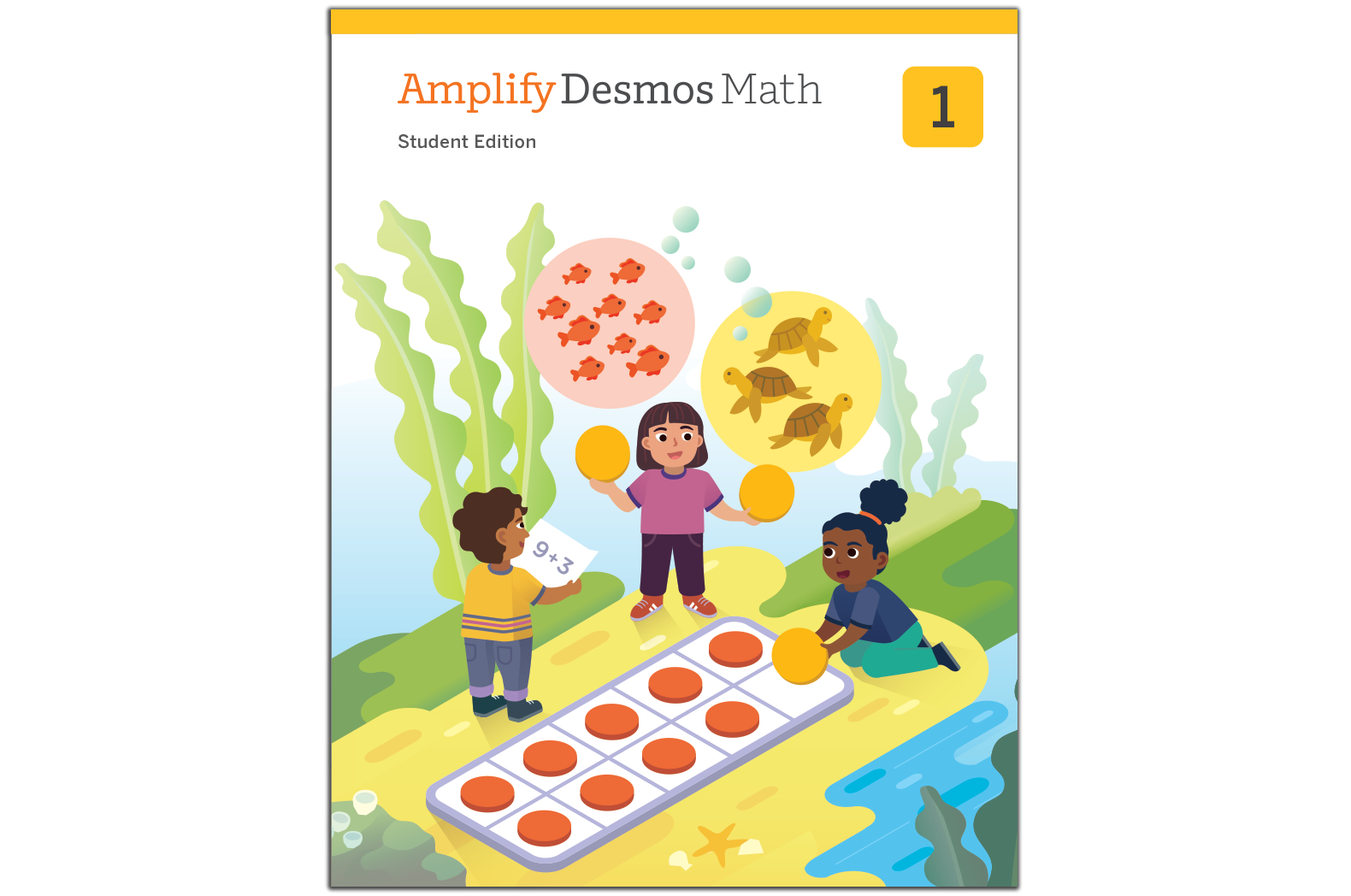
  • Busquen momentos para conversar sobre lo que están leyendo y descubriendo. Por ejemplo, usted podría preguntarle:¿Qué te llamó la atención de lo que leíste hoy? ¿Alguna frase o palabra te resultó confusa? ¿Qué te sorprendió más? ¿Qué crees que intentaba comunicar el autor? ¿Estás de acuerdo con sus ideas o descripciones? ¿Qué conexiones puedes establecer entre lo que lees y tu propia vida u otros temas que hayas escuchado?
  • Escuche a su estudiante leer sus respuestas escritas o pídale que las comparta con un amigo por teléfono o en una videollamada.
  • Explore Amplify Library para encontrar libros que su estudiante pueda disfrutar y leer con fluidez por su cuenta.
  • Consulte el artículo Proteja a los niños en internet de la Comisión Federal de Comercio, cuyo tema es la seguridad digital.

Cómo acceder a textos en Amplify Library.

¡Invitamos a que los estudiantes utilicen los textos básicos de Amplify Library en casa! Por favor, siga los siguientes pasos para poder descargar un texto y poder leerlo sin contar con acceso a internet:

1. Diríjase al menú Programs & Apps (Programas y aplicaciones) ubicado en la parte superior de la pantalla y desplácese hacia abajo hasta encontrar el icono de Amplify Library. Cuando lo seleccione, Amplify Library se abrirá en una nueva pestaña.

A digital menu displays various educational tools and resources, with "Amplify ELA" highlighted at the top and the "Library" option outlined in orange.

2.  Si se le solicita, siga las instrucciones para configurar un pin para Amplify Library; de lo contrario, continúe con el siguiente paso.

A pop-up window prompts the user to create a four-character PIN of lowercase letters and/or numbers for offline reading, with Cancel and Submit buttons.

3. En la esquina superior derecha de la pantalla, busque el libro que desea descargar. Por ejemplo: The Secret of the Yellow Death: A True Story of Medical Sleuthing.

A digital library search page displays "yellow death" in the search bar with no results found for title, authors, or genre. Book covers are visible in the left sidebar.

4. Seleccione el botón Download (Descargar).

A digital library interface displays the book "The Secret of the Yellow Death" by Suzanne Jurmain, showing its cover, synopsis, and options to read or download.

5. Si pierde el acceso a internet mientras está en Amplify Library, podrá seguir accediendo y leyendo los libros descargados. Si la página se actualiza sin tener conexión a internet o usted intenta iniciar sesión en otro dispositivo sin tener conexión, perderá el acceso a los libros descargados hasta que se restablezca la conexión.

A dropdown menu under "My Library" shows options: Recently Read, Favorites, Downloaded (highlighted), and All Books. Below, a Recently Read section displays three book covers.

Para recuperar los textos descargados:

  1. Desde la aplicación de Amplify Library, abra el menú desplegable My Library (Mi biblioteca) ubicado en la esquina superior izquierda.
  2. Seleccione Downloaded (Descargados).
  3. Elija el texto que desea leer de entre todos los textos previamente descargados.

Vistazo general a los materiales

No todas las escuelas funcionan de la misma manera, pero los estudiantes que asisten a escuelas que tienen las ediciones impresas y digitales del programa probablemente tienen los siguientes materiales impresos en casa:

  • Edición para estudiantes (Student Edition): Incluye todas las lecturas y actividades necesarias para la instrucción a lo largo del año. Los estudiantes pueden leer las selecciones tanto en formato digital como impreso y anotar en ambos formatos. Las lecciones de la Edición para estudiantes impresa reflejan cada lección digital, pero se han modificado para que funcionen eficazmente en formato impreso.
  • Diarios de escritura (Writing Journals): Este espacio proporciona a los estudiantes la posibilidad de responder a indicaciones de escritura (Writing Prompts) y completar otras tareas escritas.

En el caso de que los estudiantes no tengan acceso a dispositivos o Internet, pueden continuar completando tareas clave de lectura y escritura utilizando las Ediciones para estudiantes impresas y los Diarios de escritura para estudiantes.

Los maestros también pueden acceder a, imprimir y enviar por correo las guías de novelas (Novel Guides) para estudiantes. Las guías abarcan hasta 12 novelas que suelen enseñarse en las escuelas. Seis de estas novelas están disponibles en Amplify Library y la mayoría debería estar disponible en una biblioteca pública.

Reseñas de unidades

A continuación, se presentan breves descripciones generales de cada unidad que su estudiante estudiará en su grado a lo largo del año. Con cada unidad se incluye una guía descargable que ofrece un repaso más detallado del contenido cubierto y de cómo puede ayudar a su estudiante a profundizar en la comprensión de los temas.

Unidad 6A

La narrativa de Dahl

Cada estudiante comienza con escritura narrativa para aumentar rápidamente su producción de escritura, aprender la destreza básica de enfoque y familiarizarse con los hábitos y rutinas clave del salón de clases que utilizarán todo el año. Luego, aplica su nueva capacidad de observación a entretenidas lecturas de la biografía de Roald Dahl, Boy, y aprende a trabajar de cerca con evidencias del texto.

Unidad 6B

Misterios e investigaciones

Cada estudiante lee con la atención propia de un investigador, embarcándose en un estudio del cautivante mundo del trabajo de detective en distintos géneros literarios. Al final de la unidad, el niño o la niña escribe una composición para explicar cuál es el rasgo más útil de un investigador en la resolución de problemas.

Unidad 6C

Colección acerca del chocolate

Los aztecas lo usaban como moneda, Robert Falcon Scott lo llevó a la Antártida, los nazis diseñaron con él una bomba para matar a Churchill. La historia del chocolate se remonta a 3,700 años en el pasado y está repleta de vicisitudes que la vuelven un tema de investigación gratificante. En esta unidad los y las estudiantes analizan documentos de primera fuente y conducen investigaciones independientes para entender mejor la extraña y maravillosa gama de roles que el chocolate ha desempeñado en el mundo a lo largo de los siglos.

Unidad 6D

Los griegos

Los mitos griegos nos ayudan a entender no solo la cultura griega antigua, sino también el mundo que nos rodea y la función que cumplimos en él. Partiendo de las rutinas y destrezas establecidas en las unidades anteriores, estas lecciones motivan a cada estudiante a dejar atrás el enfoque en una sola persona —él mismo o ella misma o un personaje— para contemplar cuestiones más amplias sobre el papel que las personas desempeñan en el mundo y en las comunidades donde residen.

Unidad 6E

El verano de las mariposas

Las tierras fronterizas de Estados Unidos y México son lugares poblados de leyendas, tanto verdaderas como ficticias. El verano de las mariposas, de Guadalupe García McCall, implanta una versión de la Odisea en este entorno, embarcando a cinco hermanas en una aventura que transcurre en un mundo de héroes y malhechores inspirado en mitos aztecas y leyendas latinoamericanas. La experiencia ayuda a las hermanas a aceptar la disolución del matrimonio de sus padres y a encontrar fortaleza renovada en su identidad de hermanas y en su conexión a un linaje azteca. En esta unidad, cada estudiante analiza el uso que McCall da a la estructura de una epopeya para crear una narración emocionante de aventuras, y cómo la autora hace uso de la narración para celebrar el poder femenino, su herencia latina y una definición más amplia de lo que es una familia. Cada estudiante también tiene oportunidad de comparar el viaje ficticio de las jóvenes a México con la descripción del viaje real de un jovencito a Estados Unidos.

Unidad 6F

Colección acerca del Titanic

Para aprender a diferenciar las fuentes primarias, secundarias y terciarias, determinar si una fuente dada es fiable y entender los usos éticos de la información, cada estudiante formula sus propias preguntas de investigación y busca las respuestas en internet. Asumirá así el papel de uno de los pasajeros o pasajeras de la lista de embarque del Titanic y considerará cuestiones de clase y género, a medida que investiga y escribe relatos desde el punto de vista de los viajeros.

Unidad 6F y unidad 6G

Comenzar a escribir un cuento

En esta unidad cada estudiante puede poner en práctica sus destrezas de escritura creativa, para aprender elementos de narración y desarrollo de personajes, y la importancia del lenguaje vívido. Cada estudiante consigue una noción de propiedad sobre su propia escritura a medida que experimenta los diferentes impactos de sus decisiones autorales en oraciones, lenguaje, rasgos de personajes y giros de la trama.

Unidad 6F

Gramática

En esta unidad cada estudiante completa instrucciones para seguir un aprendizaje autoguiado y practica lo que el maestro y la maestra le asignará durante el año.

Unidad 7A

La narrativa y La joven del pañuelo rojo

En esta unidad se presenta la autobiografía sumamente cautivante de una joven cuya vida transcurre en China durante la Revolución Cultural. Cada estudiante aprende la historia y el contexto político de este periodo, enfocándose en el relato de alguien que vivió en la época de la revolución. A medida que cada estudiante recorre el camino de la protagonista en ese mundo convulsionado, puede apreciar los cambios que se produjeron en los sentimientos y motivaciones de la joven a lo largo del tiempo.

Unidad 7B

Carácter y conflicto

Leyendo Una pasa al sol y Inocentón, cada estudiante explora el tema de las personas que, al enfrentar adversidades, pueden infligir daño en quienes los rodean sin intención de hacerlo. Las dos narrativas se complementan para brindar a cada estudiante oportunidades de analizar las respuestas de los personajes al conflicto y el desarrollo de ideas del autor o la autora en una obra de ficción.

Unidad 7C

La ciencia del cerebro
¿Podrías sobrevivir después de que una vara de hierro te atravesara el cráneo? Phineas Gage lo hizo y su historia, escalofriante pero real, permite desarrollar la información de contexto y analizar otros textos informativos, incluyendo los contemporáneos El hombre que confundió a su mujer con un sombrero y el obviamente relevante La desmitificación del cerebro adolescente.

Unidad 7D

La poesía y Poe

Los textos de Poe siempre tienen mucho para observar, descifrar, comentar y… crisparnos los nervios. Dado que las cosas no siempre son lo que aparentan, cada estudiante usa las destrezas de lectura atenta para cuestionar si debería creer lo que el narrador de Poe les está contando.

Unidad 7E

Colección acerca de Frida y Diego

Los artistas más famosos y provocativos de México, Diego Rivera y Frida Kahlo, formaron una pareja extraordinaria que vivió en tiempos extraordinarios. Eran almas gemelas con personalidades totalmente opuestas. Las obras de Diego Rivera y Frida Kahlo y sus vidas multifacéticas ofrecen a cada estudiante un tema fértil y fascinante para examinar documentos de fuente primaria y conducir investigaciones independientes.

Unidad 7F

Colección acerca de La fiebre del oro

Cada estudiante elige entre una extensa colección de fuentes primarias y secundarias para aprender acerca de la amplia diversidad de personas que participaron en La fiebre del oro de California.

Unidad 7G

Escribir un cuento: nivel intermedio

En esta unidad cada estudiante puede poner en práctica sus destrezas de escritura creativa para aprender elementos de narración y desarrollo de personajes, y la importancia del lenguaje vívido.

Unidad 7

Gramática

En esta unidad cada estudiante completa instrucciones para seguir un aprendizaje autoguiado que el maestro o la maestra le asignará durante el año. Las sub unidades están organizadas por temas clave de gramática, de manera de que el maestro o la maestra pueda asignar el contenido que mejor se acomoda a las necesidades de sus estudiantes mientras se asegura de que trabajen con temas clave de gramática apropiados para su grado.

Unidad 8A

Perspectivas y narrativa
Esta unidad procura enseñar a cada estudiante a leer como un escritor o una escritora. Así, pone en práctica la destreza de prestar atención al oficio de la escritura: las decisiones que toma un buen escritor o escritora para darle forma a nuestra percepción de una escena o a nuestros sentimientos hacia un personaje, y para despertar nuestras emociones, sorprendernos o dejarnos pensando en lo que podría suceder después. Cada estudiante lee atentamente ejemplos de narrativas de no ficción, analiza las técnicas que usa cada autor para que sus textos evoquen emociones y practica la aplicación de estas técnicas en sus propios textos narrativos.

Unidad 8B

Libertad e igualdad
Analizamos las palabras de varios creadores —desde el poeta Walt Whitman hasta el abolicionista Frederick Douglass y el presidente Abraham Lincoln— para descubrir cómo sus escritos y obras contribuyeron a los cambios extremos de la organización social: un concepto totalmente nuevo de lo que significaba considerar a las personas “iguales”.

Unidad 8C

Ciencias y ciencia ficción
Cada estudiante leerá la obra Frankenstein de Gris Grimly, una novela gráfica que integra ilustraciones cautivantes en una versión abreviada de la edición de 1818 del libro de Mary Shelley. Combinadas con el texto de Shelley, las inquietantes —y a veces espeluznantes— representaciones de la criatura de Frankenstein diseñadas por Grimly impulsan a cada estudiante a contemplar algunos de los temas centrales del texto: el origen de la humanidad y la raíz del mal. Luego escribe un ensayo, en el cual, después de argumentar a favor de ambos lados de la cuestión, determina si en última instancia la criatura de Frankenstein debería considerarse humana.

Unidad 8D

Romeo y Julieta, de Shakespeare
Romeo y Julieta combina romance y acción, ofreciendo una amplia gama de temas y escenas que cada estudiante puede leer y representar actuando. Cada estudiante de nivel intermedio tiene la edad adecuada para identificarse con los sentimientos intensos de los amantes, y ha alcanzado la madurez suficiente como para analizar de forma crítica las decisiones que toman Romeo y Julieta.

Unidad 8E

El Holocausto: memoria y significado
Esta unidad usa una variedad de artículos, imágenes y videos de primera fuente, así como textos de no ficción literaria y no ficción gráfica, para estudiar los sucesos que hicieron posibles las atrocidades del Holocausto. Cada estudiante investiga cómo se generó y se empleó la propaganda para crear un ambiente político que llegó a corromper a toda una sociedad. Las Olimpiadas se observan a través de la lente de una campaña de propaganda internacional, al amparo de la cual los nazis comenzaron a eliminar de su cultura a las personas que no eran de lo que consideraban “raza aria”. La sub unidad final examina los resultados de la doctrina nazi y su impacto en las víctimas y sobrevivientes judíos.

Unidad 8F

Colección acerca de La carrera espacial
Cada estudiante usa internet para poner a prueba sus destrezas de investigación y lectura atenta, y distingue entre fuentes fiables y fuentes no fiables.

En esta colección los estudiantes exploran documentos primarios y llevan a cabo investigación independiente para comprender mejor esta carrera espacial entre los dos superpoderes del planeta. La dramática historia de la carrera espacial ofrece a cada estudiante un generoso tema de investigación para explorar, mientras desarrollan destrezas de lectoescritura informativa, y aprenden cómo elaborar sus propias preguntas de investigación y exploran Internet en busca de respuestas.

Unidad 8

Gramática

En esta unidad cada estudiante completan instrucciones para seguir un aprendizaje autoguiado que el maestro o la maestra le asignará durante el año. Las sub unidades están organizadas por temas clave de gramática, de manera de que el maestro o la maestra pueda asignar el contenido que mejor se acomoda a las necesidades de sus estudiantes mientras se aseguran de que trabajen con temas clave de gramática apropiados para su grado.

Unidad 8G

Escribir un cuento: nivel avanzado

En esta unidad cada estudiante pueden poner en práctica sus destrezas de escritura creativa, para aprender elementos de narración y desarrollo de personajes. También aprende la importancia del lenguaje vívido para enganchar a sus lectores y atraerles al cuento.

Actividades adicionales

Quests:

Quizás observe que su estudiante trabaja con sus compañeros en el mismo proyecto interactivo durante varios días, intentando resolver un misterio o explicar un acontecimiento histórico. Eso es lo que sucede cuando un maestro asigna una misión (Quest): una exploración minuciosa de una semana que requiere colaboración y ayuda a profundizar la interacción con los textos y con los temas tratados.

Vocab App:

La aplicación de vocabulario (Vocab App) ayuda a los estudiantes a dominar las palabras del vocabulario a través de actividades lúdicas que los hacen pensar en la morfología, la analogía y los sinónimos y antónimos, y a descifrar el significado a través del contexto.

¿Tiene alguna pregunta sobre Amplify ELA?

Visite nuestra biblioteca de ayuda (en inglés) y busque respuestas a sus preguntas sobre el programa en nuestros artículos de ayuda.

Para obtener apoyo curricular adicional, comuníquese con su maestro.